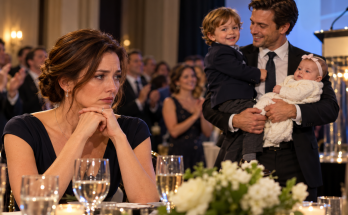
After that conversation, something changed in the way we lived together.
It wasn't dramatic.
Nobody packed a suitcase.
Nobody made a speech.
We still woke up in the same house and followed most of the same routines.
But I stopped treating every quiet moment as a problem I needed to solve.
If Martin seemed distant, I let him be distant.
If he left a question unanswered, I didn't always ask it again.
I had spent years trying to keep our marriage comfortable enough for him to tell me the truth.
I was no longer willing to make comfort the condition for honesty.
That didn't mean I stopped caring about him.
I still noticed when he looked tired.
I still remembered which meals he preferred after a difficult day.
Sometimes I caught myself about to ask how a meeting had gone, then wondered whether I genuinely wanted to know or whether I was trying to return to the habits that had once made our life feel normal.
I didn't always know the answer.
So I began paying attention to myself.
It was an unfamiliar thing to do.
For years, I had paid attention to Martin's moods before deciding what I felt.
I watched his expression when I raised a difficult subject.
I listened for signs that he was becoming impatient.
I softened my questions before asking them.
Now I was learning to notice my own reactions without immediately trying to make them easier for him.
One evening, I opened the bedside drawer to put away a receipt.
The appointment cards were still there.
I took them out and laid them beside each other.
The older card had become creased and soft.
The newer one was still stiff.
I read both.
The first reminded me of the day Martin had left me alone in the clinic.
The second reminded me of the day he finally had to sit beside me and listen to the doctor.
Neither card told the whole story.
They couldn't record the years between those appointments.
They couldn't explain every conversation we had avoided or every moment I had mistaken silence for peace.
But they reminded me that I hadn't invented the problem.
I put them back in the drawer.
Then I closed it without feeling the need to check whether they were hidden well enough.
Martin came home late that night.
He found me in the living room with a book open on my lap.
He asked whether I had eaten.
I told him I had.
He stood near the doorway for a moment.
Then he asked whether we could talk.
I put the book aside.
He sat in the chair opposite me.
For a while, he didn't speak.
Then he said he had been thinking about what it meant to be honest with me.
I waited.
He admitted that he had spent years trying to control what other people knew about his medical situation.
He had convinced himself that keeping the information private was the same as protecting his dignity.
When that became difficult, he had allowed people to believe something different.
He said he had never intended for me to suffer as much as I had.
I listened.
"I believe you didn't want to suffer," I said.
He looked at me.
"But you let me suffer instead."
He lowered his eyes.
I didn't raise my voice.
I didn't need to.
The truth was plain enough without making it louder.
He said he was sorry.
It was the first time he had apologized without following the words with an explanation.
I wanted to feel relieved.
Instead, I felt sad.
The apology came after years of waiting, and I no longer knew what I had expected it to repair.
I told him I appreciated hearing it.
Then I said I needed more than an apology.
He asked what that meant.
I explained that I couldn't continue living as though the only problem in our marriage was the medical issue.
The fertility appointment had been painful.
The doctor's findings had been difficult to accept.
But those things hadn't forced Martin to blame me.
They hadn't forced him to present Clara's children as his own in front of our colleagues.
They hadn't forced him to keep me in the dark.
Those had been his choices.
He sat quietly while I spoke.
When I finished, he said he understood.
I wasn't sure he did.
But I didn't ask him to prove it with another speech.
I wanted to see what he would do when the next difficult moment arrived.
The following days passed without another serious conversation.
I went to work.
I met a friend for lunch.
I bought groceries and made dinner.
I began reading again in the evenings instead of listening for Martin's footsteps in the hallway.
None of those things solved my marriage.
They simply reminded me that my life was still mine.
I had spent years thinking that the absence of a child meant something essential was missing from me.
Now I was beginning to see how much of my identity I had reduced to that loss.
I was Evelyn.
I had a job, friends, opinions, and plans that had nothing to do with motherhood.
I had loved Martin.
I still cared about him.
But I didn't want the rest of my life to be determined by a story he had told about me.
One Saturday morning, I went through a stack of papers on the kitchen table.
There were bills, receipts, and old notes from work.
I sorted them into piles.
When I reached the bottom, I found a small envelope containing a photograph from our wedding.
Martin stood beside me in a dark suit.
I wore a simple dress and held a bouquet.
We were both smiling.
I sat down with the photograph in my hand.
I remembered how certain I had been that we would face whatever came together.
I remembered thinking that love meant never having to wonder whether the person beside you was telling the truth.
I had been young enough to believe that trust could protect itself.
I put the photograph back in the envelope.
I wasn't ready to throw it away.
I wasn't going to pretend that the years we had shared meant nothing.
But I no longer wanted the photograph to stand as proof that our marriage had always been what I imagined.
It was a picture of two people on one particular day.
Everything that came afterward had to be judged on its own.
That afternoon, Martin asked whether I wanted to go for a walk.
I agreed.
We walked along a quiet street near our home.
For a while, we talked about ordinary things.
The weather.
A road that had been closed for repairs.
A shop that had changed owners.
Then Martin asked whether I thought we could recover what we had lost.
I stopped walking.
He stopped beside me.
I looked at him for a moment before answering.
"I don't know."
He nodded.
I could see that the answer disappointed him.
But I couldn't offer certainty just because he wanted it.
For years, I had offered reassurance whenever he became uncomfortable.
I had told him things would be all right before I knew whether they would be.
I had mistaken that habit for love.
Now I understood that sometimes the most honest answer was the one neither person wanted to hear.
We continued walking.
When we returned home, Martin went into his study.
I remained in the kitchen and placed my keys beside the small dish near the door.
I stood there for a moment, looking at the ordinary objects around me.
The dish.
The counter.
The drawer where I kept the appointment cards.
Five years earlier, I had walked into that kitchen believing the truth would eventually bring my husband back to me.
Now I understood that the truth could only show me who was willing to stand beside me.
It couldn't make that choice for him.
And it couldn't make it for me.
Click here to continue reading: PART 9: I Stopped Asking Martin to Explain Himself, and That Was When I Began to See How Much of My Life I Had Spent Making Excuses for Him
The Night My Husband Presented Another Woman’s Children as His Own, I Finally Understood What My Silence Had Cost Me
Part 8 of 20