I had spent much of my life solving problems by finding out what was true.
Then I made a decision.
That afternoon, I would stop trying to make every painful thing fit neatly into an explanation.
The business question had been answered.
The Ambrose Hotel belonged to my company.
The acquisition had been completed six months earlier.
My name appeared on the official registration.
Mr. Whitmore had confirmed the arrangement.
Melissa Grant had heard it.
Danica had read the documents.
Nothing more needed to be established about the ownership.
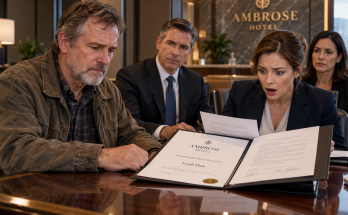
I looked at the folder.
It had seemed so important when I first pushed it across the table.
Now it looked ordinary again.
Paper.
Ink.
Names.
Signatures.
I understood their legal importance.
But emotionally, I felt strangely distant from them.
The documents had corrected a misunderstanding.
They had not repaired what had happened at the birthday dinner.
I knew that now.
And I was beginning to accept it.
I glanced toward Danica.
She no longer looked at me with the same certainty she had shown earlier.
I could see the change.
But I did not know what it meant beyond that.
I hoped she had learned something.
I hoped she would think twice before judging another person by the condition of a vehicle.
I hoped she would understand that basic courtesy was owed to everyone.
But those were hopes.
Not facts.
I had to let them remain that way.
I could not force her to become wiser.
I could only make sure my own behavior remained fair.
Mr. Whitmore sat beside me.
He had been steady throughout the conversation.
I appreciated that.
He had not allowed Danica's disbelief to alter the facts.
And he had not exaggerated my authority for effect.
He had simply explained what the ownership records showed.
That was all I had needed.
Melissa had also remained composed.
I looked toward her for a moment.
I was grateful that the meeting had not become louder or more confrontational.
There was no need for that.
I had experienced enough humiliation.
I did not want the room filled with more of it.
I looked at the polished table.
My hand rested close to the folder.
I thought about how often a person could hold something valuable and still feel that something essential was missing.
I owned a hotel through my company.
That was an achievement.
I had no reason to dismiss it.
But I was also a father whose son had told him to leave his birthday dinner.
That was a wound.
I had no reason to hide it from myself.
Both things were true.
Neither erased the other.
I had spent too long acting as though success in one part of life could compensate for disappointment in another.
It couldn't.
I had learned that.
Perhaps I should have learned it sooner.
I wondered what my son would think if he sat in this room and read the documents.
Would he be surprised?
Would he be embarrassed?
Would he reconsider what happened at his birthday dinner?
I had no way of knowing.
And I was finally ready to stop answering those questions for him.
I had imagined enough conversations.
I had guessed at enough motives.
I had spent enough time trying to understand feelings he had not explained.
When we spoke, I wanted the real answers.
Not the answers I feared.
Not the answers I hoped for.
His answers.
I wanted to listen.
That did not mean I would pretend the hurt was small.
It wasn't.
I had been deeply wounded by being told to leave.
I wanted him to understand that.
I wanted him to know the evening had mattered to me.
I had attended because I loved him.
I had not been looking for admiration.
I had not wanted anyone to recognize my financial position.
I had simply wanted to celebrate his birthday.
And I wanted him to know how painful it had been to discover that he did not want me there.
Those were the words I hoped I could eventually say.
Plainly.
Without anger making them harsher.
Without money making them sound like a threat.
Without turning the conversation into a question of who owed what to whom.
I looked at the ownership registration again.
There was my name.
Lyall Puit.
I thought about the difference between a name on a document and a name spoken by someone who loved you.
The first established authority.
The second could make you feel that you belonged.
I had the first.
I wanted the second.
I felt ashamed for a moment.
Not because wanting affection was wrong.
Because I had spent so much time pretending I didn't need it.
I had told myself I was independent.
That I could handle disappointment.
That I didn't require anyone's approval.
Some of that was true.
I didn't need strangers to admire my success.
I didn't need Danica to approve of my truck.
I didn't need people to recognize my position every time I entered a room.
But I did need relationships.
I needed honesty.
I needed to know the people I loved cared about me.
That wasn't weakness.
It was ordinary.
I had forgotten that for a while.
Or perhaps I had been afraid to admit it.
I looked at Danica.
She had learned something about my finances.
I wondered whether she had learned anything about me.
Probably very little.
She knew my name.
She knew the company.
She knew the acquisition.
She knew I drove an old pickup.
But she did not know why my son's birthday dinner had hurt me.
She did not know what kind of father I had tried to be.
She did not know what I wanted from the people close to me.
I had no intention of explaining those things to her.
They were not hers to resolve.
I looked toward Mr. Whitmore.
The business records were still in front of us.
I knew they would remain important whenever questions of ownership or responsibility arose.
But I no longer wanted them to carry the emotional weight of what had happened.
I wanted to separate the two matters.
The hotel was a business.
My son was my son.
One could not substitute for the other.
I thought about the night of the dinner again.
This time, I tried not to replay the scene in search of a different ending.
I remembered it for what it was.
A painful moment.
A decision my son had made.
An injury that needed to be acknowledged.
I didn't need to make it larger by inventing reasons.
And I didn't need to make it smaller by pretending it didn't matter.
I could simply tell the truth.
He had told me to leave.
It had hurt.
I still loved him.
All three things could exist together.
That realization was difficult.
But it felt honest.
I had been tempted to believe that once my ownership became known, everything would change.
That the people who had dismissed me would suddenly understand.
That the humiliation would somehow be balanced.
But I knew better now.
Surprise was not the same as understanding.
Embarrassment was not the same as remorse.
And discovering someone had money was not the same as learning to respect them.
I wanted to remember those distinctions.
They would matter when I eventually spoke with my son.
I did not want him to apologize because he had discovered I was wealthy.
I wanted him to apologize because he understood that telling his father to leave had been hurtful.
I did not want him to invite me somewhere because I owned a hotel.
I wanted him to want me there.
And I did not want our relationship to become a series of transactions.
I wanted it to remain a relationship.
A father and his son.
Imperfect.
Sometimes difficult.
But honest.
I looked down at the table again.
The polished surface reflected part of my hand.
The ownership folder lay just beyond it.
I could see the edge of the official registration.
I had spent the afternoon watching those pages change the way Danica regarded me.
Now I understood that I did not want the same kind of change from my son.
I didn't want the revelation of my finances to become the reason he valued me.
If our relationship was going to improve, it needed a different foundation.
Truth.
Respect.
A willingness to acknowledge pain.
And the simple desire to remain part of each other's lives.
I could offer those things.
I couldn't make him accept them.
That was the hard part.
For years, I had been comfortable making decisions.
I could review an agreement.
I could assess a business arrangement.
I could sign a document and know what responsibilities followed.
But with my son, I had to accept something I couldn't control.
His feelings belonged to him.
His choices belonged to him.
And whatever happened between us next would depend on more than my wishes.
I let that thought settle.
It was uncomfortable.
But it was real.
I looked at Danica one last time.
The documents had established the ownership.
I had answered the question about the pickup.
Mr. Whitmore had confirmed who I was.
There was no need to repeat myself.
I had proved what could be proved.
The rest would require people to think about how they had treated someone before knowing what he owned.
I hoped they would.
But I was finished trying to make the paperwork do more than it could.
I kept my hands still.
I let the room remain quiet.
I thought of my son.
Not as someone I needed to defeat.
Not as someone I needed to impress.
As my child.
The person whose birthday I had wanted to celebrate.
The person whose rejection had hurt me more than I wanted to admit.
The person I still hoped would one day understand why his father had come.
I knew I could not buy that understanding.
I could not demand it.
I could not place it in a folder and slide it across a table.
I would have to speak honestly and see what happened.
That was the decision I could make.
And for the first time since the birthday dinner, I was willing to leave the unanswered questions where they belonged.
With the people who had to answer them.
Click here to continue reading: PART 17: I Had Stopped Trying to Prove My Worth, but the Silence Across the Table Reminded Me How Much Had Already Been Lost
My Son Had Already Made Me Feel Unwelcome, but the Woman Across the Table Still Had No Idea Who I Was
Part 16 of 20