The following week, Eleanor and I met for our walk.
I arrived first and waited near the square, watching people cross the street.
The morning was cool enough that I had brought a light jacket.
I kept my hands in its pockets and looked at the shops along the pavement.
When Eleanor appeared, she raised one hand in greeting.
“You chose the route,” she said. “I hope you've chosen wisely.”
“I've chosen a perfectly ordinary route.”
“That's what people say before they get lost.”
I laughed, and we started walking.
For the first few minutes, we talked about the weather.
Then Eleanor asked whether I had continued writing in my notebook.
“A little.”
“About the reunion?”
“Sometimes.”
She looked at me but did not ask for details.
I appreciated that.
“I've been thinking about what you said,” I told her. “About not needing to turn the whole thing into a lesson.”
“And?”
“I think I was making too much work for myself.”
She smiled.
“That sounds familiar.”
I laughed again.
We passed a shop with a display of winter scarves in the window.
One was green, with small yellow flowers woven into the fabric.
I stopped without intending to.
Eleanor followed my gaze.
“Pretty,” she said.
“Yes.”
I looked at the scarf for another moment.
The colors reminded me of the dress I had worn at Oakridge High.
For years, I would have turned away from something that brought back that memory.
I might have told myself I didn't like the pattern.
I might have found another reason to keep walking.
Instead, I stood there and allowed myself to like it.
The scarf was pretty.
That was all.
It did not have to become a symbol of humiliation.
It did not have to carry the weight of every cruel word I remembered.
I could admire it without returning to the hallway in my mind.
“Shall we keep going?” Eleanor asked.
“Yes.”
We continued along the pavement.
As we walked, I thought about Brenda.
I had spent a long time imagining what she might say if I explained the connection between the apron and the dress.
I had rehearsed conversations that never happened.
In some versions, Brenda listened carefully and apologized.
In others, she laughed and told me I was too sensitive.
Sometimes I imagined myself answering with perfect calm.
Other times, I imagined saying everything I had held back since school.
None of those conversations had taken place.
I had been arguing with a person who existed mostly in my imagination, trying to prepare for every possible response.
It was exhausting.
“I think I've been waiting for Brenda to understand,” I said.
Eleanor glanced at me.
“Understand what?”
“Why it hurt. Why the apron brought back the dress. Why I couldn't laugh along.”
“And do you think she will?”
“I don't know.”
We walked a little farther before I continued.
“I used to think that if she understood, I could finally stop feeling embarrassed.”
Eleanor adjusted her scarf.
“But you don't think that now?”
“I don't think I need her to understand before I can stop blaming myself.”
She nodded.
“That sounds different.”
“It feels different.”
We reached a small stretch of pavement where the trees cast shadows across the ground.
I watched our feet move through them.
“I can still wish she had been kinder,” I said. “I can still wish she had thought before she handed me that apron. But I don't have to spend the rest of my life waiting for her to say the right thing.”
“No,” Eleanor said. “You don't.”
I thought about how much power I had given an apology I might never receive.
I had imagined it as a key.
If Brenda offered it, I would be free.
If she refused, I would remain locked inside the old memory.
But the lock had never been in Brenda's hands.
She had hurt me.
That was true.
I had also spent years repeating her judgment to myself, long after she had stopped speaking.
I could not change what she had done.
I could change whether I continued doing that to myself.
We stopped at a bench to rest.
Eleanor sat beside me and rubbed her hands together.
“I remember being frightened of Brenda,” she said.
I turned toward her.
“You were?”
“Not frightened in the way you might imagine. But she could make a room feel as though everyone was waiting for her opinion.”
I knew exactly what she meant.
Brenda had always seemed certain of her place.
She spoke as if the world had already agreed with her.
Even when I disagreed with her, I had sometimes found myself questioning my own judgment.
“I thought I was the only one who felt that way,” I said.
“You weren't.”
I let out a slow breath.
It was comforting to hear, but I did not want to turn the conversation into a judgment of Brenda's entire life.
I did not know what had shaped her.
I did not know what she had regretted or what she might have learned since school.
I knew only the parts of her behavior I had witnessed.
And I knew how those moments had affected me.
That was enough to discuss honestly.
“Do you think she remembers the dress?” I asked.
Eleanor considered the question.
“Perhaps. Perhaps not.”
“I used to think that if she remembered, she must know she hurt me.”
“Remembering something and understanding it are different things.”
I looked down at my hands.
That was true.
Brenda might remember the hallway and still believe it had been harmless.
She might have forgotten the incident completely.
She might have carried a different version of it all these years.
I could not know.
And I no longer wanted to invent an answer simply to fill the silence.
We stood and continued walking.
By the time we reached the square again, the morning had warmed.
Eleanor asked whether I wanted to stop for another coffee.
“Not today,” I said. “I'd rather go home and have lunch.”
“All right.”
I waited for the familiar guilt to arrive.
It did not.
I had said what I wanted.
Eleanor had accepted it.
We parted with a hug, and I walked to my car.
On the drive home, I passed the road that led toward the old school.
I had not thought about Oakridge High that morning until the green scarf appeared in the shop window.
Now the building came to mind again.
I pictured the hallway, the classroom doors, and the students moving between lessons.
I could still hear the laughter.
But I could also remember the school as a place where I had learned things, completed assignments, and spent ordinary days.
Brenda had been part of that time.
She had not been all of it.
I turned onto my street and continued home.
The afternoon passed quietly.
I made lunch, washed my plate, and sat down with my notebook.
I wrote that I could wish for an apology without depending on one.
I wrote that understanding would be welcome but was not required.
Then I added one final sentence.
Brenda does not have to agree with my memory for my memory to be real.
I put the pen down.
I read the sentence once more.
It did not make the past disappear.
It did not make me like what had happened.
But it gave me a place to stand.
For the first time, I could imagine seeing Brenda again without needing the encounter to resolve everything between us.
I could listen if she spoke.
I could answer if I wanted.
I could leave if the conversation became unkind.
I did not need to prepare a speech.
I only needed to remain honest.
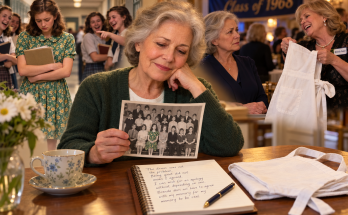
That evening, I looked at the school photograph on the shelf.
The girl in the green floral dress was still there.
I did not ask her to forgive anyone.
I did not ask her to forget.
I simply let her be.
Click here to continue reading: PART 18: I Learned That a Peaceful Life Did Not Require Me to Pretend the Hurt Had Never Happened
The Woman Who Once Made Me Ashamed of My Clothes Had No Idea What My Life Had Become
Part 17 of 20