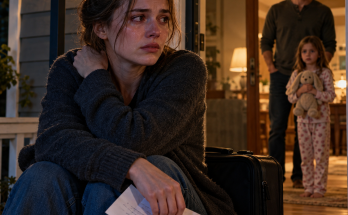
The regional archive occupied a converted schoolhouse twenty miles from Bellweather. Its windows were tall and narrow, and the old classrooms had been divided into rooms filled with cabinets, scanning equipment, and shelves of bound records. Clara arrived shortly before noon, carrying Evelyn's letter and the photograph of the child in the red coat.
Thomas drove her there but waited in the car.
“You can come inside,” Clara told him.
He shook his head. “This part belongs to you.”
She almost told him that he had no right to decide which parts belonged to her. Instead, she walked toward the entrance alone.
The archivist listened carefully as Clara explained that she was searching for a birth register from a closed hospital. He asked for the approximate year, her legal name, and any details about the original registration.
When Clara mentioned that the record might have been altered, his expression became more serious.
“Some of the older registers were copied by hand when the hospital closed,” he said. “If the original and the transcription disagree, we need to examine both.”
He led her to a reading room and returned with two large volumes. The first contained the public birth index. The second was marked Supplementary Registrations — Restricted Historical Access.
Clara found her legal birth date in the public index. The entry listed Margaret Whitmore as her mother and left the father's name blank. The paper had yellowed, but the handwriting was neat and unremarkable.
Then the archivist opened the supplementary register.
Several entries had been amended in different ink. Beside Clara's name was a reference number that did not appear in the public index. The number directed them to a separate page near the back of the volume.
The original entry listed a different mother.
Evelyn Anne Whitmore.
Clara sat very still.
The archivist compared the entry with the public index and pointed to a note written in the margin.
“Transfer authorized by the county registrar,” he said. “The amendment was made six months after the birth.”
“Who requested it?”
“The file should contain an authorization form.”
He retrieved a thin folder. Inside was a typed statement signed by Margaret, confirming that she would assume full parental responsibility for the child. Attached was a second document, this one handwritten.
Clara recognized her grandfather's signature.
The statement claimed that Evelyn had voluntarily relinquished all parental rights and agreed never to contact the child.
But the signature beneath the statement was not Evelyn's.
Clara had seen enough of Evelyn's letters to recognize her handwriting. The signature on the document was clumsy, the letters uneven and unfamiliar.
“Can this be challenged?” Clara asked.
“I'm an archivist, not a lawyer,” the man replied. “But I can tell you that the supporting documents are incomplete. There is no witness statement, no independent confirmation, and no original consent form.”
Clara photographed every page and requested certified copies.
When she stepped outside, Thomas was waiting beside the car with a paper bag containing sandwiches and coffee.
He looked at her face and immediately understood that she had found something.
“She was my mother,” Clara said. “Evelyn. The records confirm it.”
Thomas nodded slowly.
“And Margaret?”
“She adopted me, or at least took responsibility for raising me. But the document says Evelyn agreed never to contact me. Her letters say she tried to return.”
Thomas leaned against the car.
“Then someone used the records to make the separation permanent.”
Clara opened the folder and showed him the handwritten statement.
He studied the signature.
“This wasn't filed through the office where I worked,” he said. “It was handled directly by the county registrar. That office had its own procedures.”
“Could your records show who authorized it?”
“Possibly. But the registrar's papers were moved when the county offices merged. Some boxes went to Bellweather. Others were sent to the capital.”
Clara felt the familiar frustration rising again. Every answer seemed to lead to another room, another box, another person who had known more than they admitted.
Then she noticed something on the bottom of the authorization form.
A small handwritten number.
14\.
She pulled the photograph of the courthouse note from her phone. The same number appeared beside the instruction to return correspondence.
“Room Fourteen,” she said.
Thomas looked at the form.
“The registrar used the same filing code.”
“So the room wasn't just a storage space. It was part of the system that changed my identity.”
He nodded.
Clara studied the documents again. The form had been signed in the same month that Evelyn's letters abruptly stopped. It was also the month Margaret had returned from her unexplained six-week absence.
She could no longer regard the dates as coincidence.
“Where did the registrar's private papers go?” she asked.
Thomas hesitated before answering.
“There's an old records depot in Bellweather. It was scheduled to be cleared out years ago, but I heard the demolition was postponed because of a dispute over the building's ownership.”
Clara gave a bitter laugh.
“Of course it was.”
She put the documents away and looked toward the road.
“We're going there.”
Thomas didn't argue. He started the car, but before he pulled out, Clara's phone vibrated.
An unknown number had sent her a photograph.
It showed a woman standing beside a harbor wall, wearing a dark coat and holding a folded newspaper. Her face was older, her hair almost entirely white, but the resemblance to the woman in the old family pictures was unmistakable.
Beneath the photograph was a message.
If you still want the truth, come to Greyhaven alone. Tomorrow at six. Ask for the woman who remembers the red coat.
Clara read it twice.
“Is it Evelyn?” Thomas asked.
“I don't know.”
“Don't go alone.”
The words sounded sincere, but Clara could no longer afford to trust sincerity by itself.
She saved the photograph and checked the number. It had been sent through a service that concealed the sender's identity.
Then she noticed the newspaper in the woman's hand. The date was visible in the corner.
It had been published that morning.
Whoever had sent the photograph knew where Clara was looking and had access to a recent image of the woman she believed was her birth mother.
Clara looked at Thomas.
“We're going to Greyhaven,” she said. “But first, we're going to the records depot. If somebody is trying to lead me away from Bellweather, I want to know what they're afraid I'll find here.”
Thomas started the engine.
As they drove back toward town, Clara opened Evelyn's letter one more time. She read the final sentence, the one she had barely noticed in Lydia's sitting room.
The house is not the answer. The name on the original birth register is.
For the first time, Clara understood that Evelyn had not been asking her to reclaim a property or expose a family scandal.
She had been asking Clara to reclaim herself.
And somewhere in the records depot, among the documents her grandfather had tried to conceal, there might be proof of what had happened when Evelyn came back for her daughter.
Clara folded the letter and placed it inside her coat.
Tomorrow, she would go to Greyhaven.
But she would not go empty-handed.
Click here to continue reading: PART 17: The Records Depot
The Night My Granddaughter Reached for the Telephone and Exposed a Secret Our Family Had Buried for Years
Part 16 of 20