Rachel did not tell me she was going until she was already there.
My phone rang at nine-twelve.
“Don’t panic.”
Those words are uniquely effective at causing panic.
“Where are you?”
“At the house.”
I stood.
“Inside?”
“In the driveway.”
“Rachel—”
“I’m fine.”
The property had remained tied up in divorce and evidentiary issues.
By then, investigators had released most of it.
Nolan would not be returning.
Rachel had legal access.
Still, the house carried history.
“Do you want me there?”
A pause.
“Yes.”
I drove over.
Rachel waited outside the garage.
The old police seal was gone.
The bright padlock had been removed months earlier as evidence.
A replacement lock now hung from the hasp.
Rachel held its key.
“You bought that?”
“Yesterday.”
“Why lock it again?”
“Because there are tools inside.”
I looked at her.
She smiled.
“See? Sometimes a padlock is actually for tools.”
The joke hurt and helped simultaneously.
She inserted the key.
Turned it.
Removed the lock.
Then she opened the door herself.
Morning light spread across the concrete.
The garage had been cleaned after evidence processing.
No bottles.
No blanket.
No bucket.
No covered window.
But outlines remained.
A darker rectangle where a cabinet had stood.
Dust patterns.
Scratches.
The workbench.
Rachel stayed at the threshold.
“You don’t have to go in.”
“I know.”
She stepped inside.
I followed only after she looked back and nodded.
The smell was different.
Less stale.
Cold wood.
Dust.
Machine oil.
Rachel touched the workbench.
“This was mine.”
“Yes.”
“Partly.”
She looked toward the corner where police had found her.
Then away.
No ceremony.
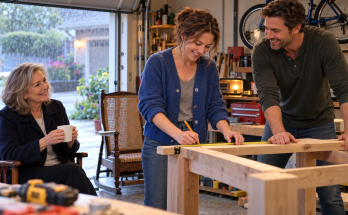
She walked to the unfinished chair.
An old dining chair with a curved back and damaged cane seat.
Rachel had been restoring it before everything happened.
One leg had been stripped.
The others still carried dark varnish.
She ran a finger along the wood.
“I hated this thing.”
“I remember.”
“Nolan said to throw it out.”
“You refused.”
“I said the frame was good.”
She laughed quietly.
“Apparently I’ve always had boundary issues with furniture.”
We moved the chair near the open door.
Rachel found sandpaper.
Some supplies had been removed as evidence, but ordinary tools remained.
She began working.
At first I stood uselessly.
Then she handed me a cloth.
“Make yourself useful.”
“Yes, ma’am.”
For nearly an hour we did not discuss Nolan.
Dust gathered on the floor.
The repetitive movement calmed the room.
Scrape.
Pause.
Wipe.
Turn.
Rachel opened both windows.
Then the side door.
Every exit remained visible.
At one point a truck passed in the alley.
Rachel froze.
Then resumed sanding.
No comment.
Around eleven she lifted the chair to reach the underside.
Something rattled.
Rachel stopped.
“What?”
“Did you hear that?”
“Yes.”
She turned the chair over.
One section of fabric dust cover beneath the seat had come loose.
Rachel pulled gently.
A small object fell onto the workbench.
Plastic.
Black.
About the size of a thumb.
I recognized it before she did.
“A flash drive.”
Rachel stared.
“Was that mine?”
“I don’t know.”
She picked it up.
Dust coated one side.
A strip of faded masking tape had been wrapped around it.
Two handwritten characters remained legible.
R-2.
Rachel did not plug it into anything.
Good.
Evidence habits had survived.
“Call Chen,” I said.
Rachel was already reaching for her phone.
Detective Chen answered on the third ring.
Rachel explained.
The chair had been inside the garage during evidence processing but had not been seized because it appeared unrelated.
The flash drive had apparently been tucked beneath its damaged seat lining.
Chen told us not to handle it further.
She would come.
Rachel set it down.
Then stared at the chair.
“Do you remember putting it there?” I asked.
“No.”
“Does R mean Rachel?”
“I don’t know.”
“Could Nolan have hidden it?”
“I don’t know.”
“Could it be old?”
“I don’t know.”
Rachel looked at me.
Then laughed once.
“What?”
“I’m getting very good at that answer.”
“Yes.”
Chen arrived forty minutes later.
Though the criminal trial was over, potential evidence relating to unresolved financial matters could still matter.
She photographed the drive where it lay.
Bagged it.
Documented discovery.
Then examined the chair.
The fabric underneath had been loosened and reattached crudely.
“How long have you owned this?” Chen asked.
“Three years.”
“Did you ever hide things inside furniture?”
Rachel considered.
“Sometimes hardware. Screws. Replacement pieces. Not electronics.”
“Did Nolan work on this chair?”
“He helped move it.”
“When?”
“I don’t remember.”
Chen nodded.
No pressure.
The drive went for forensic examination.
Rachel watched Chen leave.
“This is ridiculous.”
“What?”
“I came here to finish something.”
“You still can.”
“The chair?”
“Yes.”
Rachel looked at it.
“The police don’t need it?”
“Ask.”
Chen had photographed and cleared it.
Rachel resumed sanding.
But the room had changed.
A question had returned.
Not about guilt.
That was adjudicated.
About information.
The trial had uncovered extensive financial misconduct, but investigators always suspected some records were missing.
Seventy-eight pounds of shredded paper.
Deleted files.
Unexplained transfers.
Sterling Bridge accounts.
The flash drive might contain nothing.
Old photographs.
Tax forms.
A software installer.
Or evidence.
Rachel refused to speculate aloud.
Three days later, Chen called.
The drive was encrypted.
That alone meant little.
Many business drives were.
Forensic specialists had been able to identify fragments and metadata but not yet access all contents.
One recovered filename mattered.
RACHEL AUTH.
Another:
SB BRIDGE BACKUP.
And another:
CE-W.
Rachel asked, “What does CE-W mean?”
“We don’t know.”
“Celia Warren?”
“We don’t know.”
Rachel appreciated the repetition.
Chen continued.
One file timestamp predated Rachel’s marriage.
That made the drive potentially relevant beyond the recent Sterling Bridge conduct.
Investigators requested appropriate authority before deeper examination.
The criminal case that had just ended would not simply reopen because a drive appeared.
Different procedures.
Different possible offenses.
Different limitation periods.
Different evidentiary questions.
Rachel listened.
“Do I have to do anything?”
“No.”
“Will I have to testify again?”
“Too early to know.”
Rachel closed her eyes.
The future she had imagined after sentencing had lasted three days.
Chen seemed to understand.
“This may lead nowhere.”
“I know.”
“And even if it leads somewhere, you are not required to organize your life around the investigation.”
Rachel looked toward the unfinished chair.
“Good.”
After the call, she phoned me.
I expected anger.
Instead she said, “I’m going to the hardware store.”
“For what?”
“Cane.”
“For the chair?”
“Yes.”
“What about the drive?”
“Chen has it.”
That was all.
She had spent months learning that evidence could exist without requiring her constant attention.
A week passed.
Rachel finished stripping the chair.
She chose a lighter finish than before.
Replaced the damaged seat.
Tightened one joint.
Left one small scratch on the back untouched.
“Why leave it?”
“Because removing it would take too much wood.”
Practical.
Not symbolic.
I approved.
Then Chen called again.
This time she asked Rachel to come in.
Not urgently.
Rachel chose the following afternoon.
I went with her because she asked.
Chen placed no dramatic stack of documents on the table.
Only a few printed pages.
The forensic team had gained lawful access to part of the drive.
It contained financial backups.
Some duplicated evidence already used at trial.
Some did not.
There were records associated with Celia’s old disputed account.
Rachel stared at the page.
“So he kept them.”
“Apparently.”
“Why?”
“We don’t know.”
The records showed authorization templates.
Stored personal information.
Draft communications.
Not enough yet for Chen to characterize every act.
But enough to establish that the old Celia dispute had been more than a vague accusation lost to time.
Rachel leaned back.
“Does Celia know?”
“We’re contacting her through appropriate channels.”
“What else?”
Chen hesitated.
“There’s a folder with your name.”
Rachel’s expression hardened.
“What’s in it?”
“Mostly financial material.”
“Mostly?”
“Copies of identification documents. Signature samples. Account information.”
Rachel said nothing.
Chen continued.
“And a text file.”
“What does it say?”
“Very little.”
Chen slid a printed page across the table.
The file had been created months before the garage.
It contained short notes.
Rachel work schedule.
Elaine visits usually Sunday.
Passwords updated.
Dad anniversary bad week.
Rachel stopped reading.
The room went cold around us.
Not because any single line proved a new crime.
Because the notes treated ordinary pieces of Rachel’s life as variables.
Work.
Mother.
Passwords.
Grief.
Information that could be useful.
Information that could be used.
At the bottom was one final line.
If needed, she already doubts memory.
Rachel did not touch the paper.
Neither did I.
For months, the trial had left one central ambiguity intact.
How early had Nolan begun treating Rachel’s vulnerability not merely as something he noticed, but as something he could deliberately use?
The jury had refused to assume the answer.
Correctly.
Now a file created months before the garage offered a darker possibility.
Rachel looked at Chen.
“Can you prove when that line was written?”
“We can establish the file’s creation and modification metadata. We’re still examining whether individual lines can be dated more precisely.”
“So not yet.”
“Not yet.”
“Can you prove what he meant by ‘if needed’?”
“No.”
Rachel nodded.
The old discipline returned.
Facts first.
No filling gaps.
No making evidence say more because the implication frightened her.
She pushed the page back toward Chen.
“Then find out what you can prove.”
Chen nodded.
Rachel stood.
Outside the building, I expected her to stop.
She kept walking.
“Where are we going?”
“My apartment.”
“What about that file?”
“What about it?”
“It upset you.”
“Yes.”
“You want to talk?”
“Later.”
We reached her car.
Rachel unlocked it.
Then looked at me.
“The jury was right.”
I waited.
“They didn’t have this.”
“No.”
“They had to decide from what they had.”
“Yes.”
She opened the driver’s door.
“And now this gets decided from what actually exists too.”
No retroactive rewriting.
No resentment toward uncertainty.
Evidence had arrived late.
That did not make earlier caution wrong.
Rachel drove home.
The restored chair stood beside her apartment window.
She sat in it that evening for the first time.
It held.
The garage had produced one more hidden thing.
This time Rachel did not let the discovery lock her inside with it.
Click here to continue reading: PART 33: The hidden file pushed investigators back into Nolan’s past, where one timestamp suggested Rachel’s memory had become part of his financial planning months earlier
Seven days without my daughter turned one polished explanation, a borrowed blue cardigan, and a new padlock into something far darker
Part 32 of 46