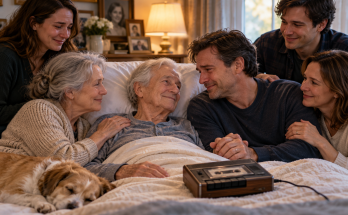
Twenty years after the wedding, my son asked if I wanted to visit the old house.
The house where Anna recorded the cassette.
The house we sold.
The house other people owned.
“Why?”
He shrugged.
“Anniversary.”
“Of your wedding?”
“Yes.”
“Shouldn’t you be with your wife?”
“She’s coming.”
“Then why me?”
“Because you were there first.”
Fair.
The current owners had changed twice since we searched the kitchen wall.
The newest family knew nothing about the criminal case beyond what property disclosures mentioned.
My son contacted them respectfully.
Explained that his mother once lived there.
Asked whether we might visit for an hour.
They agreed.
A young couple.
Two children.
Dog.
The house looked smaller.
Homes from memory usually do.
The porch remained.
Anna’s porch.
The one I nearly could not afford.
The kitchen had been renovated again.
No old pantry.
No hidden panel.
No pencil mark measuring my son at seven.
Those changes hurt for about thirty seconds.
Then one of the children ran through carrying a soccer ball and knocked over a shoe rack.
The mother yelled:
“Outside!”
Life had claimed the space.
Good.
My son stood near the kitchen table.
“This is where she recorded it?”
“Probably.”
I pointed toward the window.
“Morning light came from there.”
His wife carried the cassette in its archival case.
Not to leave.
Not to play publicly.
Just to bring.
She placed it on the table.
The homeowner asked:
“Is that the famous tape?”
My son smiled awkwardly.
“Famous in a very small circle.”
The woman laughed.
She knew enough not to ask more.
They gave us privacy and took the children to the park.
The dog refused to leave.
So the dog stayed.
Anna would have liked that.
We sat around the table.
My son.
His wife.
Me.
Carol.
Clara, now an adult, came too.
Samuel joined by video because he lived across the country and said flying for “a cassette pilgrimage” was ridiculous.
He still participated.
My son placed the player on the table.
“You want to hear it?”
Everyone looked at everyone.
Carol said:
“Not all forty-seven minutes.”
Clara laughed.
“Coward.”
“I have heard it enough.”
My son’s wife suggested only the beginning and end.
So we played the first minute.
Anna’s voice entered the kitchen again.
Not the same kitchen anymore.
Different cabinets.
Different paint.
Same room shape.
“Hello, my boy.”
My son closed his eyes.
Twenty years older than when he first heard it.
Older than Anna ever became.
That realization hit him visibly.
He was now forty-seven.
The number.
Of course.
Clara noticed first.
“Dad.”
“What?”
“You’re forty-seven.”
He stared.
Then laughed.
“No.”
“Yes.”
His wife checked.
“Actually yes.”
He looked offended.
“Why did nobody warn me?”
Carol said:
“Your mother probably arranged it.”
Everyone groaned.
We had learned not to mythologize Anna.
We still joked about it.
The tape played sixty seconds.
Then my son stopped it.
“Enough?”
Everyone nodded.
Then he advanced to the final clean section.
Not private Track 47.
Not Malcolm’s alteration.
The end of Anna’s main wedding message.
Her voice sounded tired there.
She told her son she hoped the day had been joyful.
She hoped he had eaten something.
She hoped I had behaved.
I protested.
Nobody cared.
Then:
“Whatever happens after today, remember that marriage is not one promise made once. It’s many small promises you decide whether to keep when nobody is applauding.”
My son’s wife looked at him.
Twenty years of marriage.
Two children.
Fights.
Counseling.
Moves.
Bills.
Illness.
Ordinary days.
They had kept enough small promises.
Not all.
Enough.
Anna ended:
“And please go enjoy your wedding. Your mother has talked long enough.”
Static.
My son stopped the tape.
The room remained quiet.
Not heavy.
Just quiet.
Clara asked:
“Was that the first time anyone actually followed that instruction?”
We laughed.
Probably.
For years, the tape had opened a door into investigation.
Now it closed without anything following.
No Side B secret.
No knock.
No unknown number.
No police call.
Only silence.
My son looked around the kitchen.
“What do we do with it now?”
His wife said:
“Take it home.”
Clara said:
“Archive it.”
Samuel, through the tablet:
“Digitize it and throw away the plastic.”
Everyone shouted no.
He laughed.
I asked my son what he wanted.
He thought.
“I don’t want to keep treating the original like a relic.”
“Then don’t.”
“But I don’t want to lose it.”
“Then don’t.”
“Very useful, Dad.”
“I’m old. I provide principles now.”
He rolled his eyes.
Eventually, the decision was simple.
The original stayed with him.
The digital preservation copy remained secure.
No museum.
No display.
No donation while intimate family members still lived.
Maybe later generations would decide differently.
Not our problem.
That phrase would have frightened me once.
Now I liked it.
Not our problem.
Future people could choose.
Anna had finally taught us that by destroying her continuity memorandum.
You cannot responsibly control everyone after you are gone.
We walked through the rest of the house.
The stairs creaked differently.
The upstairs hall had no built-in bookshelves now.
The bedroom where Anna spent her final months belonged to a ten-year-old boy obsessed with space.
Glow-in-the-dark stars covered the ceiling.
My son stood in the doorway.
For a moment I worried.
Then he smiled.
“Good.”
“What?”
“It’s his room.”
Yes.
Not Anna’s room preserved in amber.
Not our grief museum.
A child’s room.
Clara asked whether she could photograph the stars.
The homeowner had said photos were fine.
She did.
Not for publication.
For herself.
Downstairs, the dog had fallen asleep beside Carol.
She stroked its ears.
I watched her.
Twenty years since the wedding.
Longer since Anna died.
Carol and I were still together.
That fact surprised me sometimes.
Not because reconciliation was impossible.
Because permanence had stopped being the goal.
We stayed because, repeatedly, we chose to stay.
Not because Anna blessed it.
Not because leaving would mean failure.
Not because guilt required punishment.
Choice.
Renewed.
Sometimes tedious.
Real.
On the porch, my son handed me Anna’s cassette case.
“Hold this.”
“Why?”
“He’s taking a picture,” his wife said.
Clara set up her camera.
I groaned.
“No.”
“Yes.”
The six of us gathered.
Samuel appeared on the tablet screen propped on the porch rail.
Ridiculous.
The dog wandered into frame.
Clara set the timer.
My son stood beside me.
His wife beside him.
Carol on my other side.
We took the photograph.
Then another because I blinked.
Then another because Samuel’s video froze.
Finally one worked.
Clara looked at the screen.
“Good.”
“Show me.”
She did.
Nobody looked perfect.
My hair mostly gone.
Carol squinting.
My son halfway through a smile.
His wife looking at him instead of camera.
Samuel blurry on a tablet.
Dog facing backward.
Good.
A family picture.
Not evidence.
On the drive home, my son asked:
“What do you think silence means now?”
The question surprised me.
“Why?”
“Mom said peace and silence weren’t the same.”
I looked out the window.
Twenty years earlier, silence meant avoidance to me.
Conflict postponed.
Photographs moved.
Questions not asked.
Then silence became threat.
Missing records.
People too afraid to speak.
Now?
“Sometimes silence is just quiet.”
He nodded.
“That’s what I think too.”
Silence is dangerous when someone requires it.
When truth is buried beneath it.
When fear maintains it.
But chosen quiet after the truth has been told?
That is different.
Peace can contain silence.
It just cannot depend on it.
My son dropped us home.
Before leaving, he held the cassette up.
“Forty-seven.”
I smiled.
“What?”
“Nothing.”
He grinned.
“Exactly.”
Then he drove away.
Carol and I went inside.
The blue mug sat in the cabinet.
The yellow-striped dish towel from Anna’s house had eventually been returned from evidence and stored in a drawer.
Not displayed.
Not discarded.
Outside, evening settled.
No phone rang.
No one knocked.
No secret waited beneath the floor.
Carol made tea.
I opened a book.
And for nearly an hour, neither of us said a word.
This time, nothing was wrong.