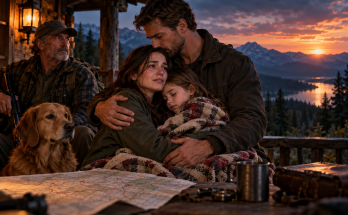
Spring arrived late in Oregon.
Snow still clung to shaded hills when Claire and I drove the blue pickup toward Thomas’s old lakeside property.
This time Noah and Lily came.
Noah insisted on driving half the way.
I complained about how he shifted.
He reminded me the truck had a modern transmission.
I told him principle mattered.
Claire and Lily exchanged the look women in our family used when men became exhausting.
Some traditions survived reform.
Open Bench stood where the old workshop cabin had been.
We had not demolished it completely.
The original timber frame remained.
New wiring.
New roof.
Better windows.
Six heavy workbenches.
Tool cabinets.
Safety equipment.
A small classroom.
No bronze plaque.
No portrait wall.
Only one sign near the entrance.
OPEN BENCH
LEARN. WORK. REPAIR. RETURN WHAT YOU BORROW.
The last line was mine.
Rachel said it sounded threatening.
“It’s practical.”
“It’s definitely you.”
Twenty-four teenagers enrolled in the first program.
Some loved school.
Some hated it.
Some had been suspended.
One had recently left foster care.
Another lived with grandparents.
Nobody was there to be rescued.
I insisted on that language.
They were there to learn.
People deserved help without becoming someone else’s redemption story.
The opening morning was chaotic.
A compressor failed.
Someone delivered lumber to the wrong address.
Lucas forgot safety glasses for half the group.
I was happier than I had been at any ceremony in my life.
Problems I could touch.
Fix.
Move.
Test.
No hidden files.
No secret wills.
At noon, Rachel gathered everyone outside.
I saw a microphone.
“No.”
She ignored me.
“Five minutes.”
“You promised.”
“I lied.”
Claire whispered, “Family trait.”
I glared at both of them.
Rachel gave a short speech.
She did not mention Thomas’s mistakes.
Or Arthur’s.
Or mine.
She said the property had existed because several people believed practical skill could create dignity.
That was enough.
Then she called me forward.
I refused.
Noah shoved me.
Traitor.
I stood beside Rachel.
She handed me a red toolbox.
The childhood set.
Thomas’s gift.
I had brought it months earlier, but Rachel had restored the case.
The tools remained old.
Scratched now from being used at the cabin during construction.
Good.
Thomas bought them for a child.
They finally worked for one.
Rachel said the set would remain at Open Bench.
Not behind glass.
Students could use it.
I liked that.
Then a boy in the front row raised his hand.
“Why is David written underneath?”
Everyone looked at me.
I considered giving the simple answer.
Because they were mine.
Instead:
“Because somebody bought them for me a long time ago and waited too long to give them.”
The boy nodded as if that made complete sense.
Teenagers sometimes accept complicated truths faster than adults.
After lunch, I taught basic engine diagnostics.
Noah handled electrical systems.
Lucas covered woodworking safety.
Lily helped one student repair an instrument case even though music was not technically part of the program.
Claire organized food and somehow became everyone’s emergency contact within three hours.
Rachel watched all of us.
At one point, she stood beside me.
“Dad would be happy.”
“Maybe.”
“You still won’t give me that?”
“No.”
She smiled.
“Good.”
We did not need dead men approving everything.
The living could choose.
That evening, after the students left, our family stayed by the lake.
Emma brought her daughter.
Kevin had been invited but could not travel because of legal and treatment obligations.
Brenda obviously could not come.
Mark could not either.
Their absences were noticeable.
Not celebrated.
No family photograph could pretend everyone was healed.
Lily played violin near the water.
No performance.
Just music.
Noah opened a cooler.
Rachel’s grandchildren chased each other between trees.
Claire sat beside me on a fallen log.
“Do you ever think about what our life would have been if Dad took that apartment?”
“All the time.”
“Better?”
“Some parts.”
“Worse?”
“Some.”
She nodded.
“Same answer for marrying me?”
I looked at her.
“That’s a trap.”
“It’s therapy.”
“Worse.”
She laughed.
Then I answered.
Our marriage had cost things.
Every marriage did.
It gave things too.
Same arithmetic.
Wrong question.
Arthur had finally learned that.
We were learning earlier.
I held up his house key.
I still carried it.
Claire touched it.
“Do you think you’ll ever stop carrying that?”
“No.”
“Sentimental.”
“Efficient. It works.”
She smiled.
At sunset, Rachel brought out an envelope.
I groaned.
“I swear to God.”
She laughed.
“Not from Arthur.”
“Good.”
“From Thomas.”
I stared at it.
Apparently Rachel had found it inside an old equipment manual while clearing storage.
My name was on the front.
Unlike previous letters, this one had never gone through Margaret.
Never reached Arthur.
Thomas wrote it during his final year.
Rachel had considered mailing it after his death.
She didn’t.
Fear.
Again.
She apologized.
“Why give it now?”
“Because now I think I understand the difference between choosing your timing and choosing your truth.”
That sounded like something worth hearing.
I opened it.
Thomas did not apologize immediately.
That surprised me.
Instead he described the blue pickup.
He had begun restoring it because repairing machines gave him something to do while cancer treatment failed.
He imagined teaching me the things he knew.
Then admitted how foolish that fantasy was.
I was already a mechanic.
Already a grown man.
Already a father.
He had missed the years when teaching me mattered.
That line hurt.
Thomas wrote that distance had allowed him to preserve an imaginary version of me.
A son who might understand every decision.
A son who would forgive.
A son who still needed him.
The real David owed him none of those things.
I stopped.
Arthur could have written the same sentence about inheritance.
Thomas ended with a request.
Not forgiveness.
A meeting.
If he survived long enough.
He did not.
The letter never reached me anyway.
I folded it.
Rachel watched my face.
“You okay?”
“Yes.”
Not because the letter fixed anything.
Because Thomas had finally stopped asking the imaginary son to solve the real father’s guilt.
That felt honest.
I put the letter in my jacket.
Later, when everyone else went inside, I remained by the lake.
Noah joined me.
He sat without asking.
For a while, we watched the water.
Then he said, “I’ve been thinking about the garage.”
“What about it?”
“I don’t want you to give it to me.”
“I wasn’t planning to.”
“Good.”
I smiled.
“What do you want?”
“To buy in gradually.”
“That was the plan.”
“I know.”
“Then why are we talking?”
“Because I want you to know I don’t expect it.”
The sentence mattered more than he knew.
Inheritance.
Expectation.
Entitlement.
Arthur’s family had been shaped by confusion over those words.
“You’re my son.”
“I know.”
“That means you’ll inherit something eventually.”
“Probably your terrible coffee.”
“Definitely.”
He laughed.
Then grew serious.
“I want whatever you leave me to be something you chose after living your life. Not something I start counting early.”
I looked at him.
Arthur would have understood.
Maybe that was how families changed.
Not through one revelation.
Through one generation refusing a habit.
I put my hand on Noah’s shoulder.
“Good.”
He looked suspicious.
“That’s it?”
“That’s it.”
“You’re getting emotionally efficient.”
“Don’t tell the therapist.”
The next morning, we returned to Open Bench.
A student named Miguel was already waiting outside.
The same boy who had called Thomas’s tools old months earlier.
He had arrived an hour early.
“Why?”
He shrugged.
“Home’s loud.”
I unlocked the door.
Arthur’s key did not fit, obviously.
I used the workshop key.
Still, I thought of him.
A safe place.
That had been the beginning of everything.
Arthur stayed in our house because he felt safe.
Then his money quietly created safer places for other people.
The irony was not lost on me.
Miguel went directly to the red toolbox.
He selected a wrench.
“Can I use this?”
“That’s what it’s for.”
He began repairing a lawnmower engine.
I watched his hands.
Uncertain.
Then more confident.
No emotional speech required.
Sometimes help could simply be a bench, a tool, and time.
When we returned home three days later, Sarah called.
The estate administration was nearly complete.
Most major disputes resolved.
Assets transferred.
Responsibilities assigned.
Only one unusual item remained.
I sighed.
“Please don’t say envelope.”
“Not an envelope.”
“What?”
“A bank safe-deposit box.”
I closed my eyes.
Claire, hearing my side of the conversation, started laughing.
“Arthur?”
“Yes.”
“Of course.”
Sarah said the box was listed in the inventory but had not been opened because ownership records were incomplete.
The bank finally cleared access.
Arthur rented it thirty-four years earlier.
Before he moved into our house.
Before he met Margaret.
Before Thomas’s trust.
Before Claire married me.
“What’s inside?”
“I don’t know.”
“You’re not allowed to say that anymore.”
Sarah laughed.
She suggested we open it together.
The next morning, Claire and I met her at the bank.
A manager led us into a private room.
The box was longer than I expected.
Sarah used Arthur’s key.
Inside were no stacks of cash.
No jewelry.
No surprise bonds.
One photograph album.
A packet of legal papers.
A small velvet pouch.
And a letter addressed to Eleanor.
Claire whispered, “Mom.”
The letter had never been opened.
Arthur wrote it.
The date was one year before Eleanor died.
Beside it lay a second letter.
Addressed to Arthur.
Eleanor’s handwriting.
Also unopened.
Claire stared at the two envelopes.
“They wrote letters to each other and never opened them?”
Apparently.
The legal papers underneath concerned a trust I had never heard about.
Not Arthur’s wealth.
Not Thomas’s.
Eleanor’s.
She had inherited money from her parents decades earlier.
Not millions.
Enough.
She created a small private fund.
Beneficiary:
Claire Vance Pierce.
Claire stared at the page.
“My mother left me money?”
Sarah read carefully.
The fund had never been distributed.
Why?
A condition.
Eleanor instructed Arthur to release it only after Claire no longer felt responsible for keeping her siblings together.
I looked at Sarah.
“That cannot be a legal condition.”
“It isn’t phrased as a binding condition.”
More like a personal instruction.
Arthur retained discretion.
He never exercised it.
The current balance was approximately one hundred eighty thousand dollars.
Claire sat down.
Her mother had seen the burden too.
Decades ago.
The money was not the important part.
The letter was.
Claire held Eleanor’s unopened envelope.
Her hands shook.
“Can I?”
Sarah nodded.
Claire opened it.
She read silently.
Tears appeared quickly.
Then she handed it to me.
Eleanor wrote that Claire had always been the child who stepped between everyone.
Between Mark and Kevin.
Between Brenda and their father.
Between Arthur and Marcus.
Between conflict and peace.
Eleanor had praised that quality when Claire was young.
Now she regretted it.
She wrote:
I taught you to believe keeping people together was the same as loving them.
It is not.
Sometimes love lets people leave.
Sometimes love tells the truth.
Sometimes love refuses to stand in the middle.
Claire stopped me.
“That’s enough.”
She took the letter back.
For a long time she said nothing.
Then she looked at Arthur’s unopened letter to Eleanor.
“Should I read Dad’s?”
Sarah said the decision was Claire’s.
She considered.
Then shook her head.
“No.”
I was surprised.
“Why?”
“It wasn’t written to me.”
That answer would have been impossible six months earlier.
We had become so obsessed with hidden truth that opening everything felt justified.
But privacy was not the same as secrecy.
Another distinction.
Claire placed Arthur’s letter back in the box.
“Can we leave it sealed?”
“Yes.”
Sarah said the bank could preserve it.
Claire kept Eleanor’s letter.
The trust would transfer to her.
She had no immediate plans for the money.
Good.
Not every dollar required symbolic redemption.
As we left the bank, she looked lighter.
Not happy exactly.
Released.
“My mother knew.”
“Yes.”
“She knew I was carrying everyone.”
“Yes.”
“And she still left Dad to decide when I was ready.”
I smiled.
“Family trait.”
Claire laughed.
Then she stopped on the sidewalk.
“What if I’m ready now?”
“For the money?”
“No.”
She looked at me.
“To stop standing in the middle.”
Mark.
Brenda.
Kevin.
Arthur’s memory.
Me.
Everyone.
“You don’t need my permission.”
“I know.”
That might have been the answer Eleanor wanted.
Claire took my hand.
We walked toward the truck.
Behind us, inside a bank vault, one letter between two dead people remained unopened.
For once, a secret stayed closed not because of fear.
Because it belonged to someone else.
Click here to continue reading: PART 25: Claire Stopped Standing Between Everyone, and Her First Decision Without Permission Changed More Than Arthur’s Money Ever Could
The Morning After Arthur’s Funeral, a Lawyer Brought His Blue Ledger Into the House and Asked Me to Sit Down
Part 24 of 35