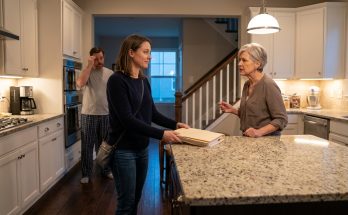
Three years after the morning David arrived before sunrise with Brenda and Jason, I woke before six.
For one second, I expected knocking.
None came.
The house was dark.
Quiet.
Rain touched the windows softly.
I lay still and listened.
There had been a time when silence made me anxious because I assumed it meant someone was planning something outside my view.
Now silence was simply silence.
I got up.
Made coffee.
Used a plain white mug.
Not Mom’s.
Not symbolic.
Just the mug nearest the front of the cabinet.
The inheritance accounting was finished.
Not every lawsuit.
Not every appeal.
But my part.
Final.
After all restitution, taxes, settlements, charitable releases, property sales, and disputed transfers, I retained enough money that people still called me wealthy.
I no longer thought of the exact number often.
Money mattered.
Pretending otherwise would be dishonest.
It gave me freedom.
Security.
Time.
The ability to say no.
But it no longer felt like Mom.
That distinction saved me.
For years, I had confused preserving what she left with preserving her.
They were never the same.
Her house had been sold.
I kept a few things.
The roof photograph.
The mystery novel.
Recipe cards.
Two pieces of jewelry.
One scarf that still faintly smelled like her after all that time.
No hidden drives.
No false panels.
I had checked.
Twice.
Dad lived forty minutes away now.
Not with me.
Not close enough to collapse boundaries.
Close enough for coffee.
Sometimes we went two weeks without talking.
Sometimes he called twice in one day because he forgot he already told me something.
I complained.
He apologized.
Ordinary.
He never became the father I had as a child.
That person did not exist.
He became an older man I chose to know.
That was different.
Enough.
Michael remained impossible.
He sent long emails about property markets despite my repeated request that he stop.
I rarely read them.
When I told him this, he said:
“Then why do I write them?”
“Compulsion.”
“Possibly.”
He continued anyway.
Some people improved without transforming.
Brenda changed more than I expected.
Not dramatically.
She still wanted to fix.
Still offered advice too early.
Still calculated costs automatically.
But she had learned to ask:
“Do you want help?”
That question represented decades of lost time.
Better late than never.
Jason stayed employed.
Continued restitution.
No miracle success.
No sudden wealth.
He once told me:
“I used to think having money meant never needing anyone.”
“What do you think now?”
“That not needing to lie is richer.”
I told him it was a terrible line.
He agreed.
Then wrote it down anyway.
David moved away.
We did not stay in contact.
Once a year, perhaps, something practical passed through email.
Tax document.
Legal closure notice.
When Brenda was hospitalized briefly for pneumonia, we exchanged two messages.
She’s stable.
Thank you.
That was all.
I sometimes thought about him.
Without anger.
Without longing strong enough to change anything.
He belonged to a chapter of my life that contained real love and real betrayal.
Neither cancelled the other.
I no longer needed the chapter rewritten into something simpler.
Leonard died in prison.
I learned from a news alert I had forgotten to disable.
For several minutes, I stared at the headline.
Then closed it.
No satisfaction.
No forgiveness.
No need to feel a prescribed emotion.
Paul Renner’s family eventually received compensation from the foundation and Meridian settlements.
I met his daughter once.
Not planned.
A patient-safety program event.
She recognized my name.
“I’m sorry about your mother,” she said.
“I’m sorry about your father.”
We stood there.
Two daughters whose parents had been harmed by the same system.
She asked:
“Do you think they knew each other?”
“Maybe through records.”
“Dad mentioned an Ellen once.”
“Mom mentioned Renner.”
We smiled sadly.
Then she said:
“I spent years wishing someone had noticed sooner.”
I understood.
“So did I.”
The patient-safety program funded medication tracking upgrades across several hospitals.
No family names.
No plaques.
Good.
The foundation’s public reports were boring.
Charts.
Audits.
Compliance metrics.
I read them every year.
Boring had become one of my favorite qualities.
Grace fully transferred archive authority and retired.
She wrote a book proposal once.
Not about Mom specifically.
About distributed records and institutional accountability.
She asked whether mentioning our family history would bother me.
“Depends.”
“On what?”
“Whether you turn everyone into characters.”
She laughed.
“Hard not to.”
“Then don’t use us.”
She changed the proposal.
That mattered.
Miriam died overseas the following year.
Grace attended the funeral.
When she returned, she said:
“I still don’t know what I think of her.”
“You don’t have to finish.”
Grace looked at me.
“That sounds familiar.”
We had learned.
Caroline never returned to high-profile practice.
Richard did.
He remained irritatingly successful.
But his company structures were transparent enough to satisfy the monitors.
He once sent me a holiday card.
No message beyond:
Peaceful year.
I laughed.
Then kept it.
Not because we were friends.
Because peaceful year sounded like a worthy ambition.
The university archive opened its first major research collection from Mom’s records.
An academic published an article arguing Victor Whitmore was the central architect of the original control system.
Another argued Charles Vale transformed Victor’s private coercion into a scalable financial network.
A third focused on the Shaw procurement structure.
I read none fully.
I knew enough.
History needed scholars more than it needed heirs.
One researcher emailed asking whether I believed Mom considered herself a whistleblower.
I answered:
“No.”
Then deleted the rest of my draft.
I had started explaining her.
Defending her.
Categorizing.
Not my job.
The records existed.
Let them work.
On the third anniversary of Mom’s death, Dad asked whether I wanted to visit the cemetery.
“No.”
“Okay.”
“I’m going somewhere else.”
“Where?”
“The lake.”
He knew which one.
Robert’s old property had been sold during the accounting.
The house no longer belonged to any family entity.
A young couple bought it.
They renovated.
Removed the false-bottom desk.
Opened windows.
Painted over the dark study.
I did not visit the house.
I went to the public lake nearby.
Sat on a bench.
Brought coffee.
Mom had hated sitting still outdoors.
Five minutes into any peaceful view, she would say:
“Well, now what?”
I smiled imagining it.
“Nothing,” I told her.
A woman walking her dog glanced at me.
I pretended I was on the phone.
Then laughed.
Maybe grief eventually becomes permission to look ridiculous in public.
I thought about the morning everything began.
David at the door.
Brenda behind him.
Jason ashamed.
Thirty million dollars they wanted me to transfer.
A crisis that turned out to be partly real, partly manufactured, and entirely rooted in secrets older than our marriage.
If I had written the check that morning, what would have happened?
Brenda would have pushed money into the debt structure.
Caroline might have tried to broker a settlement.
Richard would have learned I was financially reachable.
The hidden Sarah trust might have remained buried.
Mom’s archive might have stayed fragmented.
Leonard’s Meridian system might have survived longer.
David and I might have remained married.
For a while.
That possibility no longer tempted me.
A quieter lie was not a better life.
I once believed the inheritance changed everything.
It did not.
The inheritance revealed what was already there.
David’s secrecy.
Brenda’s control.
Jason’s debt.
Mom’s fear.
Dad’s absence.
Victor’s manipulation.
Charles’s exploitation.
The Shaw network.
The archive.
The money was a flashlight.
Not the room.
That distinction became important.
Because I did not want to spend the rest of my life believing wealth had ruined us.
People made choices.
Money amplified them.
Fear justified them.
Love complicated them.
Documents preserved them.
Then eventually, someone had to decide whether to continue.
Mom tried.
Too late.
Imperfectly.
She left that final choice to me.
I had once resented her for it.
Maybe I still did.
But now I understood what she had finally stopped doing.
She did not leave instructions telling me whom to forgive.
Whom to sue.
Whom to save.
Whom to hate.
She left records.
And asked me to decide.
That was different from control.
Not completely.
She still designed the sequence.
Still set conditions.
Still shaped discovery.
Even dying, Mom had trouble letting go.
But at the end, she moved closer.
Let Sarah decide.
Those words mattered because she had spent years doing the opposite.
I finished my coffee.
Walked along the lake.
No revelation waited.
No stranger approached.
No unknown number texted.
My phone stayed quiet.
At home, a package sat near the door.
For one absurd second my heartbeat jumped.
Then I saw the return address.
Dad.
I called him immediately.
“What is this?”
“You didn’t open it.”
“No.”
“Then how should I know?”
“You sent it.”
“That does give me an advantage.”
“Dad.”
“A sweater.”
I stared at the box.
“You mailed me a sweater from forty minutes away.”
“It was on sale online.”
“Why?”
“You said your office is cold.”
I laughed.
No secret document.
No hidden evidence.
A sweater.
“What color?”
“Blue.”
I froze.
He heard it.
“Bad blue?”
“No.”
“Cup blue?”
“Maybe.”
“I can return it.”
“No.”
I opened the package.
Soft blue wool.
Nothing hidden.
I checked the pockets.
Dad laughed through the phone.
“I should have put a note in there saying stop checking.”
“You created this problem.”
“Fair.”
I put on the sweater.
It fit.
“Thank you.”
“You’re welcome.”
“Coffee Sunday?”
“Yes.”
“Ten-thirty?”
“Eleven.”
“You’re becoming lazy.”
“Goodbye.”
He laughed.
“Goodbye, Sarah.”
After we ended the call, I walked into the kitchen.
The evening light fell across the cabinets.
I opened the one where Mom’s chipped blue cup once sat.
The empty space remained.
I had kept it deliberately at first.
A memorial.
Then habit.
Now it seemed silly.
I took the plain white mug I used most mornings and put it there.
It fit.
That was all.
No symbolism needed.
Still, I stood looking at it.
Mom had left me money.
Then documents.
Then choices.
But what remained after all of that was simpler.
I could decide who entered my house.
I could decide who knew my finances.
I could decide whom I helped.
Whom I loved.
Whom I forgave.
Whom I did not.
I could change my mind.
I could say yes without obligation.
No without guilt.
I could know the truth and still refuse to let it occupy every room.
That was what control should have meant all along.
Not controlling others.
Owning your own decisions.
The next morning I woke after sunrise.
Late.
Sunlight already crossed the bedroom floor.
For once, I had slept through dawn.
I made coffee.
Used the white mug from Mom’s old spot.
Sat by the window.
My phone buzzed.
Jason.
A photograph.
Not evidence.
His first tomato plant.
Three tomatoes.
Caption:
Look. Something I didn’t financially ruin.
I laughed.
Replied:
Give it time.
He sent back an insult.
I drank my coffee.
Outside, the street was ordinary.
A delivery truck stopped next door.
Someone walked a dog.
A child rode past on a bicycle.
No one was coming to demand anything.
No hidden fortune waited to be found.
No archive needed assembling.
The story of my mother would continue in court files, research collections, family memories, and people who disagreed about what she had done.
That was fine.
She did not belong to one explanation.
Neither did I.
I looked at the photograph on my office shelf later that morning.
Mom at twenty-three, standing on the roof with her shoelace undone.
Before me.
Before David.
Before most of the money.
Already fighting Victor.
Already trying to become herself.
I touched the frame.
“You were complicated.”
The room gave no answer.
Good.
I did not need one.
I went back to work.
The End
Read more original stories on Feel Every Story.
Before Sunrise, My Husband Brought His Family to My Door and Asked for Something My Mother Had Already Protected
Part 44 of 44