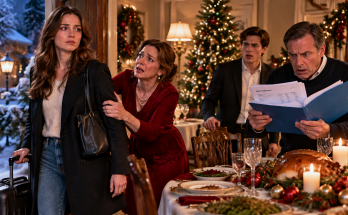
We returned to the federal facility without speaking much.
There was nothing useful to say until we saw the document.
Robert Miller’s confession was thirty-seven pages.
The first twenty dealt with the European project, Arthur Vollen, preservation research, and Robert’s increasing opposition to lineage selection.
Then came 1979.
Robert had learned that Susan Carter—me—was being monitored.
He warned Evelyn.
Keene intercepted the letter.
Robert confronted William.
According to the confession, the argument became violent.
Not physically.
Threats.
Exposure.
Robert threatened to release documents proving the project used reproductive samples without complete consent.
William warned that doing so would destroy multiple families and implicate Robert himself.
Then Robert became ill.
Cancer.
Real.
Aggressive lymphoma.
The confession did not claim William caused the disease.
It claimed William interfered with treatment.
I read the relevant paragraph three times.
In March 1980, I learned that the medication protocol recommended by my oncologist had been replaced after consultation with a foundation-affiliated physician. William admitted requesting the change because he believed my treatment interfered with preservation studies involving my blood and marrow.
Michael’s face went blank.
“He changed Dad’s cancer treatment to protect research.”
Reyes said carefully, “That is Robert’s allegation.”
I continued.
Robert wrote that the substitute protocol was medically defensible but less aggressive.
Not murder in a simple sense.
A choice.
Made without Robert’s knowledge.
William allegedly prioritized research continuity over the treatment Robert wanted.
Michael whispered, “That could have shortened his life.”
“Yes,” Reyes said.
“Can we prove it?”
“Medical experts would need the full records.”
“Do we have them?”
“Prague does.”
Of course.
Michael stood.
“Get them.”
Reyes nodded.
Already underway.
I reached toward him.
He stepped away.
Not from me specifically.
From everyone.
“I need air.”
He left.
I let him.
Old Susan might have followed.
Old Michael might have disappeared for days.
We were trying to become people who gave space without turning it into punishment.
I remained with Reyes.
“Did William confess?”
“Not in Robert’s document.”
“His own records?”
“We’re searching.”
“What does Keene say?”
“He claims William ordered the change.”
“Keene lies.”
“Yes.”
“He also sometimes tells the truth.”
“Yes.”
I hated that.
My mother arrived.
She read Robert’s accusation.
Then sat down.
“You knew.”
It was not a question.
She shook her head.
“Not this.”
“Did you know William interfered in Robert’s care?”
“No.”
“Did you know they argued?”
“Yes.”
“How badly?”
“Very.”
“About me?”
“Partly.”
“About the program?”
“Yes.”
“Did William ever say Robert was dangerous?”
Evelyn looked at the paper.
“Yes.”
My stomach tightened.
“What exactly?”
“That Robert would destroy everything if he went public.”
“Everything meaning the project.”
“And our family.”
Again.
Family as justification.
I felt exhausted.
“Did you ever ask whether Robert’s death benefited William?”
My mother looked horrified.
“No.”
“Why not?”
“Because he had cancer.”
Reasonable.
And perhaps exactly why interference was possible.
A death that needed no invention.
Only acceleration.
Harris joined remotely.
When shown the confession, his face changed.
“You knew too.”
He hesitated.
My anger sharpened.
“Leonard.”
“I knew William spoke to Robert’s oncologist.”
“Why?”
“He told me Robert was refusing appropriate treatment.”
“Was he?”
“I did not see the records.”
“So you accepted William’s explanation.”
“Yes.”
“Did you benefit from Robert dying?”
Harris looked wounded.
“That is a terrible question.”
“It is also a question.”
He considered.
“Indirectly.”
“How?”
“Robert’s death ended organized internal opposition.”
“Then yes.”
Harris lowered his head.
“Yes.”
The system did not require everyone to kill.
Only enough people to look away when another person’s absence became convenient.
Michael returned forty minutes later.
He had washed his face.
His eyes were red.
He sat beside me.
I waited.
He said, “If William did this, I don’t know whether I can be around him.”
“You don’t have to.”
“You can.”
I looked at him.
“He’s your father.”
“Not biologically.”
“That distinction stopped meaning much this week.”
Fair.
“If I choose to see him?”
Michael looked at his hands.
“I don’t want to punish you for loving someone who harmed my family.”
The maturity of that sentence nearly broke me.
“But?”
“But I may not be able to sit at the same table.”
“You won’t have to.”
“What if you want birthdays?”
“Then we make different arrangements.”
“Holidays?”
“Different arrangements.”
He looked at me.
“You make it sound simple.”
“It won’t be.”
“No.”
“But we spent eighteen years pretending one room had to contain every truth.”
His expression softened.
“That is oddly specific.”
“I’m learning.”
He took my hand.
“We’re not letting our fathers end our marriage.”
“No.”
“Even if William hurt mine.”
“No.”
“Even if Robert steered me toward you.”
“No.”
“What if none of it was accidental?”
I looked at him.
“Meeting may have been arranged.”
“Yes.”
“Staying wasn’t.”
He squeezed my hand.
“Good.”
The Prague medical records arrived that evening.
Robert’s original oncologist recommended an aggressive combination therapy.
The foundation consultant changed the plan.
Signature approving consultation:
William Carter.
Reason:
Preservation of hematologic viability for ongoing study.
Michael stared at the phrase.
“They wanted his blood usable.”
Harris whispered, “My God.”
Robert’s treatment had been altered partly to preserve biological material.
The same obsession.
Samples.
Lineages.
Future utility.
Experts could not say whether the altered treatment definitely shortened his life.
But it carried lower expected effectiveness for his disease stage.
William had intervened.
That much was clear.
Reyes asked whether I wanted to be present when they questioned him.
I said no.
Michael said yes.
I looked at him.
“You sure?”
“No.”
He went anyway.
I waited with Lily and Jake.
Two hours later, Michael returned.
He looked devastated.
I stood.
“What did he say?”
“He admitted it.”
My stomach dropped.
“Everything?”
“He told Robert’s doctor he wanted a less destructive protocol.”
“Why?”
“The research.”
Michael sat.
“He said he convinced himself the treatment remained medically acceptable.”
“Did he understand the tradeoff?”
“Yes.”
I closed my eyes.
“What did he say about Robert dying?”
“That he didn’t intend it.”
“Do you believe him?”
Michael thought for a long time.
“Yes.”
That surprised me.
“He still did something unforgivable.”
“Yes.”
“But you don’t think he meant to kill him.”
“No.”
“Does that matter?”
“Yes.”
“How?”
Michael looked at me.
“It makes the truth more complicated, not less serious.”
I nodded.
We were becoming good at holding both.
William had not secretly poisoned Robert.
He had interfered with treatment for selfish institutional reasons.
That may have shortened his life.
Intent did not erase consequence.
Consequence did not automatically prove murderous intent.
Both mattered.
“Did you tell William how you feel?”
“Yes.”
“What did you say?”
“That I don’t forgive him.”
My chest tightened.
“What did he say?”
“He didn’t ask me to.”
Of course.
“Anything else?”
“I told him he doesn’t get to use you as a bridge to me.”
I stared.
“What?”
“If you choose a relationship with him, that does not mean I do.”
“Yes.”
“And he agreed.”
I touched Michael’s face.
“Thank you.”
“For what?”
“For separating us.”
His brow furrowed.
“That sounds wrong.”
“I mean separating our choices.”
He understood.
“We should have done that years ago.”
“Yes.”
The next morning, federal prosecutors announced multiple arrests.
Two retired physicians.
A former trust administrator.
Martin Cole, the official who buried Samuel’s investigation.
Rachel entered a cooperation agreement subject to prosecution decisions.
Harris was formally charged with several offenses connected to unauthorized procedures and falsified medical records.
He surrendered without resistance.
Daniel was charged separately.
His attorneys emphasized later cooperation.
Prosecutors emphasized that later cooperation did not erase 2008.
Good.
Both could be considered.
Keene faced the broadest case.
Conspiracy.
Fraud.
Medical offenses.
Kidnapping-related counts.
Obstruction.
Evidence tampering.
More would likely follow.
But the story did not end with arrests.
For the people in the records, it was beginning.
The Open Record Fund received preliminary court approval.
Lily refused any personal distribution beyond legitimate education and health expenses until survivors’ claims were addressed.
Mara told her she was legally entitled to far more.
Lily answered:
“So were they.”
That ended the discussion.
One afternoon, I found her reading a list of program subjects.
“You shouldn’t do that alone.”
She looked up.
“I’m not reading details.”
“What are you doing?”
“Counting.”
“How many?”
“Ninety-three confirmed births.”
“Yes.”
“Four unauthorized conceptions like mine.”
“Yes.”
“Jake’s case separate.”
“Yes.”
“Leonard separate.”
“Yes.”
She closed the file.
“There are probably more.”
“Probably.”
She looked at me.
“I used to wish I had a bigger family.”
I almost laughed.
“Careful what you wish for.”
She smiled.
Then became serious.
“Do I call William Dad?”
“No one can answer that for you.”
“He’s biologically my father.”
“Yes.”
“But he’s also the man Susan called Dad.”
“Yes.”
“That feels weird.”
“It is weird.”
“Do you call Harris Dad?”
“No.”
“Why?”
I thought.
“Because biology arrived too late to replace relationship.”
She nodded.
“And William?”
“I still call him Dad sometimes because relationship arrived before truth.”
“That makes sense.”
“Doesn’t make it easy.”
“No.”
She leaned against me.
We were learning closeness cautiously.
No assumptions.
No demands.
Later that evening, Michael moved his things out of the guest room.
Not everything.
Just shirts.
Books.
His alarm clock.
He stopped in the doorway of our old bedroom.
“Is this okay?”
The question mattered more than the boxes.
“Yes.”
He placed them down.
We did not climb into bed like newlyweds.
We did not erase eighteen years.
We sat on opposite sides of the mattress.
Then he reached for my hand.
I took it.
No grand declaration.
Touch after eighteen years did not need one.
His thumb moved across my knuckles.
“I forgot your hands were always cold.”
I laughed softly.
“They still are.”
We sat there a long time.
Then my phone rang.
Reyes.
The sound instantly tightened both of us.
I answered.
“What happened?”
“We finished reviewing Robert Miller’s confession.”
My stomach tightened.
“There’s more?”
“One final attachment.”
“What?”
“A letter addressed to Michael.”
He stared.
“From my father?”
“Yes.”
“Why wasn’t it delivered?”
“Keene kept it sealed.”
Michael held out his hand.
“Read.”
Reyes hesitated.
“It concerns Susan.”
Michael closed his eyes briefly.
“Of course.”
“What does it say?”
Reyes read the first line.
Michael, if you ever receive this, then I failed to stop Vollen’s people from shaping your life.
Michael’s grip tightened around mine.
Then the second:
Do not blame Susan for what they may engineer between you. They can place people together, alter diagnoses, and manipulate circumstance, but they cannot manufacture love.
We looked at each other.
Neither spoke.
Reyes continued.
If you love her, make decisions with her, not for her.
Michael laughed once.
A broken sound.
His father had written the lesson we took four decades to learn.
Then Reyes stopped.
“What?”
“There’s another page.”
“Read it.”
“It’s about David.”
Michael went still.
“What about him?”
Reyes’s tone changed.
“Robert says David knew his samples had been taken.”
“That contradicts Harris.”
“Yes.”
“Did he consent?”
“Not initially.”
“Then?”
Reyes paused.
“According to Robert, David later signed authorization allowing his stored material to be used for one purpose.”
Michael’s face tightened.
“What purpose?”
Reyes read the line.
To help Michael have a child if natural conception proved impossible.
The room went quiet.
David had not consented to the original collection.
But later, before he died, he had apparently chosen to let his brother use the stored sample if needed.
Michael closed his eyes.
Jake.
His biological father had intended, in some form, to help create him.
Not through deception.
Not without Michael knowing.
Keene had corrupted that wish.
But the wish had existed.
Michael began crying.
I held him.
For once, a buried record did not make our family smaller.
It gave something back.
Click here to continue reading: PART 33: David’s Letter Gave Jake One Piece of His Story Back, but Karen Bell’s Testimony Revealed Daniel Had Tried to Stop Keene Years Earlier
Eighteen Years After My Marriage Went Silent, One Routine Question From My Doctor Made Michael’s Distance Look Completely Different
Part 32 of 43