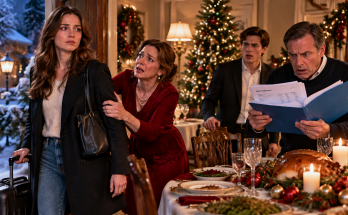
Nobody touched the tracing page after that.
The investigator placed it in an evidence sleeve.
The pale pencil impressions looked almost childish through plastic.
Names written again and again.
Hale.
Mercer.
Sloane.
The kind of repetition a child might use learning cursive.
Except a child had not spent years collecting family documents, extracting money, and forging signatures.
The possibility that Dara had practiced Everett’s handwriting disturbed Patricia more than I expected.
“She never needed his signature for the cabin participation agreement.”
“No.”
“Or the contractor.”
“No.”
“So if she practiced Everett, she may have intended to create historical evidence.”
Dad looked ill.
“To prove something that never happened.”
“Possibly.”
It was the word everyone used when reality had not yet become legally certain.
Possibly.
Allegedly.
Consistent with.
Suggests.
I understood why the language mattered.
I also began to hate it.
The investigator asked whether we possessed known examples of Everett’s signature.
We did.
The 1979 agreement.
The 1984 relinquishment.
Tax receipts.
Notebook pages.
Calvin had photocopies.
Margaret had letters.
There was enough comparison material.
“What are you looking for?” I asked.
“Anything newly appearing that purports to be Everett’s.”
“Newly appearing where?”
“That’s the problem.”
We did not know.
Dara’s scheme had spread across too many people.
Relatives.
Contractors.
Lenders.
Parents.
Historical witnesses.
Any of them might have received something we had not seen.
So we asked narrowly.
Not publicly.
No family-wide announcement.
Alicia contacted people who had participated in the cabin arrangement.
Did Dara ever show you old handwritten documents about the property?
Ben said no.
Aunt Linda remembered a photograph.
Uncle Roger remembered a letter.
“What letter?” I asked.
He searched his email.
Five minutes later he forwarded it.
My heart accelerated as soon as the attachment opened.
The document appeared old.
Yellowed paper.
Handwriting.
Signed:
Everett Sloane.
The letter was dated 1983.
It stated that Arthur Hale’s financial contributions created a permanent family interest in the Laurel Creek property, regardless of recorded ownership.
I read the sentence twice.
Then I laughed.
Not because it was funny.
Because it contradicted every genuine document Everett had written.
“Permanent family interest?”
Patricia took the page.
“That phrase sounds modern.”
“Could Everett have written it?”
“Let’s not assume.”
The letter continued.
If anything happened to Everett, the Hale family was to be treated as having moral and equitable rights.
There was that word again.
Moral.
The obsession at the center of Dara’s thinking.
At the bottom, Everett’s signature looked remarkably close to known examples.
Too close, perhaps.
I thought of the tracing page.
“Where did Roger get this?”
Alicia called him.
Dara had emailed it during the months she was collecting family contributions.
She told relatives the document proved the cabin had “always really belonged to us.”
That phrase made my stomach turn.
The forged owner agreement had not been the only false document underpinning the plan.
Dara had apparently used historical material too.
Uncle Roger had not questioned it.
Why would he?
Most people do not receive a scanned eighty-year-old letter from a sibling and assume forensic forgery.
He believed his niece had done research.
He believed family history was messy.
He believed there was some old technical problem being corrected.
Again, Dara had relied on reasonable trust.
We sent the letter to the investigator.
The handwriting examiner requested the highest-resolution original file.
Roger still had Dara’s email attachment.
Metadata showed the scan had been created four months before the reunion.
The forensic comparison took time.
While we waited, I went back to the cabin.
For once, I did not search anything.
I cleaned gutters.
Repaired a loose shelf.
Raked leaves.
Margaret had told me not to make the cabin pay for what happened there.
I understood now.
If I treated every board and tree as evidence, Dara still controlled the place.
So I forced myself to live in it.
Saturday afternoon, Mom came alone.
She had never done that before.
Usually Dad drove.
Or Alicia came with her.
She parked outside the gate and called.
“May I come in?”
That simple question made me smile.
“Yes.”
She brought apple bread.
We ate it on the porch.
For a while we spoke about nothing important.
Then Mom said, “I keep remembering things.”
“About Dara?”
“Yes.”
“What things?”
“Moments I thought were normal.”
That was another pattern.
Once you understood manipulation, old memories changed texture.
Mom remembered Dara borrowing Grandma’s stationery.
Asking for samples of Grandpa’s handwriting for a “family history album.”
Taking photographs of Everett’s letters years ago.
Copying signatures onto labels because she said she wanted the genealogy folders to look authentic.
“Did that sound strange then?”
“No.”
“Does now.”
“Yes.”
Mom looked toward the meadow.
“I thought being suspicious of your own child would make you a bad mother.”
“What do you think now?”
“I think refusing to see them clearly can hurt everyone.”
I let that sit.
Then she said, “I defended her against you.”
“Yes.”
“Many times.”
“Yes.”
“I’m sorry.”
This was not the first apology.
But it was the first that named the pattern rather than a single incident.
“I know you are.”
“I thought I was preventing conflict.”
“You were delaying it.”
She nodded.
“Your father said almost the same thing.”
For several minutes we listened to wind in the trees.
Then Mom reached into her handbag.
“I found this.”
She handed me an envelope.
I stared.
“No more letters.”
“I know.”
“What is it?”
“A photocopy.”
The page inside showed a typed inventory.
At the top:
SLOANE / HALE DOCUMENTS — DARA COPY.
The list was dated twelve years earlier.
Long before I bought the cabin.
Items included:
1979 agreement.
1984 release.
Evelyn letter.
Margaret correspondence.
Draft deed.
Tax receipts.
Everett statement re descendants.
I stopped.
“What Everett statement?”
Mom shook her head.
“I don’t know.”
“Where did this come from?”
“In Grandma’s old recipe file.”
“Why was it there?”
“No idea.”
The item description might refer to the genuine Statement of Intent.
Or something else.
But the date proved Dara possessed copies of central documents twelve years ago.
Not six.
Not three.
Twelve.
“She knew all of this before I bought the cabin.”
“Yes.”
Mom’s voice was almost a whisper.
Then I noticed a handwritten note at the bottom.
Need E.S. confirmation if M. refuses.
I read it again.
“Need Everett Sloane confirmation.”
Mom looked at me.
“But Everett was already dead.”
Exactly.
If the inventory date was correct, Everett had been dead for years.
Dara had written that she needed confirmation from a dead man.
Unless E.S. meant something else.
Patricia did not believe it did.
Neither did the investigator.
The handwriting examiner’s result arrived two weeks later.
The supposed 1983 Everett letter was not genuine.
The writing imitated Everett’s known hand but showed signs consistent with simulation.
The signature had been slowly drawn.
Several letter formations matched the tracing-page practice more closely than Everett’s authentic writing.
The conclusion was careful.
Not “Dara forged it.”
But the document was fabricated.
Someone had created historical evidence that never existed.
The investigator traced its first known appearance.
Dara.
No earlier copy had been found.
No mention in Everett’s inventory.
No reference in Margaret’s collection.
No original.
Only a digital scan.
Dad took the news quietly.
Then he asked, “Could Dara have believed what the fake letter said?”
Patricia looked at him.
“Yes.”
“That almost makes it worse.”
I understood.
Forging something you know is false is one kind of wrongdoing.
Forging something because you believe reality should say it is another.
It means facts have become obstacles.
Margaret was less surprised.
“She wanted Arthur to have left a legacy.”
“He did,” Dad said.
“What?”
“Us.”
Margaret smiled sadly.
“That wasn’t enough for her.”
No.
Dara needed something tangible.
Land.
Documents.
Proof.
Maybe because love in our family had so often been indirect.
Grandpa hid a daughter while leaving money through someone else.
Grandma apologized in letters she could not speak aloud.
Dad loved through fixing things.
Mom loved through smoothing conflict.
Dara loved through organizing.
I loved by leaving.
Everyone translated affection into behavior and assumed the recipient understood.
Property became easier to measure than emotion.
That did not excuse Dara.
But it helped explain why the cabin became such a powerful symbol in her mind.
Then Calvin Mercer called Dad.
He had remembered another meeting.
Dara had visited him twice, not once.
The second visit came after he refused to sign her prepared statement.
“She brought a letter.”
“What letter?” Dad asked.
“One supposedly from Everett.”
The fake one.
Calvin recognized something wrong immediately.
“Everett never wrote that way.”
“What do you mean?”
“He was blunt. That letter sounded like a lawyer pretending to be a farmer.”
I almost smiled.
Calvin had refused to validate it.
Dara became furious.
Then she said something he had forgotten until the investigator’s questions brought it back.
“If nobody will tell the truth because they’re scared of paperwork, I’ll make the paperwork tell the truth.”
Dad repeated the sentence later at my kitchen table.
Nobody spoke afterward.
There it was.
Not a confession to a specific forgery.
Something more revealing.
Dara believed documents should serve her truth.
If reality failed to cooperate, she would correct the record.
The investigator asked Calvin whether Dara brought any other papers.
“One.”
“What kind?”
“A map.”
My stomach tightened.
“What map?”
“Survey map of the cabin land.”
“Current?”
“Yes.”
“With whose name?”
“Her sister’s.”
Mine.
Calvin remembered Dara had drawn a red line across part of the acreage.
“What did she say it meant?”
“She said Arthur’s share.”
Patricia frowned.
“There was no subdivided share.”
“I told her.”
“What did she say?”
“That the original arrangement was fifty-fifty.”
It was.
Financially.
But no physical half had ever been legally divided.
“Where was the red line?”
Calvin described it.
The creek.
Oak.
Cabin.
North meadow.
Dara had drawn Arthur’s supposed half to include the house and best portion of the land.
Convenient.
“Did she say what she planned to do with it?”
Calvin thought.
“She said if her sister wouldn’t share voluntarily, she might have to force a partition.”
Patricia stared at him.
“A partition action?”
“Yes.”
I laughed once.
“You can’t partition property with someone who doesn’t own it.”
“That is what I told her.”
Dara had apparently researched enough law to know the word but not enough reality to have standing.
Unless she intended to manufacture it.
That evening Patricia found an old draft complaint on Dara’s seized laptop records from the earlier case.
It had never been filed.
The caption listed:
Dara Hale, Plaintiff
versus
My full legal name, Defendant.
The complaint alleged that Dara, Dad, Alicia, and I were descendants of Arthur Hale and therefore equitable owners of a one-half interest in the Laurel Creek property.
Attached as proposed exhibits were:
The 1979 private agreement.
The fake Everett letter.
Calvin’s forged statement.
A draft affidavit for Dad.
And a genealogy chart.
My hands trembled.
“What did Dad’s affidavit say?”
Patricia read it.
Thomas Hale states that he knew his father retained a family interest in the property and intended all descendants to share in it.
Dad whispered, “I never said any of that.”
The signature line was blank.
At least that.
But now we knew why Dara had practiced his handwriting.
She had been preparing to turn him into her star witness whether he agreed or not.
Before she forged my signature for the cabin agreement, she had considered forging my father’s support for a lawsuit against me.
And the most chilling part was not that she failed.
It was how close she had come to deciding that family love entitled her to create the consent reality refused to provide.
Click here to continue reading: PART 15: Dara’s Unfiled Lawsuit Showed She Planned to Claim Half My Land, but One Blank Affidavit Revealed Who She Intended to Betray Next
My Sister Planned a Family Reunion Without Me, but the Secret I Kept Made Her Exclusion Suddenly Much More Complicated
Part 14 of 40