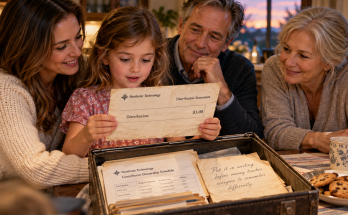
The final pages of Mom’s journal were the hardest to read.
Not because they described crimes.
Because they described choices before those choices hardened into identity.
Rebecca Hayes had once written like someone who believed she could still turn around.
She was angry.
Suspicious.
In love.
Frightened.
Sometimes cruel.
Sometimes surprisingly generous.
She did not yet sound like the woman who invented mortgage emergencies and forged my signature.
That woman emerged gradually.
Which was worse.
Monsters would have been easier.
People became what they practiced.
Mom practiced secrecy.
Leverage.
Justified deception.
Every repetition made the next one easier.
The journal resumed after Michael’s departure in 1998.
Mom wrote that everything had become impossible.
She was carrying Michael’s child.
Planning to marry Arthur.
Anna had vanished into Grant’s control.
Lily had been placed with strangers.
Grant wanted his stolen documents back.
Henry wanted his affair hidden.
Evelyn knew enough to ruin everyone.
And Mom still wanted proof about Samuel.
One line appeared three times over several pages.
I just need enough truth to make them stop lying.
The tragedy was that she pursued truth by lying more.
Then came an entry about Evelyn.
She knows about Dad.
Not Arthur.
Samuel.
Grandma had finally shown Mom records proving Henry manipulated Samuel’s loan.
Rebecca demanded they expose him publicly.
Evelyn refused immediate action.
Mom wrote:
She says proof must survive anger.
I hated the sentence because it sounded exactly like Grandma.
Mom hated it too.
Her next line:
People with power always ask wounded people to be patient.
That was also true.
This story had never been difficult because only one side ever made sense.
Evelyn wanted durable proof.
Rebecca had already waited years.
One woman feared reckless exposure.
The other feared delay would become burial.
Both fears were reasonable.
What followed was not.
Mom decided she would create her own leverage.
She began moving copies of documents.
Taking money from Henry.
Feeding selective information to Grant.
Recording conversations.
Working with Carol when useful.
Threatening when necessary.
Evelyn discovered part of it.
Their relationship changed permanently.
Then the journal reached September 1998.
Daniel had been born.
Lily had disappeared.
Anna was under Grant’s control.
Michael was gone.
Mom wrote:
I solved nothing.
Then:
I moved every piece and somehow made the board worse.
I read that twice.
Mom knew.
Even then.
She understood she was escalating.
But knowledge did not produce stopping.
The next entries shifted to Arthur.
Dad.
He was grieving what he believed was a miscarriage.
Mom could not tell him the pregnancy had resulted in Daniel.
She could not tell him Michael was the father.
She could not tell him Lily existed.
Could not tell him Henry fathered Lily.
Could not tell him Samuel’s documents existed.
Could not tell him Henry’s role in Samuel’s crash.
Every secret protected another.
And each one became an argument for continuing all the others.
Dad sat beside me as we read.
At one point he whispered, “She could have told me.”
Michael answered from across the table.
“Yes.”
Dad looked at him.
“Would I have left?”
“Yes.”
The honesty hurt.
Dad nodded.
“I think so too.”
Mom probably knew.
That was why she continued.
Not because truth would kill Dad.
Because truth would cost her the life she wanted.
A choice.
Again.
The journal moved into early 1999.
Henry began paying Rebecca.
First voluntarily.
Then under pressure.
Money for silence.
Money for Lily.
Money connected to Samuel.
Money connected to Michael.
The categories blurred.
Mom wrote:
He thinks every check buys forgiveness.
Then later:
I deposit them anyway.
That line stayed with me.
She despised what the money represented.
She took it.
Contradiction became habit.
Then came Evelyn’s confrontation.
Grandma discovered the payments.
Rebecca wrote six pages about their argument.
Evelyn called the money poison.
Rebecca called Evelyn a hypocrite.
Evelyn had protected Henry.
Protected the family name.
Protected Michael through exile.
Protected Lily through secrecy.
Rebecca accused her of using morality only after everyone else had already paid.
Then Evelyn said something Rebecca remembered word for word:
You are right about what I failed to do. That does not make what you are doing right.
Dad stared at the page.
“That sounds like her.”
Michael smiled faintly.
“Yes.”
Rebecca wrote:
I hated her because I knew she was right.
The journal stopped for several months.
Then resumed with an unexpected entry.
Rebecca was pregnant again.
This time with Dad’s child.
Me.
The handwriting changed.
Softer.
More uncertain.
The entry described fear.
Not joy first.
Fear.
What if another child became leverage?
What if Henry tried to use the pregnancy?
What if Grant found another route into the family?
What if Evelyn took control?
Mom wrote:
I do not want this baby born owing anyone.
My throat tightened.
She had wanted freedom for me once.
Before turning me into a financial instrument years later.
People can betray their own principles more completely than someone else ever could.
The next entry described an argument with Evelyn.
Grandma wanted to restructure the trust.
Rebecca objected.
Not because she wanted the money.
Because she did not want Evelyn designing another child’s life.
That surprised me.
Mom wrote:
She cannot keep building cages and calling them lifeboats.
I looked away.
That was an accurate criticism of Grandma.
Then Evelyn apparently asked Mom a question.
If this child grows up and wants nothing to do with any of us, will you let her leave?
Mom’s answer in the journal:
Of course.
I stared at that word.
Of course.
Years later, on Christmas Eve, she built a legal trap specifically to prevent me from leaving freely.
Dad saw it too.
His eyes filled.
“She meant it when she wrote it.”
“I know.”
That was what hurt.
Michael leaned back.
“People mean promises when they make them.”
Sebastian looked toward him.
“Then why break them?”
Michael shrugged.
“Because later they want something else more.”
Simple.
True.
The journal continued.
Evelyn decided I would eventually receive a protected trust interest.
Rebecca fought her.
She worried money would distort me.
Grandma apparently answered that dependency was the greater danger.
Mom wrote:
She thinks I will use the child.
I told her she was disgusting.
The next line:
I am terrified she sees something in me I don’t.
Silence filled the room.
Mom had seen the future coming.
Not clearly.
But enough.
The final entries became less frequent after I was born.
One described Dad holding me in the hospital.
Mom wrote that he cried.
Dad covered his face when he read it.
Another described Sebastian meeting me.
He apparently stared into the bassinet and asked whether I could play yet.
Sebastian laughed softly.
“That sounds like me.”
Then the tone darkened.
Money problems returned.
Henry died.
Grant applied pressure.
Carol demanded documents.
Evelyn restricted access.
Mom wrote that everyone assumed she could manage.
So she did.
Until managing became manipulation.
The final entry was dated shortly before Grandma formalized the trust changes.
Mom had met Evelyn at Lake Geneva.
They argued again.
Then apparently stopped.
The entry was different from all the others.
No anger.
No accusation.
Just exhaustion.
Rebecca wrote:
Evelyn says Chloe watches everything.
I was barely old enough to walk.
She says Chloe notices who is upset before anyone notices her.
I don’t like hearing that.
Then:
She says if we are not careful, we will teach her that love means anticipating everyone else’s needs.
My throat tightened.
Grandma had understood the pattern before I had language for it.
Mom continued:
I told Evelyn I will never do that to my daughter.
Then one final paragraph.
If I ever become the kind of person who needs Chloe to sacrifice herself to keep this family standing, Evelyn says I must let Chloe choose herself instead.
I stopped reading.
Dad stared.
Sebastian looked down.
Michael closed his eyes.
The journal ended with one sentence.
I promised her I would.
Nothing after.
No later confession.
No correction.
Just the promise.
Twenty-five years later, Christmas Eve tested it.
Mom failed.
She needed me to beg to stay.
Needed my payments.
Needed my dependency.
Needed my trust.
And I walked out.
Maybe that was why her reaction had been so extreme.
Some part of her remembered exactly what Grandma had warned.
Some part of her knew that the moment I chose myself, I was doing what she once promised she would allow.
Dad reached toward my hand.
Then stopped before touching it.
I noticed.
He was asking without words.
I turned my palm upward.
He took it.
That small hesitation meant more than speeches.
My phone rang.
Mom’s attorney.
She wanted to know whether I had finished reading.
I said yes.
A few minutes later, Mom called through the approved facility line.
I answered.
Neither of us spoke first.
Finally she whispered, “You found the last page.”
“Yes.”
Silence.
“I remembered writing it.”
“When?”
“Christmas Eve.”
I stared at the table.
“When I packed?”
“Yes.”
“Before or after you asked about the payment?”
“After.”
Her voice cracked.
“When you opened the door.”
Snow outside.
Suitcase.
Blue folder.
My hand on the knob.
Mom behind me.
You’ll still make the payment, right?
“What did you remember?”
“Evelyn asking me whether I would let you choose yourself.”
I closed my eyes.
“And?”
“I realized I had become exactly what she warned me about.”
“Did that stop you?”
“No.”
Honest.
Again.
“Why?”
“Because I was afraid.”
“Of losing money?”
“No.”
“Then what?”
Mom breathed shakily.
“Of finding out you didn’t need me.”
That sentence finally reached the center.
Not trust clauses.
Not millions.
Not revenge.
Mom had built dependence in part because usefulness ran both directions.
If I needed her, she remained important.
If she needed me, I remained close.
Money became the rope.
“I did need you,” I said.
She began crying.
“Just not like that.”
“I know.”
“You could have been my mother without controlling my life.”
“I know.”
“You could have asked for help.”
“I know.”
“You could have told me you were scared.”
“I know.”
Nothing more complicated remained.
No legal structure could improve the answer.
I looked around the table.
Dad.
Sebastian.
Michael.
The people who had finally begun telling the truth without demanding that truth produce immediate forgiveness.
“What happens now?” Mom asked.
“Investigators investigate.”
“And you?”
“I don’t know yet.”
“Will you ever speak to me again?”
I thought carefully.
“I’m speaking to you now.”
She laughed through tears.
“That isn’t what I mean.”
“I know.”
I refused to promise.
That mattered too.
Before we ended the call, Mom said one final thing.
“Evelyn chose you because she thought you would leave.”
I looked at the journal.
“No.”
“What?”
“She chose me because she wanted me to know I could.”
The difference was everything.
Leaving was not the goal.
Choice was.
That afternoon, Agent Chen contacted me with the next stage of the investigation.
The recovered journals and ledgers had provided enough evidence to begin formal asset tracing across the old HMIC network.
Grant.
Carol.
Northstar.
Meridian.
Whitmore entities.
Henry’s estate structures.
Rebecca’s accounts.
Mercer-linked investments.
Dozens of transactions would be reviewed.
Years of work, potentially.
There would be no dramatic single day when every number became clean.
No instant restoration.
No neat villain losing everything while innocent people walked away untouched.
Real repair would be slower.
Messier.
More careful.
That felt appropriate.
Then Chen gave me one piece of immediate news.
“What?”
“The court approved provisional protection of the recovery pool.”
“Meaning?”
“No beneficiary can liquidate, transfer, or disclaim interests without independent review.”
Relief moved through me.
“So Mom can’t take control if I step away.”
“Correct.”
“Carol?”
“No.”
“Sebastian?”
“No unilateral control.”
“Me?”
“Same restriction.”
I smiled.
Good.
Power should have obstacles.
Especially mine.
Then Chen added:
“The court wants a temporary beneficiary representative.”
I almost laughed.
“No.”
“You haven’t heard the proposal.”
“I don’t want to control it.”
“That is one reason they are considering you.”
“I’m serious.”
“So are they.”
I thought of Grandma.
The original HMIC clause.
An outside beneficiary who could protect assets when managers became conflicted.
The mechanism she designed decades ago had returned to me.
But this time there would be lawyers.
Auditors.
Court oversight.
Victim representation.
No hidden compartments.
No unilateral family decisions.
“What would I actually do?”
“Approve preservation decisions. No distributions without court review.”
“For how long?”
“Until an independent fiduciary structure is appointed.”
“Can I refuse?”
“Yes.”
That was the first question I needed answered.
Choice.
Always choice.
“I’ll consider it.”
Chen nodded.
“That’s all anyone is asking.”
After the call, Dad asked what I would do.
“I don’t know.”
Sebastian looked surprised.
“You always know.”
“No.”
I smiled.
“I usually just decide quickly because everyone else is panicking.”
He laughed.
“Fair.”
Michael lifted his coffee.
“To not deciding today.”
Dad raised his cup.
Sebastian did too.
I joined them.
For the first time, uncertainty did not feel dangerous.
It felt like space.
Then Daniel called.
His voice was tense.
“What happened?”
“We finished a preliminary review of the current ownership map.”
“And?”
“One entity doesn’t fit.”
“What kind?”
“Not restitution. Not Northstar. Not old HMIC.”
“Then what?”
“A private holding company created after Evelyn died.”
“Owner?”
“Initially Rebecca.”
My stomach tightened.
“Current?”
“That’s the problem.”
“Who owns it?”
Daniel paused.
“Legally, you do.”
I closed my eyes.
“Of course.”
“But Chloe?”
“What?”
“It doesn’t hold money.”
“What does it hold?”
A pause.
“Land.”
“How much?”
“About six hundred acres.”
“Where?”
Daniel answered.
“Lake Geneva.”
I stared.
“The house?”
“Much more than the house.”
“What land?”
“The entire development corridor Mercer has been trying to assemble.”
That made no sense.
The disputed cottage was only one parcel.
Daniel continued.
“Someone quietly accumulated surrounding properties for years through shell companies.”
“Who?”
“Rebecca.”
“Why?”
“I don’t know.”
“Then why put them in my name?”
“She didn’t.”
I went still.
“Who did?”
Daniel’s answer reopened one final branch of the mystery.
“Evelyn.”
Click here to continue reading: PART 33: Evelyn’s Hidden Lake Geneva Land Trust Revealed She Had Been Quietly Buying Back The Corridor Grant’s Network Took From Families Decades Earlier
Christmas Dinner Was Almost Over When My Parents Told Me To Leave, Then Mom Asked The Question Dad Was Never Supposed To Hear
Part 32 of 40