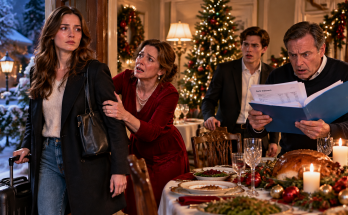
Peter Vale’s arrest did not end the paperwork.
It multiplied it.
For months, our dining table had been a place where evidence arrived faster than meals. After Vale, federal investigators finally moved the remaining boxes somewhere else.
The first morning without them, I stood in the doorway and stared at the empty wood.
Michael came up behind me.
“You look disappointed.”
“I’m suspicious.”
“Of the table?”
“Of empty surfaces.”
He laughed.
“Trauma response.”
“Don’t diagnose me.”
“Right.”
He poured coffee.
The basement chamber had changed too.
The false wall remained open. Michael removed the electronic lock, hidden wiring, and steel bolts.
Inside, we installed shelves.
Normal shelves.
Lily put paint samples on the floor.
“What are we doing with it?”
“I don’t know.”
“Wine cellar?”
“No.”
“Emergency bunker?”
“Definitely no.”
Jake appeared behind her.
“Laundry.”
Michael looked offended.
“After everything that room has witnessed?”
“Exactly. Humble it.”
I laughed.
Laundry won.
There was something satisfying about replacing classified records with detergent.
Vale’s identity archive remained in federal custody. Ruiz had been assigned to the interagency team processing it, though she complained that “interagency” usually meant twelve people arguing over one password.
She came over one evening carrying a sealed envelope.
I looked at it.
“No.”
“You don’t know what it is.”
“That shape has never brought me happiness.”
She smiled.
“This one is different.”
She placed it on the table.
The label read:
SUSAN MILLER — PERSONAL ACCESS AUTHORIZATION.
“What does that mean?”
“Vale kept a file on you.”
“I know.”
“We finished validating the portions relevant to criminal cases.”
“And?”
“The remaining material is personal.”
I stared at the envelope.
“You brought it here?”
“I brought the authorization.”
Not the file.
Good.
“If you sign, you can see everything.”
Michael remained silent.
Another good sign.
“What’s in it?”
Ruiz shook her head.
“I deliberately didn’t read beyond what the investigation required.”
“Why?”
“Because of the rule.”
Our rule.
Need, consent, choice.
I sat.
“What categories?”
“Medical records. childhood surveillance. psychological observations. correspondence about you. photographs.”
“From when?”
“Birth through three months ago.”
My stomach tightened.
A lifetime.
Someone had watched me almost continuously.
Vale knew things I did not.
The old version of me would have signed immediately.
Truth had become addictive.
Every hidden fact felt dangerous simply because someone had hidden it.
But I had learned something.
Information could also be invasive when accurate.
I asked, “Is there anything in there that affects my current health?”
“No.”
“My children’s health?”
“No.”
“Anyone’s legal identity?”
“Not that hasn’t already been disclosed.”
“Criminal evidence?”
“Separated.”
“Immediate safety?”
“No.”
I pushed the authorization back.
“I don’t want it.”
Michael looked surprised.
Ruiz did not.
“You’re sure?”
“No.”
She smiled.
“That’s allowed.”
“I mean I’m not sure, and I still don’t want it.”
“Also allowed.”
I looked at the envelope.
“What happens?”
“Sealed under court order unless you request access later.”
“Then seal it.”
Ruiz picked it up.
Something inside me loosened.
I did not need to know what Vale thought about me at seventeen.
I did not need photographs proving which strangers followed me through grocery stores.
I did not need transcripts of private conversations stolen by people who believed observation created ownership.
Some truths belonged to the people who lived them.
Others belonged in evidence lockers.
When Ruiz left, Michael asked, “Do you want to know what I would have done?”
“No.”
He laughed.
“Good.”
Then he became serious.
“I would have opened mine.”
“You have one?”
“Yes.”
“Are you going to?”
“I think so.”
I nodded.
No judgment.
His history had been physically erased by memory loss.
For him, the archive might return pieces no one else could.
Different person.
Different need.
Two days later, he asked me to come with him.
We sat in a federal records room.
Ruiz remained outside.
Michael opened his file.
The first photograph showed him at six.
David Mercer.
Short hair.
Missing tooth.
Standing beside Anne Mercer.
His mother.
Michael touched her face through the plastic sleeve.
“I remember that dress.”
I waited.
Another photograph.
Samuel watching from across a schoolyard.
Another.
Richard beside David at a formal dinner, one hand on the boy’s shoulder.
Michael stared.
“I remember being afraid of him.”
“Richard?”
“Yes.”
“Why?”
“He corrected everything.”
“What do you mean?”
“How I sat. How I held a fork. How loudly I laughed.”
He turned the page.
There were school reports.
Military records.
Notes written by Vale.
SUBJECT RESPONDS POORLY TO PATERNAL AUTHORITY.
Michael laughed.
“At least he noticed.”
Another page contained a report about the accident.
Richard had ordered a mechanic to damage the steering linkage.
Not enough to cause a crash, according to his later claim.
Enough to frighten David.
The mechanic had overdone it.
The vehicle rolled.
The real Michael Miller died.
David Mercer suffered head trauma.
Michael stopped reading.
“You don’t have to continue.”
“Yes.”
“Today?”
He thought.
“No.”
He closed the file.
That was progress too.
Truth did not expire because we waited until tomorrow.
Outside, Ruiz handed him another document.
“What’s this?”
“Corrected death certificate.”
For the soldier.
Michael Robert Miller.
The man whose name my husband had carried.
His grave marker had finally been replaced.
David Alan Mercer’s death record had been vacated.
Legally, the man beside me now existed as Michael Samuel Miller.
I stared.
“Samuel?”
Michael looked embarrassed.
“You added it.”
“Yes.”
“Why?”
“Not because he was my father.”
“Then?”
“Because he admitted he failed me.”
I understood.
Richard had insisted he was right.
Samuel had left behind an apology.
That difference mattered.
“You kept Miller.”
“Yes.”
“For the soldier?”
“Partly.”
He looked at me.
“Mostly because it became mine.”
I took his hand.
Not romantic.
Not yet.
But deliberate.
That weekend, we attended the rededication of the soldier’s grave.
Carol stood beside us.
The new marker read:
MICHAEL ROBERT MILLER.
Correct dates.
Correct service.
Correct identity.
Michael placed flowers beneath it.
Then stepped back.
Carol touched his arm.
“You don’t owe him your name.”
“I know.”
“Good.”
“I’m keeping it anyway.”
She smiled.
“I think Uncle Mike would have enjoyed that.”
On the drive home, we passed my childhood house.
Margaret’s car was outside.
Mom had been discharged from rehabilitation into a small accessible apartment nearby, but she and Margaret had started meeting at the house occasionally.
I had not asked what they discussed.
That was theirs.
Michael glanced at me.
“Want to stop?”
I almost said yes.
Then saw Margaret and Mom through the front window.
Two women sitting opposite each other.
Talking.
No mediator.
No audience.
“No.”
Michael kept driving.
Some reunions did not need witnesses.
At home, Jake had news.
He had been accepted into graduate school.
Different state.
He looked terrified when he told us.
Michael immediately said, “That’s great.”
I immediately said, “How far?”
Jake laughed.
“There we are.”
I glared.
“What?”
“Dad responds like a normal parent. You ask geography.”
“I’m allowed geography.”
“Three hours.”
“Driving?”
“Flying.”
“Jake.”
He laughed harder.
“I’m kidding.”
It was four hours by car.
I could survive.
Probably.
“When?”
“August.”
Lily came downstairs.
“What’s August?”
“Jake is abandoning us.”
“I’m going to graduate school.”
She screamed.
Actually screamed.
Then hugged him.
I watched.
Once, the possibility of losing a child had been used to control me.
Now my son was choosing to leave for something good.
The fear felt similar in my body.
But this time I did not turn fear into a cage.
“You should go,” I said.
Jake looked at me.
“Really?”
“Yes.”
“You look like you’re going to throw up.”
“Both can be true.”
He smiled.
That phrase had become useful.
Lily had news too.
She had applied to nursing school.
I stared.
“After everything involving hospitals?”
“Exactly.”
“Why?”
“Because I know what happens when patients don’t have anyone in the room asking questions.”
Michael smiled.
“That sounds like you.”
She looked at him.
“Biologically confirmed.”
The joke survived.
Good.
Weeks passed.
Then months.
The criminal cases moved slowly.
Richard remained alive.
Awaiting trial.
Evan entered a plea on several charges while contesting others.
Daniel’s sentencing was delayed because his cooperation continued.
Margaret was not charged in Samuel’s death. Prosecutors concluded there was insufficient evidence that she had participated in Thomas’s killing rather than failed to prevent it.
Ruiz did not celebrate.
Neither did Margaret.
Some outcomes were legally clear and emotionally unfinished.
Vale began negotiating too.
His archive helped identify twenty-three living people whose identities had been altered as infants or children.
Twenty-three.
I could barely comprehend it.
Ruiz told me once.
I asked her not to update me unless something affected our family or someone requested my participation.
She respected that.
The story was becoming larger than me.
That was healthy.
One evening, Mom called.
“I want to ask you something.”
“What?”
“Do you want your childhood house?”
I laughed.
“No.”
She sounded surprised.
“It’s legally mine.”
“I know.”
“I thought you might.”
“No.”
“Why?”
“Because I had my childhood there.”
Silence.
“I don’t need to own the building to prove it happened.”
Mom began crying.
“Mom?”
“I’m fine.”
“You’re crying.”
“I’m old. We leak.”
I laughed.
“What will you do with it?”
“I asked Margaret.”
“And?”
“She said no too.”
Of course.
“So?”
Mom paused.
“We thought of donating it.”
“To whom?”
“A family transition program.”
I smiled.
Children leaving foster care.
Parents rebuilding after displacement.
People who needed a house to become a beginning instead of evidence.
“Yes.”
“You approve?”
“You don’t need my approval.”
“I know.”
Another lesson learned.
“But?”
“I like it.”
Mom exhaled.
“Good.”
The transfer happened quietly.
No plaque naming us.
No Miller wing.
No legacy branding.
Just a house becoming useful.
The red and blue blankets stayed with Margaret and me.
Not in a museum.
Not evidence.
Ours.
On the evening the deed transferred, Margaret came to my house.
Alone.
She carried the red blanket in a paper bag.
“I’m not giving it to you.”
“Good.”
“I brought it because I wanted to ask something.”
“What?”
She looked uncomfortable.
“Do you want to have dinner?”
I smiled.
“We’ve had coffee.”
“Dinner is more serious.”
“Apparently.”
“As sisters.”
There it was.
No dramatic embrace.
No music.
One word.
Chosen.
Not imposed.
I opened the door wider.
“Yes.”
Margaret entered.
And for the first time since discovering I had a twin, neither of us needed proof.
Click here to continue reading: PART 34: Richard Mercer Offered Michael One Last Inheritance Before Trial, but Our Children Had Already Decided What His Empire Would Become
For Eighteen Years My Husband Slept Behind Another Door, Until One Ordinary Morning Made His Silence Impossible to Ignore
Part 33 of 35