Christmas Eve arrived quietly.
That surprised me.
For months, the date had carried the weight of Project Christmas.
Medication changes.
Conservatorship plans.
Trust consolidation.
Family reunification.
A dinner table designed to convert relatives into signatures.
I expected my body to remember before I did.
Instead, I woke to snow.
Thin.
Soft.
Enough to whiten the garden without closing roads.
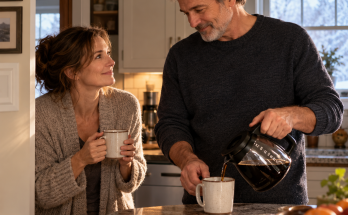
My new house smelled like coffee and cinnamon because Caleb had convinced me to let him make toast and had used enough cinnamon for six families.
Owen was on the floor assembling a model airplane.
Clare came downstairs wearing pajamas at eleven in the morning and announced college students would apparently require “serious hibernation.”
“You’re not a college student yet.”
“Practicing.”
She had deferred nothing.
Not school.
Not departure.
She would leave in January for an early-start program after deciding waiting until fall felt like letting the previous year keep one more season.
I understood.
Jessica sent gifts for the boys through her attorney.
We opened the box first to make sure nothing inappropriate was inside.
No hidden cameras.
No legal forms.
No tracking devices.
That sentence would once have sounded insane.
Now it was simply careful.
The gifts were ordinary.
Books.
Sweaters.
A soccer ball.
A handwritten card for each boy.
They chose to read them privately.
Clare’s envelope remained unopened.
Jessica had respected the court order and stopped sending additional letters after Clare asked through counsel.
That counted as something.
Not absolution.
Respecting a no after years of ignoring them is still better than ignoring it again.
Michael sent nothing.
His choice.
Or perhaps his understanding.
He had written me three letters from prison.
I read them.
They contained no requests for forgiveness.
No complaints about sentence length.
Mostly descriptions of the prison library, work assignments and a restorative-justice course he initially mocked and later admitted was harder than expected.
In the second letter he wrote:
I keep wanting to tell you what Dad did before saying what I did.
I’m practicing reversing the order.
Then he listed his own conduct first.
That was progress.
I did not call it transformation.
Too early.
People are not repaired by one insight.
Neither are families.
I wrote back once.
Three pages.
Mostly about the boys.
Some about Open Door.
One sentence about myself.
I bought a car.
Michael replied:
Good.
No advice.
No opinion.
I noticed.
Christmas dinner was at my house.
Not Open Door.
No symbolic return to Maple Street.
I did not need to reclaim that dining room.
We had already transformed its purpose.
My table was new.
Oak.
Six chairs.
I bought it because I liked the grain.
That was the entire story of the table.
No hidden compartments.
No trust papers.
No history.
Rose attended by video from Maine.
She refused travel.
“Christmas airports are punishment for crimes I didn’t commit.”
Margaret came in person.
She brought a pie nobody was allowed to criticize.
Miriam joined through another screen from California.
The technology confused her for ten minutes.
Then she spent twenty complaining that everyone looked too small.
Ruth came late.
I had invited her.
That decision took months.
Not because I decided everything was forgiven.
Because I wanted to know whether a relationship could exist after trust changed shape.
She arrived carrying flowers.
No wine.
No casserole.
No dramatic peace offering.
Just flowers.
“Where do you want them?”
The question mattered.
Not where should I put them.
Where do you want them.
I pointed toward the kitchen.
“Vase under the sink.”
She found it herself.
We were not what we had been.
Maybe we never would be.
But we were something honest enough to stand in the same kitchen.
Elena stopped by before dinner with her wife.
Daniel did not.
We remained civil through legal proceedings.
He testified fully.
His professional conduct was reviewed.
He received sanctions for failures connected to disclosure and conflict management, though investigators found no proof he knowingly joined the criminal enterprise.
He wrote me an apology.
I accepted the letter.
Not his representation.
Some relationships survive in altered form.
Others end.
Both can be right.
At four, Open Door called.
An emergency resident had arrived unexpectedly.
A seventy-six-year-old man named Harold whose daughter had obtained an emergency financial order after he fell twice.
He did not deny the falls.
He denied needing to lose control of everything because of them.
The staff had space.
A volunteer attorney was available.
No crisis required me personally.
That was another achievement.
Open Door did not depend on Eleanor Bennett answering every call.
I almost went anyway.
Clare caught me putting on shoes.
“Where are you going?”
“Open Door.”
“Why?”
“They got an intake.”
“Are you scheduled?”
“No.”
“Did they ask you?”
“No.”
She crossed her arms.
“Interesting.”
I laughed.
“You’ve become unbearable.”
“Excellent.”
I took off my shoes.
Learning not to make yourself indispensable is harder than it looks.
Especially after a lifetime of measuring love through usefulness.
Dinner began at six.
Roast chicken.
Potatoes.
Green beans.
I realized only afterward that I had recreated the meal from Sunday night.
Not consciously.
Maybe bodies write menus too.
Owen noticed first.
“This is what we had when Grandma left Dad’s house.”
The room became quiet.
Children are excellent at dropping truth into places adults decorate carefully.
“Yes,” I said.
Caleb looked worried.
“Are you leaving again?”
“No.”
Then I corrected myself.
“Not tonight.”
He frowned.
“Why say it like that?”
“Because people are allowed to leave places.”
He thought.
“Even family?”
“Yes.”
“If they’re mad?”
“Yes.”
“If they still love you?”
“Yes.”
He looked relieved rather than frightened.
Good.
That was what I wanted him to learn.
Leaving is not always abandonment.
Staying is not always love.
Clare raised her water glass.
“To doors.”
Margaret lifted hers.
“To unlocked ones.”
Rose’s voice came through the tablet.
“To good lawyers.”
Miriam shouted, “I heard that.”
We laughed.
Ruth looked at me.
I lifted my glass.
“To being asked.”
That became the toast.
Being asked.
Not assumed.
Not volunteered by someone else.
Not assigned.
Not signed for.
Asked.
After dinner, the boys went upstairs.
Margaret fell asleep in the living-room chair.
Rose disconnected after complaining we kept her awake too late.
Miriam somehow disconnected herself while trying to turn down the volume.
Ruth and I washed dishes.
For a while, only water and plates.
Then she said, “I almost didn’t come.”
“Why?”
“I was afraid you invited me because you thought you had to.”
“I don’t think that anymore.”
She smiled slightly.
“No.”
“I invited you because I wanted you here.”
Her eyes filled.
I pointed a wet finger at her.
“Don’t make it a ceremony.”
She laughed.
“Fine.”
Then she handed me a plate.
“Are we okay?”
“No.”
Her smile vanished.
I continued.
“We’re real.”
She thought about that.
“I’ll take real.”
“So will I.”
Later, Clare and I sat on the porch.
Cold enough that we wore blankets.
Snow moved under the streetlight.
She would leave in two weeks.
The thought hurt.
I let it.
Pain is not always warning.
Sometimes it is simply the cost of not holding too tightly.
“Do you think Mom would like Open Door?” she asked.
“Yes.”
“You always answer that fast.”
“Because I knew her.”
“She’d probably complain about the name.”
“Yes.”
Clare laughed.
Then became quiet.
“I think I’m going to read Jessica’s letters before I leave.”
“Okay.”
“You don’t think I should wait?”
“Your choice.”
“You’re really committed to that answer.”
“I’ve had practice.”
She leaned her head against my shoulder.
“Do you hate Dad?”
“No.”
“Grandpa?”
I looked at the snow.
“No.”
“Ward?”
That one took longer.
“I don’t know.”
She nodded.
“Is it bad if I hate them?”
“No.”
“Is it bad if I stop?”
“No.”
She was quiet again.
“What do you feel about Grandpa now?”
I had asked myself that often.
“Grief.”
“For him?”
“For many things.”
The husband I thought I had.
The man he actually was.
The choices he made.
The choices he almost made differently.
The possibility that he might have changed sooner and did not.
The life we shared that was neither wholly false nor safely true.
“I don’t forgive everything,” I said.
“I know.”
“I don’t need to decide one final feeling.”
Clare nodded.
“That sounds healthy.”
“You’re sixteen.”
“Almost seventeen.”
“Still irritating.”
She smiled.
Then asked, “Do you wish you never moved in with Dad?”
I expected an easy yes.
It did not come.
“If I hadn’t, maybe none of this would have come out.”
“So no?”
“That isn’t what I mean.”
I looked at her.
“I wish he hadn’t done what made leaving necessary.”
That was the cleanest truth.
I did not need gratitude for betrayal because it eventually exposed worse betrayal.
Pain does not become good simply because something useful follows.
I could value what we built afterward without blessing what caused it.
We went inside when the cold became too much.
At eleven thirty, the boys woke and demanded an early present.
I allowed one each.
Caleb opened socks and declared Christmas ruined.
Owen opened a model-airplane tool kit and immediately forgave the holiday.
Clare handed me a small box.
“I said no expensive gifts.”
“It’s not.”
Inside was a brass key.
Not old.
New.
“What’s this?”
“Open Door.”
I already had keys.
She shook her head.
“Different one.”
She led me to the car.
We drove the short distance to Maple Street.
The house glowed softly.
No residents had been scheduled overnight because holiday staffing was reduced, but the emergency room remained available.
Clare unlocked the front door.
Then led me to the dining room.
The hidden archive room had changed again.
Shelves removed.
Walls painted.
A round table.
Two chairs.
A telephone.
A small lamp.
On the wall hung framed copies of three documents.
Not originals.
Laura’s sentence:
Truth is not betrayal.
Rose’s guardianship reversal order.
And my own letter from 1974.
The one Henry never mailed.
I stared at it.
“Why is that here?”
“Board approved it.”
“You were on the board meeting?”
“Margaret cheats.”
Probably true.
Beneath the documents was a plaque.
THE LISTENING ROOM.
For anyone who needs to tell the story before they know what to do next.
My eyes filled.
No attorney required.
No police report required.
No diagnosis.
No decision.
A person could simply speak.
That was what I had needed in 1974.
Not a man deciding whether my marriage could survive.
Not a doctor deciding what I remembered.
Not a friend deciding silence would protect me.
One room.
One unlocked door.
One person listening.
Clare handed me the key.
“This one doesn’t lock people in.”
I closed my hand around it.
“No.”
We stood there together.
The dining room where Michael once ate Sunday dinners.
The wall where Laura hid evidence.
The house Henry turned into a container for secrets.
Now a woman could enter through the front door, sit down, make a phone call and leave whenever she chose.
No dramatic justice could equal that.
But it was real.
At midnight, my phone vibrated.
I almost laughed.
Of course.
A message.
Prison system.
Michael had sent a scheduled Christmas note.
I opened it.
Mom,
I know I don’t belong at the table this year.
I’m learning that belonging is not something I can demand because we share a name.
Tell the boys Merry Christmas if that is appropriate.
Tell Clare nothing unless she asks.
And for you:
Thank you for leaving.
I read that line twice.
Not because I agreed with every implication.
Leaving did not save him.
He had not earned gratitude through being exposed.
Still, I understood.
If I had stayed, the system might have continued.
My silence might have become another supporting beam.
I typed a reply.
Merry Christmas, Michael.
I hope you keep doing the work.
Love,
Mom
I did not write I forgive you.
I did not write everything will be okay.
I did not write we will be a family again.
Love did not require those promises.
I sent it.
Clare watched.
“You okay?”
“Yes.”
And I was.
Not healed in the polished way people use that word when they want pain to have a final chapter.
I still woke some nights remembering Philadelphia.
I still sometimes heard Henry’s voice and missed him before remembering everything else.
I still grieved Laura.
I still felt anger at Ruth.
I still loved Michael.
None of those feelings canceled the others.
They no longer had to.
We turned off the lights at Open Door.
Outside, snow had covered our earlier footprints.
The street looked new without actually being new.
I locked the front door because empty buildings still need locks.
Then I checked that the emergency entrance remained accessible through the staff system.
Clare smiled.
“Still controlling things.”
“Safety is not the same as control.”
“I know.”
“Good.”
We walked to the car.
My car.
I drove.
At home, Owen and Caleb had fallen asleep on the sofa waiting for us.
Ruth had covered them with blankets.
Margaret was still snoring in the chair.
The Christmas tree lights blinked beside a pile of half-opened gifts.
No contracts.
No medical forms.
No hidden cameras.
No one measuring whether gratitude justified obedience.
I stood in the doorway and looked at them.
For years, I thought family meant being needed.
Then I thought it meant staying.
Then surviving everything together.
Now I understood it more simply.
Family, when it is healthy, leaves room around each person.
Room to refuse.
Room to tell the truth.
Room to change.
Room to leave.
And, when they choose, room to come back.
I set the brass key on the table beside my own car keys.
Two keys.
Neither borrowed.
Neither controlled by my son.
One opened my home.
One opened a place built for people who needed their own way out.
At 7:15 the next morning, my phone rang.
For one sharp second, my body remembered danger.
Then I looked at the screen.
Clare.
From the upstairs bedroom.
I answered.
“What?”
Her sleepy voice came through.
“Can you make pancakes?”
I smiled.
“Are you incapable of walking downstairs?”
“Yes.”
“Medical opinion?”
“Severe condition.”
“Very serious?”
“Terminal without syrup.”
I laughed.
“No.”
Silence.
Then:
“Okay.”
No guilt.
No accusation.
No reminder of everything she had done for me.
Just okay.
I lay back against the pillow.
A minute later, footsteps sounded on the stairs.
Cabinet door.
Pan.
Caleb complaining.
Owen laughing.
Life beginning without permission from the dead.
I closed my eyes for another five minutes.
Nobody needed me immediately.
Nobody owned my morning.
And when I finally got up, it was because I chose to join them.
The End
Read more original stories on Feel Every Story.
At Sunday Dinner, My Son Pointed Toward the Door and Finally Told Me What He Thought I Was Worth
Part 35 of 35