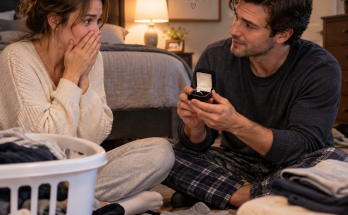
We married on a Saturday in early autumn.
Not in a ballroom.
Not beneath chandeliers.
Not in front of two hundred people who would spend the evening whispering about property.
The ceremony was held in the garden behind Rebecca’s Hudson Valley cabin.
She had eventually planted a pear tree.
Not because she liked pears.
Because Mom had become unbearable about it.
The tree was still small.
Its branches moved in the breeze behind the folding chairs.
Forty-three people came.
Mom claimed the extra three proved she had won.
I refused to acknowledge that.
David’s daughter stood with him.
Natalie stood with me.
Claire sat beside Rebecca.
Lauren came from Colorado.
Emily attended.
Melissa flew despite predicting “catastrophic seasonal weather,” then complained that the sky was suspiciously pleasant.
Dad wore a suit that made him look uncomfortable.
Mom wore dark blue and promised everyone she had no microphone.
I believed her only because Natalie had searched her handbag.
There was no wedding planner controlling every minute.
No press.
No public engagement announcement designed to make retreat expensive.
We had told people gradually.
Privately.
If plans changed, plans changed.
They did not.
Three months before the wedding, David and I completed financial disclosures.
Everything.
Income.
Retirement accounts.
Debt.
Property.
Insurance.
His obligations to his daughter.
My business.
My apartment.
The prenup was negotiated calmly.
Not romantically.
Not suspiciously.
Practically.
The apartment remained mine.
David had no claim created merely by marriage.
Future joint property would be specifically designated.
Separate debts remained separate.
Shared obligations required shared signatures.
Both attorneys reviewed.
Both of us changed clauses.
Neither interpreted a requested change as evidence of insufficient love.
When we signed, David said:
“That was profoundly unsexy.”
His lawyer answered:
“Excellent.”
I laughed so hard the receptionist looked in.
Then we went to dinner.
No emergency.
No secret lender.
No next-day correction.
The paperwork was finished weeks before the wedding.
That mattered to me.
The morning of the ceremony, I woke at Rebecca’s cabin before sunrise.
For several minutes, I forgot what day it was.
Then I saw the dress hanging beside the window.
Not my first wedding dress.
That one had gone on to someone else.
This dress was simpler.
Silk.
No lace.
No elaborate train.
I chose it because I liked it.
Not because it symbolized anything.
I stayed in bed listening to birds.
Then someone knocked.
Mom.
“Can I come in?”
I smiled.
“Yes.”
She entered carrying coffee and a flat document envelope.
My whole body reacted.
Not fear exactly.
Recognition.
Mom saw my face.
Then looked at the envelope.
“Oh.”
“What is that?”
She started laughing.
“I did not think this through.”
“Apparently not.”
She placed the coffee down.
“This is not something to sign.”
“Mom.”
“I swear.”
“What is it?”
“The apartment papers.”
I stared.
“Which apartment papers?”
“Copies.”
“Why?”
She sat on the edge of the chair.
“I found the first protective transfer packet while cleaning our safe.”
Of course she kept old copies.
“I was going to give them to you after the wedding.”
“Why today?”
“I thought it would be meaningful.”
“It is currently ominous.”
“I realize that.”
I laughed.
Then she handed me the envelope.
I opened it.
Inside were photocopies from years earlier.
The urgent pre-wedding structure.
My signature.
Her temporary role.
Mr. Kaplan’s notes.
The paperwork that changed everything.
On top, Mom had placed another page.
Not legal.
A handwritten note.
I read it.
Sophia,
The first time I gave you these papers, I was afraid there would not be enough time for you to understand why they mattered.
Today there is no urgency.
Nothing is hidden.
Nothing needs your signature.
Your home is yours.
Your marriage is your choice.
So is everything after it.
Love,
Mom
I stopped reading.
Mom looked nervous.
“That was too much, wasn’t it?”
“No.”
I started crying.
She did too.
“Great,” she said. “We’ll ruin the makeup before breakfast.”
I laughed through tears.
Then I looked at the old papers again.
Years earlier, that same envelope represented secrecy.
Fear.
Protection imposed because time felt dangerous.
Now it contained no demand.
Only history.
The apartment had long since returned fully to the permanent structure I chose.
Mom held no authority over it.
David held none through marriage.
The pages had become evidence not of control—
but of the difference between then and now.
I folded Mom’s note.
“I’m keeping this.”
“The legal copies?”
“No.”
She looked offended.
“They are historically significant.”
“They are duplicate tax clutter.”
“Sophia.”
“I’m keeping the note.”
She smiled.
“Fine.”
Then she reached for my hand.
“Nervous?”
“Yes.”
“About David?”
“No.”
“What?”
“Being wrong again.”
Mom was silent.
There it was.
The fear I had not said aloud.
I trusted David.
Loved him.
Had disclosures.
Independent lawyers.
Years of observed behavior.
Clear boundaries.
Still, certainty did not exist.
“What if I missed something?”
Mom thought carefully.
Then:
“You might.”
I looked at her.
“That’s not comforting.”
“It’s true.”
She squeezed my hand.
“Being informed doesn’t mean becoming omniscient.”
I stared.
“You can know someone well and still be surprised.”
“Then how do I trust?”
“By knowing what you’ll do if reality changes.”
My breathing slowed.
Mom continued.
“The first time, you thought trust meant committing to your decision after you made it.”
Yes.
Defend the engagement.
Defend the marriage.
Back out only if catastrophe became undeniable.
“Now?”
“Now I think trust includes being allowed to revise.”
Mom nodded.
“If David becomes someone unsafe, you leave.”
The simplicity of it steadied me.
Not:
You should have known.
Not:
Marriage means enduring.
Not:
Try harder.
“You don’t have to predict every future version of someone before loving the present one.”
I stared at my mother.
“When did you become wise?”
“I have always been wise.”
“There she is.”
She laughed.
Then Natalie knocked.
“If the Roberts women are having emotional breakthroughs without me, I’m billing overtime.”
Mom opened the door.
Natalie took one look at us.
“Oh, good. Crying already.”
“Helpful.”
She started working on my makeup repairs.
By ten, the cabin filled with people.
David did not see me before the ceremony.
Not because of superstition.
Because his daughter wanted the tradition.
I agreed.
Choice.
Even traditions felt different when chosen.
Dad came into the room fifteen minutes before we started.
He looked at me.
Then cried immediately.
“Dad.”
“I’m fine.”
“You are objectively not.”
He laughed and wiped his face.
“I wanted to say something before we go out.”
Mom groaned.
“Not a speech.”
“Margaret.”
He looked at me.
“Years ago, when your mother asked you to sign those papers, I told you if the secret changed nothing, no harm was done. If it changed something, you needed to know what.”
I remembered.
That sentence had helped me sign.
Dad continued.
“I was wrong about part of it.”
“What part?”
“Secrets always change something.”
I stayed quiet.
“Even protective ones.”
Mom looked down.
Dad touched her shoulder.
“We were lucky that one protected you more than it damaged your trust.”
Mom nodded.
“It did both.”
“Yes.”
Dad looked at me.
“So today, no secrets.”
I smiled.
“No secrets.”
Then he handed me nothing.
No heirloom.
No documents.
No symbolic key.
Just his arm.
“Ready?”
I breathed in.
“Yes.”
We walked outside.
Forty-three people stood.
David waited under an old maple tree.
No stage.
No microphone except the one used by the officiant because Melissa had complained she did not travel five hundred miles to “guess at vows.”
David saw me.
His face changed.
That expression belonged only to the moment.
I did not need to interrogate it.
Dad kissed my cheek.
Then asked quietly:
“Still yes?”
I almost laughed.
“Yes.”
He let go.
The officiant began.
We had written our own vows, but we kept them short.
I had no interest in promising impossible things.
I did not promise never to disappoint David.
He did not promise to keep me happy every day.
We promised honesty about material things.
We promised to ask rather than assume.
We promised to treat no as information, not betrayal.
We promised to make major financial decisions together and to keep each other informed enough to choose freely.
Not romantic vows according to Mom.
She cried through all of them.
Then David added one line that was not in the draft we practiced.
“I promise that loving you will never mean deciding for you.”
My throat tightened.
He looked nervous.
Not because the line was secret.
Because he knew what it meant.
I answered:
“And I promise that loving you will never require either of us to disappear.”
His eyes filled.
The officiant asked the familiar question.
Did I take David as my husband?
Years ago, I answered yes without knowing what the marriage actually contained.
This time I knew the finances.
The obligations.
The past marriages—his one, mine one annulled.
The family responsibilities.
The living arrangement.
The property structure.
The messy habits.
The terrible coffee beans.
The annoying way he left architectural samples on the dining table.
I knew enough.
Not everything.
Enough to choose.
“I do.”
David answered the same.
We exchanged rings.
Nobody interrupted.
No mother-in-law stood.
No apartment announcement.
No police.
When the officiant pronounced us married, applause rose from the garden.
I kissed David.
And then, because life apparently appreciates symmetry, Mom dropped her purse.
Everything spilled.
Lipstick.
Tissues.
Reading glasses.
A pen.
And a tiny microphone-shaped novelty keychain Natalie had given her as a joke.
The entire front row saw it.
Claire screamed with laughter.
Rebecca doubled over.
I stared at Mom.
“You promised.”
“It is not functional!”
David whispered:
“Wedding canceled.”
I laughed into his shoulder.
The tension dissolved completely.
Lunch followed beneath a white tent.
No assigned seats beyond immediate family.
Rebecca sat beside Mom.
Claire beside Eleanor.
Yes, Eleanor came.
I had thought about it for weeks.
Claire asked.
Not Eleanor.
I said yes.
Not because I wanted reconciliation.
Because I no longer needed exclusion to feel safe.
There were conditions.
No speech.
No discussion of the old wedding unless I initiated it.
No gifts involving property.
Claire delivered them.
Eleanor accepted.
She arrived quietly.
Wore gray.
Sat where assigned.
When our eyes met after the ceremony, she nodded.
I nodded back.
That was enough.
Jason did not attend.
Of course.
He had learned about the engagement through Claire months earlier.
He sent no message.
No gift.
No letter.
I appreciated that more than almost anything he could have said.
Claire told me only once that he knew the wedding date.
Then she never mentioned it again.
The boundary held.
During lunch, Eleanor approached me while David was speaking with his daughter.
She stopped at the edge of the table.
“May I say something?”
I looked at her.
“One thing.”
She almost smiled at the familiar limit.
“You look happy.”
“I am.”
“I’m glad.”
“Thank you.”
She started to leave.
Then I said:
“Eleanor.”
She turned.
“How is your apartment?”
She looked surprised.
“Small.”
“Still baking?”
“Badly.”
I smiled.
“Good.”
That was all.
I did not need her suffering.
I did not need her redemption.
I simply preferred a world where she learned to live inside the size of her own life.
No annexing someone else’s.
Later, Rebecca pulled me aside.
“Come look.”
She pointed toward the pear tree.
One tiny pear hung from a branch.
I stared.
“You hate pears.”
“I know.”
“Mom did this.”
“She claims nature did.”
Mom called from across the lawn:
“I heard that.”
We laughed.
Rebecca looked toward the house.
“I never thought I’d own another place.”
“You didn’t have to.”
“I know.”
“That’s why it works.”
She nodded.
Choice again.
Everything came back to it.
Near sunset, Mom finally gave a toast.
Voluntarily approved.
Microphone supervised by Natalie.
She stood beside Dad.
“I have been given ninety seconds.”
“Eighty now,” I said.
People laughed.
Mom looked at me.
“The last time I spoke at one of Sophia’s weddings, things became complicated.”
More laughter.
Even Eleanor smiled faintly.
Mom continued.
“So I will keep this simple.”
She looked at David.
“Thank you for never asking Sophia to prove trust by giving up choices.”
Then at me.
“And thank you for teaching me that protecting someone does not mean owning the decision.”
My throat tightened.
Dad touched her back.
Mom lifted her glass.
“To a marriage with doors that open both ways.”
I smiled.
That was exactly right.
Not no doors.
Not no shared rooms.
Doors.
Access that could be given.
Privacy that could remain.
Exits that did not threaten the relationship simply because they existed.
We drank.
The party ended early.
By ten, David and I were back in Manhattan.
No honeymoon flight that night.
We had booked Italy for the following week.
Actually booked.
Confirmed.
Every reservation forwarded to both of us because David found the joke funny.
The first time the itinerary arrived, I stared at the email for a long time.
Rome.
Florence.
Lake Como.
Places Jason once researched and never booked.
I considered choosing somewhere else.
Then decided Italy did not belong to him.
Countries are difficult to monopolize.
So we booked it.
On our wedding night, though, I wanted home.
Our apartment.
My apartment legally.
Our home by choice.
David carried one bag inside.
I carried the other.
No hidden boxes waited.
No emergency call.
No lender.
No one had moved into the guest room.
Claire had watered the plants earlier with permission.
The place smelled faintly of basil because Mom had left a pot by the kitchen window as a wedding gift.
A note beside it:
No permanent plant access requested.
I laughed.
David came behind me.
“What?”
“Nothing.”
I handed him the note.
He laughed too.
We changed clothes.
Opened champagne.
Sat on the terrace.
The skyline looked almost exactly as it had years earlier after my first wedding.
That similarity did not bother me.
Cities repeat views.
People decide what they mean.
David leaned back.
“Mrs.?”
“No.”
He smiled.
“Ms. Roberts?”
“Yes.”
“Good.”
I had kept my name.
Not because Jason once had mine attached to his.
Because it was mine.
David kept his.
No argument.
The champagne glasses touched.
A tiny sound.
I thought of the beginning.
Before my first wedding, Mom had forced me to put my two-million-dollar apartment under her protection and told me not to tell Jason or his family.
I thought she was crazy.
Then Eleanor stood at my wedding and announced plans for my home as though ownership were a family rumor rather than a legal fact.
Jason’s reaction revealed the question he had hidden behind every romantic promise.
Who controls the asset?
That question exposed the marriage.
But it also exposed something older.
Eleanor’s archive.
Peter’s methods.
Rebecca’s missing money.
Thomas’s warnings.
Claire’s childhood.
Dad’s shame.
Mom’s stubborn habit of comparing documents.
Dozens of people had been separated by narratives designed to keep them from speaking to one another.
Then they compared notes.
The truth did not arrive as one revelation.
It arrived as a network.
The apartment survived because Mom acted.
I survived because people talked.
The marriage ended because once I had enough information, I could finally make the decision Jason had tried to postpone until after commitment.
I left.
Years later, David asked for a different decision.
He gave me time before I answered.
That difference contained almost everything I had learned.
David looked at me.
“You went somewhere.”
“Old wedding.”
He nodded.
“Want to talk?”
I thought.
“No.”
“Okay.”
I smiled.
Then changed my mind.
“One thing.”
He waited.
“I used to think the lesson was never mix love and money.”
“That seems impractical.”
“It is.”
“Good.”
“The real lesson is that nobody gets to convert one into the other without asking.”
He considered.
“I like that.”
“Love isn’t collateral.”
“No.”
“Property isn’t proof of commitment.”
“No.”
“Marriage isn’t automatic financial consent.”
“No.”
“Family need isn’t ownership.”
“No.”
“And an apology doesn’t buy access.”
David raised his glass.
“You’ve clearly prepared a manifesto.”
“I had fifty parts.”
He looked confused.
I laughed.
“Nothing.”
The city wind lifted my hair.
Inside, the apartment lights were warm.
Thomas’s letter remained framed in the study.
Mom’s wedding-morning note sat in a drawer.
The old legal files were stored away.
I kept them.
Not because I expected danger.
Because records matter.
Then you close the drawer.
That part matters too.
I thought about Jason one final time.
Not the criminal case.
Not the debt.
Not whether he had changed.
The young man Rachel remembered.
The one who once wrote:
Leave her out of this. She is not a funding source.
He had known the principle before I ever met him.
He lost it one compromise at a time.
That truth had once made me furious.
Now it felt like a warning worth keeping.
Nobody becomes safe because they once made a good choice.
Nobody becomes permanently corrupt because they once made a bad one.
Character is built through repeated decisions, especially when the next decision costs something.
Jason knew the right answer and abandoned it when pressure increased.
Mom sometimes made imperfect choices under pressure too, but she learned to return authority to me.
Rebecca chose truth without demanding revenge.
Claire chose boundaries without pretending love disappeared.
Eleanor, eventually, learned that need did not create entitlement.
And I learned that independence did not mean refusing help.
It meant help could not replace choice.
David touched my hand.
“Happy?”
I looked at him.
Then through the terrace doors.
The apartment.
The basil.
Our travel bags.
His daughter’s photograph beside the lamp.
My books.
His terrible coffee beans.
No part of the room felt smaller because someone else belonged there too.
“Yes.”
Completely.
Not permanently guaranteed.
Not protected from every future disappointment.
Happy now.
Informed now.
Choosing now.
That was enough.
The next morning, I woke early.
David slept beside me.
Sunlight crossed the bedroom floor.
I made coffee.
Then I walked to the study.
For no particular reason, I opened the old apartment file.
The first page I saw was the original transfer paperwork from before my first wedding.
My signature.
Mom’s temporary protective role.
The decision I made without fully understanding what danger she saw.
I flipped forward.
Later documents.
Mom’s release.
My permanent structure.
Northstar lender confirmation.
Jason’s signed declaration of no property claim.
Then the latest page.
My prenup with David.
Separate property acknowledged.
Independent counsel certified.
Full disclosure complete.
I ran my finger along the edge.
Same apartment.
Different paperwork.
Different process.
That was the whole story.
Paper itself did not protect people.
Neither did marriage.
Neither did love.
What mattered was whether the person signing understood the choice.
Whether refusal remained possible.
Whether information was shared before commitment instead of after.
Whether trust survived questions.
I closed the folder.
David appeared in the doorway, hair standing up.
“Why are you doing legal archaeology at seven in the morning?”
“I’m done.”
“Excellent.”
He held up two mugs.
I took one.
Then he glanced at Thomas’s framed sentence.
“Still like that?”
“Yes.”
“Truth survives when people compare notes.”
“Yes.”
He nodded.
“Coffee survives when people buy better beans.”
I stared at him.
“We have been married less than twelve hours.”
“Strong relationships require honesty.”
I laughed.
Loud enough that the sound filled the apartment.
Then I walked past him into the kitchen.
No hidden recorder caught it.
No profile translated it into leverage.
No ledger recorded whether I was easier than my mother.
It belonged to no evidence file.
It did not need interpretation.
It was simply my life.
My mother had once asked me to place my apartment in her name because she feared someone else was trying to turn my future into collateral.
She was right about the danger.
Imperfect about the method.
And completely wrong about one thing she never actually said but both of us once feared:
Protecting my independence did not require me to remain alone.
The apartment was still mine.
The marriage was ours.
Neither fact threatened the other.
David opened the balcony doors.
Morning air entered.
The plants moved slightly in the breeze.
I looked around the home I had almost lost without ever knowingly risking it.
Then at the man I had chosen after learning exactly what choice required.
For years, the question had been:
Who owns the apartment?
In the end, that was never the most important question.
The important one was:
Who gets to decide what happens to my life?
The answer was mine.
It always should have been.
And now it was.
The End
Read more original stories on Feel Every Story.
Two Weeks Before My Wedding, My Mother Demanded My Apartment Deed and Refused to Tell Me What She Knew
Part 50 of 50