Daniel made his will at seventy-three.
That was not unusual.
What was unusual was that he invited Ethan to review the practical instructions after everything had already been signed.
Not before.
No request for approval.
No opportunity for Ethan to become responsible for Daniel’s choices.
Just information.
Ethan called me afterward.
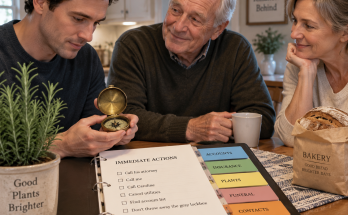
“Dad has a death binder.”
I stopped watering the rosemary.
“A what?”
“A binder about dying.”
“That sounds like Daniel.”
“It has tabs.”
“Of course.”
“Color-coded.”
“Of course.”
“Mom, there is a page called IMMEDIATE ACTIONS.”
I laughed.
“What are the actions?”
“Call his attorney. Call me. Call Caroline. Cancel utilities. Find account list. Don’t throw away the gray lockbox.”
“That seems useful.”
“There is also a section on his plants.”
I looked at my rosemary.
“Now we’ve crossed a line.”
“He wants someone to take the rosemary.”
“Absolutely not.”
“It’s apparently doing well.”
“That makes one of us.”
Ethan laughed.
The binder was not really about death.
It was about not leaving confusion behind.
Daniel had listed accounts.
Insurance.
Passwords stored through a secure service.
Professional contacts.
Funeral preferences.
No elaborate service.
No ethics speech.
No photographs from prison.
That last instruction was apparently underlined.
His assets were straightforward.
Apartment.
Retirement savings.
Ordinary investments.
A modest checking account.
No hidden entities.
No private notes.
No safe-deposit box.
No mysterious cash.
Ethan found that funny too.
“He literally wrote ‘NO OTHER ACCOUNTS EXIST.’”
“Good.”
“Then below it he wrote, ‘IF YOU FIND ONE, INVESTIGATE IT.’”
I laughed.
“That is very Daniel.”
“It gets worse.”
“How?”
“He made an asset map.”
“Adrian would be proud.”
“It’s one page.”
“Adrian would be disappointed.”
The simplicity mattered.
Daniel had spent the first half of his adult life making money increasingly difficult to trace.
He spent the later half making sure anyone who needed to understand his finances could do so in an afternoon.
Not because transparency itself was redemption.
Because secrecy had once cost other people choices.
Now clarity was simply part of his housekeeping.
“What does he want you to do?” I asked.
“Nothing yet.”
“Then why are you upset?”
“I’m not upset.”
He was.
I waited.
“He gave me the compass.”
I leaned against the counter.
“Now?”
“Yes.”
“What happened to no inheritance plan?”
“He changed his mind.”
“Allowed.”
“I told him Elise gave it back.”
“I assume he remembers.”
“He said that’s why he’s giving it to me.”
Interesting.
“What does that mean?”
“He wouldn’t explain.”
“Did you ask?”
“Three times.”
“Then maybe he doesn’t know.”
“That’s what Maya said.”
Maya was probably right.
The following Sunday Daniel came to my house for lunch.
He carried no binder.
No compass.
Only bread from the bakery near his apartment.
“Ethan told you.”
“He tells me everything.”
“That is absolutely false.”
“Enough.”
Daniel smiled.
“He thinks the binder is morbid.”
“It is morbid.”
“It’s practical.”
“Those categories overlap.”
He poured water.
His hands had begun to show age more visibly.
Veins raised beneath the skin.
A slight stiffness in the fingers.
Nothing alarming.
Still, I noticed.
“What’s with the compass?”
He sighed.
“Not you too.”
“You gave it to Ethan.”
“Yes.”
“Why?”
“Because it’s his.”
“It was Elise’s.”
“She returned it.”
“It was yours.”
“It was Dad’s.”
I stared.
“We have had this conversation for approximately thirty years.”
“Then you should understand.”
“I understand nothing.”
He laughed.
Then became thoughtful.
“I carried it for three years.”
“And?”
“I liked having it.”
That was surprisingly simple.
“Then why give it away?”
“Because I realized I was waiting.”
“For what?”
“To know who should have it after me.”
I said nothing.
“That turned it into an assignment.”
Yes.
“Dad didn’t assign it.”
“No.”
“Elise didn’t.”
“No.”
“So I gave it to Ethan because I wanted to.”
“Does he have to keep it?”
“No.”
“Did you tell him?”
“Yes.”
“Will he believe you?”
“Eventually.”
I smiled.
There was the actual inheritance.
Not the compass.
Permission to release it.
We ate outside.
The rosemary looked bad.
Daniel insulted it.
I threatened to send it to him in my will.
Then he asked, “Have you done yours?”
“My will?”
“Yes.”
“Years ago.”
“Updated?”
“Yes.”
“Instructions?”
“Yes.”
“Passwords?”
“Yes.”
“Funeral?”
I stared.
“You have become unbearable.”
“Preparation.”
“Control.”
He stopped.
Then laughed.
“Fair.”
I had instructions too.
Simpler than his.
No funeral preferences beyond no religious ceremony unless Ethan wanted one.
No expensive coffin.
No elaborate flowers.
My business succession documents were separate and current.
Personal belongings mostly to Ethan, with specific pieces to Laura’s children and a few former employees.
Nothing dramatic.
“What about the house?” Daniel asked.
“Ethan.”
“He’ll sell it.”
“Probably.”
“Does that bother you?”
“No.”
I realized it was true.
This house had been mine longer than Chestnut Hill ever was.
It held decades.
Work.
Grandchildren.
Christmas dinners.
Quiet mornings.
Arguments.
Illness.
Laughter.
It mattered enormously.
That did not mean it had to matter forever to someone else.
“I don’t need him to keep it,” I said.
Daniel nodded.
“Good.”
“What?”
“Nothing.”
“Daniel.”
“I used to think keeping something proved it mattered.”
The old house.
The cars.
The accounts.
The marriage, perhaps.
“And now?”
“Things can matter and end.”
I looked at him.
“That took you a while.”
“Yes.”
We finished lunch.
He washed the plates without asking.
The habit had survived.
Before leaving, he stopped near the hallway shelf where Robert’s letter once sat before Daniel took it back years ago.
“Do you know what I’m leaving Ethan?”
“Besides money?”
“Yes.”
“Plants.”
“Unfortunately.”
“Your framed copy of his scholarship speech?”
“No.”
I laughed.
“What?”
“I’m leaving that to Elise.”
“Cruel.”
“She mocked me for framing it.”
“Excellent.”
“What I’m leaving Ethan is the notebook.”
I knew immediately which one.
The old notebook Daniel had once kept with calculations and notes from the years before everything collapsed.
Not evidence anymore.
History.
“Why?”
“He asked for it.”
That surprised me.
“When?”
“After the scholarship speech.”
“Why?”
“He said he wanted the whole sequence.”
I understood.
Robert’s warning.
Daniel’s old calculations.
The false confidence.
Then later notes.
The record of a person persuading himself one more adjustment would solve the last one.
“Are you comfortable with that?”
“No.”
Good.
“Why give it?”
“Because discomfort isn’t a reason to hide something.”
There it was.
Still practicing.
Always.
A week later Ethan brought the notebook to my house.
“Dad gave it early.”
“Apparently everyone is distributing their estates while alive.”
“He said waiting until death was dramatic.”
“He is correct.”
Ethan placed the notebook on the table.
I had seen parts of it during the investigation.
Not all.
He opened near the beginning.
Ordinary business notes.
Revenue projections.
Targets.
Then increasingly dense calculations.
Margin.
Liquidity.
Debt.
Refinancing.
Amounts circled.
Dates.
Robert’s old loan.
The handwritten Never again.
Later pages showed the shift.
Need 90 days.
Recover before Q3.
Refi.
E.M.
Custodial.
Asset control.
Words reducing human beings into variables.
Ethan ran his fingers along one page.
“Dad said I can destroy it.”
“Do you want to?”
“No.”
“Then don’t.”
“I might scan it.”
“Practical.”
“He said I can donate it to the ethics program someday.”
“Also practical.”
“Or burn it.”
“More theatrical.”
He smiled.
Then turned toward the final pages.
These were new to me.
Written after prison.
Different handwriting.
Slower.
Less compressed.
The first entry:
If I feel urgency, identify what is actually urgent.
Another:
If the plan requires someone not knowing enough to object, stop.
Another:
Embarrassment is not an emergency.
I smiled.
Ethan turned the page.
No financial calculations.
Questions.
Who owns the risk?
Who has enough information to consent?
Am I solving the problem or hiding the evidence of the problem?
What happens if I do nothing for twenty-four hours?
Who can tell me no?
The last one was underlined.
Ethan looked at me.
“He turned it into a manual.”
“Apparently.”
“Do you think that’s healthy?”
“I have no idea.”
He laughed.
Then reached the final written page.
Only three lines.
Robert was right.
Emma was right.
Ethan did not need either of us to be right forever.
I read it twice.
“That’s irritating.”
“What?”
“Your father getting concise in old age.”
“He says words cost more now.”
“Inflation.”
Ethan closed the notebook.
Then he asked something I had not expected.
“Do you regret not leaving earlier?”
I looked at him.
The question was not about Daniel.
Not entirely.
“When?”
“Before the divorce.”
I thought of the years before Tuesday evening.
Daniel’s growing absence.
His office door.
The missing statements I had not yet noticed were missing.
Rachel.
The money.
The emotional distance I had named stress because stress was easier.
“I didn’t know enough.”
“That’s not what I asked.”
Family trait.
I smiled.
“Yes.”
He waited.
“I regret things I ignored.”
“Like?”
“Not financial crimes. I didn’t know those.”
“What then?”
“How little we were talking. How much of the parenting had become mine without discussion. How often your dad answered questions with reassurance instead of information.”
“Would you have divorced him?”
“I don’t know.”
“Really?”
“Really.”
A marriage could be troubled without being doomed.
A person could be selfish without becoming fraudulent.
History made earlier moments look more inevitable than they felt while living them.
“I might have demanded changes.”
“Would Dad have changed?”
“Maybe.”
Ethan smiled.
“You hate that word.”
“No. You hate it.”
“True.”
He looked at the notebook.
“I used to wish you had caught him earlier.”
“So did I.”
“Then I thought maybe everything would have been different.”
“Yes.”
“Now I think that’s pointless.”
“Mostly.”
He looked toward the window.
“Because then I wouldn’t be me.”
There was the temptation.
Turn suffering into necessity because something good followed.
I shook my head.
“Careful.”
He looked at me.
“You don’t need what happened to be necessary in order to value who you became afterward.”
He considered.
“Dad says that.”
“Your father steals everything.”
“He says you steal his material.”
“Impossible.”
We laughed.
Ethan took the notebook home.
The compass remained on his desk for several months.
Then one afternoon Elise visited and saw it.
“You have this again?”
“Apparently.”
“Why?”
“Grandpa gave it to me.”
She rolled her eyes.
“This family.”
“What should I do with it?”
“I don’t care.”
“You really don’t?”
“No.”
That was probably the healthiest answer anyone had ever given about the compass.
Ethan eventually placed it in the same drawer as the notebook.
No display.
No shrine.
No assignment.
Months passed.
Daniel remained healthy enough.
Then not quite.
A routine examination found an abnormal heart rhythm.
Treatable.
Medication.
Monitoring.
No immediate danger.
Still, the news frightened everyone.
Especially Daniel.
He called me.
“I have a heart condition.”
“You have an arrhythmia.”
“That is a heart condition.”
“Technically.”
“I’m seventy-three.”
“Yes.”
“This feels targeted.”
I laughed.
Then asked, “Are you scared?”
“Yes.”
Immediate.
No shame.
“What did the cardiologist say?”
“That it’s manageable.”
“Then manage it.”
“Terrible bedside manner.”
“I’m not your doctor.”
He followed instructions.
Medication.
Less caffeine.
Walking.
No dramatic health reinvention.
He complained about reduced coffee.
Caroline sent him decaf as an insult.
Elise mailed a card:
YOUR HEART HAS BAD RHYTHM BECAUSE YOU CAN’T DANCE.
He framed that too.
Of course.
The arrhythmia stabilized.
Life continued.
That was the part nobody had understood during the worst years.
After consequences.
After redemption arcs.
After revelations.
Life kept becoming ordinary again.
Not permanently.
Nothing was permanent.
But long enough to matter.
One evening Daniel and I walked through a park near my house.
Slowly.
He tired sooner.
Neither of us mentioned it.
Then he said, “I think I finally understand Dad’s letter.”
“Which part?”
“Do not spend your life trying to earn something you already had.”
I waited.
“I thought it meant his approval.”
“It did.”
“Yes.”
“But?”
“I think I did the same thing with Ethan.”
My chest tightened.
“Trying to earn his love?”
“Yes.”
“For years.”
“Yes.”
“Did you?”
Daniel smiled.
“No.”
Good.
“He loved me before I deserved his trust.”
That was true.
“And later?”
“I earned some trust.”
“Yes.”
“But the love wasn’t payment.”
“No.”
He looked ahead.
“That would have made it another transaction.”
Exactly.
We reached a bench.
Sat.
Children played nearby.
Someone walked a golden retriever.
A cyclist nearly collided with a stroller and apologized profusely.
Nothing symbolic.
Daniel said, “I wasted a lot of years turning everything into something that could be earned.”
“Money does that to people.”
“It wasn’t money.”
“No.”
“Worth.”
I looked at him.
He smiled.
“I know. Therapy word.”
“Useful one.”
We sat until the light changed.
Then walked back.
At my driveway, Daniel hugged me.
That had become normal enough not to surprise either of us.
“See you Sunday,” he said.
“Bring bread.”
“You only love me for carbohydrates.”
“I care about you as family.”
He groaned.
“Still brutal.”
“Accurate.”
He left.
I watched his car disappear.
Not because I feared it was the last time.
Because at our age, I had stopped pretending ordinary departures came with guarantees.
Sunday would come.
Or it would not.
The only useful thing was that nothing important had been hidden before he drove away.
Click here to continue reading: PART 50: Decades After Daniel Asked for Everything Except His Son, Ethan Stood Between Us Again—This Time With Nothing Left to Divide
My Husband Divided Our Marriage Into Things He Wanted and One Person He Was Willing to Leave Behind
Part 49 of 50