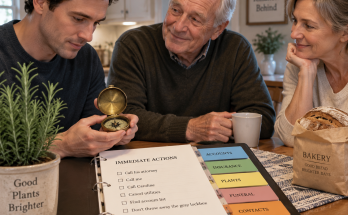
Sunday did come.
Daniel brought bread.
He also brought the wrong cheese.
I complained.
He accused me of becoming inflexible with age.
I reminded him he once built a spreadsheet comparing three brands of olive oil.
Ethan arrived halfway through the argument.
Maya came behind him.
Elise was home from college for the weekend and immediately sided with me despite having no idea what we were discussing.
Daniel declared the gathering corrupt.
That became one of the last completely ordinary Sundays before everything changed again.
Not catastrophically.
Naturally.
Age did what no court, creditor, or investigator had ever managed.
It made all of us less interested in pretending time was unlimited.
My business was mostly in other hands by then.
I still consulted.
Mostly when younger designers wanted someone to tell clients that a wall could not move merely because they disliked where it was.
Daniel had fully retired from paid work.
The ethics nonprofit kept recordings of several sessions with his permission.
He disliked that.
Elise found it hilarious.
“You’re educational content.”
“Terrible fate.”
“You’re basically homework.”
“Worse.”
Ethan and Maya had become the center of family logistics without anyone officially declaring it.
Holidays happened at their house more often.
They remembered medications.
Flight times.
Appointments.
They made decisions while still asking.
That distinction mattered.
Then Daniel had a stroke.
Small, the doctors said.
A word I immediately hated.
Nothing about seeing him in a hospital bed felt small.
He was seventy-six.
Speech slightly slowed.
Right hand weak.
Face mostly unchanged.
Cognition intact.
He looked furious.
Good sign.
I entered after Ethan.
Daniel saw me.
“Everyone needs to stop looking like that.”
His words were clear but deliberate.
“Like what?”
“Funeral.”
I pulled up a chair.
“You look terrible.”
“Thank you.”
“You’re welcome.”
Ethan laughed.
Relief entered the room.
Daniel began rehabilitation.
He improved.
Not completely.
Walking required a cane for several months.
Fine motor control in his right hand remained difficult.
He hated asking for help with buttons.
Hated slower typing.
Hated fatigue most.
Not because pain was unbearable.
Because his body no longer obeyed urgency.
That might have been the final boundary life imposed on him.
He could not force recovery.
Only participate.
Exercises.
Rest.
Medication.
Repeat.
One afternoon I visited his apartment.
He was trying to open a jar.
I reached for it.
He pulled it away.
“Daniel.”
“I can do it.”
“Fine.”
He tried again.
Nothing.
His jaw tightened.
I waited.
He tried once more.
Then held it toward me.
“Please.”
I opened it.
No speech.
No lesson.
He said, “Thank you.”
That was enough.
Recovery plateaued.
Daniel adapted.
The cane disappeared eventually.
His right hand remained weaker.
He stopped driving at night.
Then voluntarily stopped driving entirely after a near miss in a parking lot.
That decision hurt him more than I expected.
“Feels like surrender.”
“It’s transportation.”
“I know.”
“Then?”
“Independence.”
There it was.
Ethan offered rides.
Daniel accepted some.
Used taxis.
Public transportation.
Walked.
No one had to take the keys.
No family confrontation.
He made the decision before fear became evidence he could dismiss.
At seventy-eight, he moved from his apartment into a smaller independent-living community.
His choice.
Close to Ethan.
Close enough to me.
Caroline objected from Oregon, then admitted she was relieved.
The move required sorting belongings.
I helped one afternoon.
We opened boxes.
Books.
Photographs.
Old business awards.
He threw most of the awards away.
I objected.
“Why?”
“They’re meaningless.”
“No.”
He looked at me.
“You earned some of those legitimately.”
“So?”
“So not everything from that life was false.”
Daniel stared at a glass plaque from a company he worked for years before the collapse.
“I don’t want it.”
“Fine.”
“But not because it was fake?”
He thought.
“No.”
“Good.”
He put it in the donation pile.
Healthy.
No purification ritual.
Just less space.
Then we found the framed scholarship speech Ethan gave him.
“Keep,” Daniel said immediately.
“Obviously.”
Elise’s essay.
Keep.
Robert’s letter.
Keep.
Evelyn’s note.
Keep.
Photographs.
Several.
Not all.
The engagement-ring receipt somehow still existed in an old folder.
I held it up.
Daniel looked horrified.
“Burn it.”
“Recycling.”
“Fire.”
“Paper recycling.”
“Emma.”
I laughed and shredded it.
Not ceremonially.
Conveniently.
Near the bottom of one box sat a copy of our divorce decree.
Daniel stared.
“Why do I still have that?”
“Legal history.”
“Do I need it?”
“Probably not.”
He looked at me.
“Want it?”
“No.”
“Ethan?”
“Absolutely not.”
He tore it in half.
Then stopped.
“I’m being dramatic.”
“Very.”
He placed it in recycling instead.
Growth at seventy-eight.
The move went well.
His new place had one bedroom.
A balcony.
No office.
That was intentional.
He kept a small desk in the living room.
On it sat Robert’s letter and Elise’s framed essay.
No photographs of his old house.
No business awards.
The compass was not there.
Still with Ethan.
I noticed.
Said nothing.
For another three years, life remained steady.
Then Daniel’s heart worsened.
Not suddenly.
Congestive failure.
Manageable until less manageable.
Medication increased.
Walking decreased.
Hospital visits became more frequent.
We all knew what was happening before anyone said it.
Daniel did too.
He did not pretend.
That was perhaps his final transformation.
No secret optimism.
No private rescue plan.
No search for a doctor who would promise certainty.
He wanted treatment.
He did not want endless intervention.
He documented that.
Discussed it with Ethan.
Discussed it with his doctors.
Then asked me to sit with him one afternoon.
“I don’t want Ethan deciding everything at the end.”
“He won’t if you document it.”
“I did.”
“Then?”
“I want you to know.”
I understood.
Not responsibility.
Witness.
“Tell me.”
He did.
Hospital care if reversible problems occurred.
Comfort-focused treatment if his heart failed beyond reasonable recovery.
No prolonged mechanical support if he could not regain meaningful consciousness.
Specific.
Discussed.
Signed.
“I hate this conversation,” I said.
“Me too.”
“Good.”
He smiled.
“I don’t want you to tell Ethan what to do.”
“I won’t.”
“I mean it.”
“I know.”
“He’ll look at you.”
“I know.”
“Don’t decide for him.”
“I won’t.”
Daniel smiled faintly.
“Full circle.”
“Unfortunately.”
His final hospitalization came in winter.
Ethan was forty-one.
Elise had finished college and was working in another state.
She flew home.
Caroline came.
Maya coordinated food because somebody always did.
I sat beside Daniel on the second evening.
He was tired.
Oxygen beneath his nose.
Still himself.
“You look terrible,” I said.
He smiled.
“Tradition.”
“Important.”
His hand rested on the blanket.
The right one.
Still slightly curled from the stroke years earlier.
I held it.
No confusion in that either.
“Ethan okay?” he asked.
“No.”
“Good.”
I looked at him.
“He’s losing his father.”
“I know.”
“He doesn’t need to perform okay for you.”
Daniel closed his eyes.
“I know.”
A minute passed.
Then:
“Did I do enough?”
There it was.
Even now.
The question that had shaped half his life.
Enough money.
Enough success.
Enough restitution.
Enough change.
Enough proof.
I squeezed his hand.
“Wrong question.”
He opened his eyes.
“Of course you’d say that.”
“You know better.”
“I’m dying. Be nice.”
“No.”
He laughed weakly.
Then waited.
I said, “You did what you did.”
His expression became serious.
“You hurt people.”
“Yes.”
“You faced consequences.”
“Yes.”
“You changed some things.”
“Yes.”
“You failed at others.”
“Yes.”
“You loved Ethan.”
His eyes filled.
“Yes.”
“He loves you.”
Daniel looked away.
“That is not a score.”
“No.”
“Then stop totaling it.”
He laughed once.
“Adrian would hate that.”
“Adrian knows when not to use a spreadsheet.”
“I’m not convinced.”
We sat quietly.
Then Daniel said, “I’m glad you didn’t forgive me too fast.”
That surprised me.
“Why?”
“I would have used it.”
Probably.
“To do what?”
“Feel finished.”
I understood.
There had never been a finish.
Only practice.
“I’m glad you eventually did,” he said.
“Forgive you?”
“In whatever way you did.”
I thought of Elise asking whether I loved him like family.
“Yes.”
He looked at me.
“I loved you badly.”
The sentence hurt even after all those years.
Because it was true.
“And sometimes well,” I said.
His eyes closed.
“Thank you.”
No need to make the marriage entirely false because it ended in betrayal.
There had been beach photographs.
Fevers.
Young dinners.
Robert’s cabin.
Ethan’s birth.
Ordinary mornings.
Tenderness did not cancel harm.
Harm did not require every earlier tenderness to become counterfeit.
Both.
Always both.
The next morning Ethan sat with him alone.
I did not ask what they discussed.
Later, Ethan told me one piece.
Daniel said, “I’m sorry I ever made you feel like something I could give away.”
Ethan answered, “You don’t have to say that again.”
Daniel asked, “Why?”
“Because I heard you.”
That was enough.
Elise came next.
She brought the compass.
Of course.
Daniel laughed when he saw it.
“Why?”
“I thought you might want it.”
“Your dad had it.”
“I stole it.”
“Excellent family values.”
She smiled through tears.
“Do you want it?”
Daniel looked at the brass case.
Then at her.
“No.”
Elise blinked.
“No?”
“No.”
“Why?”
“Because you brought it.”
She frowned.
“That doesn’t make sense.”
“It doesn’t need to.”
He touched her hand.
“Take it somewhere.”
“Where?”
“Anywhere.”
“North?”
Daniel smiled.
“North is not a destination.”
She cried then.
So did he.
Elise kept the compass.
For the moment.
Daniel died two days later.
Ethan was there.
So was I.
Caroline had fallen asleep in the chair.
Maya stood by the window.
No dramatic final words.
He had said the important ones earlier.
His breathing slowed.
Then stopped.
The room remained a room.
Machines quieted.
A nurse came in.
Time was recorded.
Paperwork began.
Death was enormous and administrative at once.
Ethan stood beside the bed.
I went to him.
He leaned into me the way he had when he was eight.
Older.
Taller.
Still my son.
For a few seconds I saw every version.
The boy with the bridge.
The teenager visiting prison.
The college student who damaged a truck.
The groom.
The father.
The man now losing his own father.
“I’m here,” I said.
“I know.”
That was all.
Daniel’s funeral followed his instructions.
Small.
No grand speech from the nonprofit.
Ethan spoke briefly.
Caroline did too.
Elise read Robert’s sentence:
Do not spend your life trying to earn something you already had.
Then she added:
“Grandpa spent a long time learning that. I’m glad he had time.”
No one tried to summarize him.
Impossible.
Afterward, people gathered at Ethan and Maya’s house.
The little brick house had changed over the years.
Expanded kitchen.
Rebuilt deck.
Trees taller.
Elise sat on the steps holding the compass.
I joined her.
“What are you going to do with it?”
She looked at me.
“You’re not going to say I don’t have to keep it?”
“You don’t.”
“I know.”
“What do you want?”
“I’m taking it hiking.”
“Where?”
“Montana.”
I smiled.
“Good.”
“Grandpa said anywhere.”
“He did.”
She closed her hand around it.
Then asked, “Was he happy?”
I thought carefully.
“Sometimes.”
“Near the end?”
“Yes.”
“Even sick?”
“Sometimes.”
She nodded.
That was enough.
A year passed.
Grief became less physically surprising.
I still reached for my phone occasionally when something happened that Daniel would have found funny.
Then remembered.
Ethan did the same.
We talked about him without turning every mention into mourning.
Some stories were terrible.
Some hilarious.
Most both.
One Tuesday evening, Ethan came to my house carrying a cardboard box.
I stared.
“No.”
“What?”
“If this is another archive, leave.”
He laughed.
“It’s Dad’s binder.”
“Death binder?”
“Yes.”
“Why do I want it?”
“You don’t.”
He sat at the kitchen table.
“I finished everything.”
Estate settled.
Accounts closed.
Final taxes.
Donations.
Possessions distributed.
No hidden surprises.
No creditor emerging from an unknown account.
No second life.
No secret money.
That fact mattered more than it should have.
Daniel had left exactly what he said he would.
“What’s in the box?”
“Stuff I didn’t know whether to keep.”
Of course.
We opened it.
Copies.
Old photographs.
A watch.
Not Robert’s.
Daniel’s.
His first employee badge from the logistics company.
A prison visitation form with Ethan’s name.
I inhaled.
“Keep?”
Ethan looked at it.
“No.”
He shredded it.
No ceremony.
Then the notebook.
He kept that.
Robert’s letter.
Keep.
Evelyn’s note.
Keep.
Elise’s essay.
Already hers.
The framed scholarship speech.
Ethan laughed.
“Dad really framed this.”
“You knew.”
“I know.”
He removed the speech.
Folded it.
Put it in the notebook.
“Frame?”
“Donate.”
Good.
At the bottom sat a plain envelope.
My name.
Emma.
Daniel’s handwriting.
I froze.
Ethan looked at me.
“You want me to leave?”
“Yes.”
He stood.
Then stopped.
“Mom.”
“What?”
“You don’t have to read it.”
I smiled.
“I know.”
He kissed my forehead.
Left.
I waited twenty minutes.
Then opened it.
One page.
Emma,
If Ethan gives you this, then apparently my organizational system survived me.
You were right that I always wanted the last word. This is an unfair advantage, so I’ll keep it short.
I spent years thinking the worst thing I did to you was lose money.
It wasn’t.
It was deciding that because I was afraid, I was entitled to make choices for you without giving you the truth.
You taught me the difference between being trusted and being trustworthy.
I wish I had learned it before it cost you so much.
Thank you for protecting Ethan when I was not capable of doing it safely.
Thank you for not teaching him to hate me.
Thank you for eventually letting me become family again without pretending I had never broken ours.
I am sorry.
Daniel
No grand declaration.
No request for forgiveness.
No explanation.
Good.
I cried.
Then laughed because of course he had still managed the last word.
I folded the letter.
Placed it beside Robert’s.
Not because it needed to become an heirloom.
Because I wanted it.
For now.
Several months later, Ethan and Maya hosted dinner.
Elise was home.
Her hiking photographs from Montana covered the table.
In one, Robert’s compass rested on a rock above a valley.
Daniel would have loved it.
Or complained that leaving brass on stone could scratch it.
Probably both.
After dinner, Ethan found me on the back deck.
“You okay?”
“Yes.”
“Really?”
“Yes.”
He sat beside me.
For a while we listened to voices inside.
Maya laughing.
Elise arguing with someone on the phone.
Ordinary family noise.
Then Ethan said, “Do you remember the night Dad asked for the divorce?”
“Yes.”
“What do you remember most?”
I could have said the house.
The island.
The missing statements.
His face.
The shock.
But one sentence remained clearest.
“He said he wanted everything.”
Ethan waited.
“Except me.”
He knew.
I had told him years earlier.
The words no longer had the power they once did.
Still, they deserved accuracy.
“Yes.”
“Did you believe him?”
“That he didn’t want you?”
“Yes.”
I thought.
“For a while, part of me did.”
Ethan nodded.
“I used to think about that.”
“I know.”
“Then I thought maybe everything after was him proving it wasn’t true.”
“Some of it.”
“And?”
“Some of it was him learning that wanting someone isn’t enough.”
Ethan looked toward the house.
Elise appeared through the glass door, saw us, and deliberately disappeared again.
Giving space.
Another inherited skill.
I continued.
“Your father wanted people. He wanted love. He wanted trust. He wanted family.”
“Yes.”
“He just spent years confusing wanting with having a right to control how those things stayed.”
Ethan nodded.
“That sounds right.”
“And you?”
“What about me?”
“Did you ever feel like what he left me with?”
Ethan smiled.
“No.”
Immediate.
My eyes filled.
“Not even when you were little?”
“I felt like he left.”
Different.
Painful.
“But I never felt like you got stuck with me.”
I looked down.
That mattered more than every court order.
Every settlement.
Every asset.
“Good.”
He leaned against my shoulder.
Forty-one years old.
Still my son.
Inside, Maya called, “ETHAN, YOUR DAUGHTER IS STEALING DESSERT.”
Elise shouted, “I AM AN ADULT.”
Ethan sighed.
“Family emergency.”
“Go.”
He stood.
Then looked at me.
“You coming?”
“Yes.”
I followed him inside.
On the kitchen island sat a plate of cake.
No financial statements.
No hidden phones.
No divorce proposal.
No man calmly dividing a life into assets and liabilities.
Just dessert.
Elise had already taken the largest piece.
Maya objected.
Ethan demanded redistribution.
I refused involvement.
Everyone appealed to me anyway.
For one second, I remembered another kitchen island decades earlier.
Daniel asking for the house.
Cars.
Accounts.
Art.
Everything.
Except the boy.
He had thought possessions were the things worth keeping and a child was the part he could assign elsewhere.
Time corrected him more thoroughly than any judge ever could.
The house went.
The cars went.
The accounts went.
The paintings disappeared into sales and settlements.
Money moved.
Documents were shredded.
Objects changed hands.
Even Robert’s compass wandered away.
The only things that lasted were never things Daniel could have kept by demanding them.
Trust had to be offered.
Love had to remain voluntary.
Family had to survive choice.
Ethan cut another piece of cake and handed it to me.
“Here.”
“Too big.”
“You’ll survive.”
I took it.
He sat beside Maya.
Elise kept arguing.
Someone laughed.
Then everyone did.
I looked around the table.
Nothing left to divide.
Nothing left to win.
No one belonged to anyone.
That was what made us family.
And at last, after everything we had lost, hidden, exposed, repaired, released, and learned to carry differently, it was enough.
The End
Read more original stories on Feel Every Story.
My Husband Divided Our Marriage Into Things He Wanted and One Person He Was Willing to Leave Behind
Part 50 of 50