Edward Sloan lived in a retirement community thirty miles outside the city.
By the time police arrived, his garage was empty.
Neighbors said he had left before dawn carrying two suitcases.
Ruiz obtained a warrant for the house.
What investigators found changed the history of Arthur’s money.
Sloan had not merely processed the $480,000 transfer twenty years earlier.
He engineered it.
The account in Kevin’s name was opened through a special internal process requiring management approval.
Sloan approved it.
He also overrode a fraud alert.
Then, when the $1.6 million transfer triggered a higher-level review, he quietly cooperated with investigators and acted surprised.
He sacrificed the larger scheme to hide the smaller successful theft.
Mark believed he had outsmarted the bank.
In reality, Sloan had used Mark.
“Why?” Claire asked.
Sarah answered.
“Fees.”
Sloan received money through a consulting company linked to the transfer.
Small enough to avoid attention.
Large enough to matter.
Over years, that consulting company evolved.
New shell entities.
Private lending.
Estate advances.
Eventually Mercer entered.
Hale.
Others.
The network grew around elderly clients whose finances Sloan or his associates could see.
Arthur had unknowingly been near the center from the beginning.
The betrayal was almost intimate.
He trusted Sloan with retirement savings.
Sloan used that trust to identify opportunity.
When Mark came asking how to access his father’s money, Sloan saw both a criminal and a tool.
Arthur discovered part of it twenty years ago but believed Mark was the architect.
Sloan stayed invisible.
Until Mercer’s recent mistakes exposed the older pattern.
I thought about Arthur’s note.
Not family. Family is leverage.
That was what Sloan and Mercer understood.
They did not need to invent greed.
They only needed to find families where greed already existed.
Mark wanted money.
Kevin had debts.
Brenda had shame.
Claire had loyalty.
I had resentment.
Every weakness became a handle.
Arthur finally saw the system.
Too late.
Or maybe just early enough to leave evidence.
Police traced Sloan’s vehicle through traffic cameras.
It headed west.
Mercer’s phone remained off.
Then a toll camera captured the passenger.
Mercer.
They were together.
Ruiz coordinated with state police.
Roadblocks went up.
No immediate result.
Sloan knew back roads.
He had lived in Colorado most of his life.
While police searched, Sarah examined Arthur’s restitution trust.
Something bothered her.
“He changed the trustee.”
“When?”
“Four days before he died.”
“From who?”
“Me.”
“To?”
She looked at Claire.
“David.”
I stared.
“No.”
“Yes.”
“I never signed anything.”
“You didn’t need to yet. Arthur named you successor trustee upon his death.”
Another responsibility.
Nearly a million dollars intended for victims.
Arthur had given it to me.
Not personally.
To administer.
“I don’t know anything about trusts.”
“He knew.”
“Then why me?”
Sarah’s expression softened.
“Because you count.”
I almost laughed.
“That doesn’t sound flattering.”
“It was to Arthur.”
She explained.
Arthur had watched me calculate every expense.
Mortgage.
Groceries.
Gas.
Medication.
I had thought that habit made me petty.
Arthur believed it made me careful.
He once told Sarah,
David knows what a dollar costs because he has spent his life earning them one at a time.
I looked away.
The man I thought judged me had been studying me with far more generosity than I deserved.
Sarah handed me a letter.
Not yet.
I couldn’t read another one.
“Later.”
She nodded.
Ruiz returned with news.
Sloan’s car had been found abandoned near an old service road.
Blood on the passenger seat.
Not enough to indicate death.
Mercer might be injured.
Or Sloan.
Tracks led toward a disused rail depot.
Police surrounded it.
For two hours we waited.
Then gunfire was reported.
Claire gripped my hand.
One suspect surrendered.
Edward Sloan.
Mercer escaped through a drainage channel.
Sloan had been shot in the leg.
Investigators initially assumed Mercer shot him.
Sloan claimed the opposite.
He said he fired at Mercer when Mercer tried to kill him.
Again, nobody’s first story could be trusted.
Under questioning, Sloan began bargaining.
He offered records in exchange for consideration.
Ruiz did not promise anything.
Sloan talked anyway.
He admitted helping Mark move the original $480,000.
Admitted taking payment.
Admitted later introducing Mercer to private lenders.
But he insisted the broader fraud network was Mercer’s creation.
“Convenient,” Ruiz said.
Sloan shrugged.
“Truth often is.”
He claimed Arthur discovered Sloan’s involvement only six weeks before his death.
Arthur confronted him privately.
Sloan expected anger.
Instead Arthur asked one question.
“How many?”
How many elderly people had lost money because of him?
Sloan could not answer.
Arthur told him he would spend whatever remained of his life finding out.
That was when the restitution trust expanded.
Sloan informed Mercer.
Mercer panicked.
Then Mark’s inheritance problem provided a convenient solution.
If Arthur’s household collapsed, his evidence could be discredited or destroyed.
I asked Ruiz whether Sloan knew about the poison.
She said his statement was careful.
Too careful.
He claimed Mercer mentioned “removing David.”
He assumed intimidation.
Everyone seemed to assume murder meant something else until the body appeared.
Then Ruiz showed him the voice message where Mercer discussed dosage.
Sloan’s composure cracked.
He admitted hearing Mercer discuss digoxin.
Not the full plan.
Enough.
That made him part of the conspiracy.
He asked for a lawyer.
Interview over.
Mercer remained missing.
Then police found his blood inside the rail depot.
He had been wounded.
Hospitals were alerted.
No arrival.
Thomas joined us late that afternoon.
He carried an envelope Arthur had mailed him three days before his death.
It had arrived that morning.
Postal delay.
One last message moving through the world after its writer was buried.
Thomas opened it with us.
Arthur wrote about Evelyn.
Thomas’s mother.
The woman Arthur believed had lost their child.
He apologized for not searching harder.
For accepting what her parents told him.
For building another life without questioning whether his first son might still exist.
Thomas cried silently.
Then he reached the final page.
Arthur had enclosed a photograph.
Young Arthur.
Young Evelyn.
Standing beside a lake.
On the back:
If Thomas wants to know where I first learned his mother was pregnant, bring him here.
Coordinates followed.
Sarah recognized the area.
An old public overlook.
Why include coordinates?
Thomas thought it was sentimental.
Ruiz did not.
Arthur rarely wrote anything without purpose by the end.
We drove there with police.
The overlook sat above a reservoir, quiet beneath late-afternoon clouds.
An old bench faced the water.
Arthur and Evelyn had apparently sat there more than sixty years earlier.
Thomas touched the wood.
Then Noah noticed scratches beneath the seat.
A metal plate.
Inside:
Another envelope.
Arthur’s obsession with hiding paper would have been funny in another life.
This envelope was addressed:
FOR THOMAS — AND DAVID IF HE STAYED.
I could barely breathe.
Thomas opened it.
Inside was a key.
Bank safe-deposit key.
And a note.
Sloan thinks I don’t know where the originals are.
The box number followed.
Ruiz immediately contacted the bank.
The branch was the same institution where Sloan had worked.
The safe-deposit box had been opened twice in twenty years.
Once by Arthur.
Once three days ago.
Access signature:
Edward Sloan.
But Sloan told police he had not seen Arthur’s original evidence in years.
He had lied.
Security footage showed Sloan entering the vault.
Then leaving with a document pouch.
He had the originals.
Or had them.
Where were they now?
Ruiz returned to Sloan.
He resisted.
Then admitted he gave the pouch to Mercer at the rail depot.
Mercer escaped with it.
The originals could prove the entire network.
He would destroy them.
Unless police found him first.
A state trooper called.
A wounded man matching Mercer’s description had stolen a pickup from a farm twelve miles west.
Heading toward the city.
Why return?
Sarah knew.
“The office.”
“What?”
“Jonathan kept a shred room.”
Digital drives.
Old files.
A commercial shredder capable of destroying paper and storage media.
If Mercer wanted evidence gone, that was where he would go.
Police raced toward Whitmore & Mercer.
We stayed behind this time.
No arguments.
Twenty-five minutes later Ruiz called.
They found the stolen pickup.
The rear door to the firm was open.
Smoke inside.
Fire alarms screaming.
Mercer had set the shred room on fire.
Firefighters entered.
Police followed.
No Mercer.
Then Sarah’s phone rang.
Unknown number.
She answered on speaker.
Mercer.
His breathing was ragged.
“You should have stayed out of this, Sarah.”
She looked at Ruiz.
“Where are you?”
“You know.”
“No.”
“Yes.”
Sarah’s face changed.
Her eyes moved toward me.
Then toward Thomas.
“He’s not at the office.”
“Where?”
She whispered,
“Arthur’s house.”
Mercer laughed through the phone.
Then said,
“I’m sitting in the room where the old man spent twenty years planning how to destroy us.”
My stomach dropped.
Arthur’s bedroom.
Our house.
Where Claire, Noah, and Lily had just returned.
Click here to continue reading: PART 16: Mercer Entered Arthur’s Bedroom Looking for One Last File, but the Thing He Found There Was Never Meant to Save Money
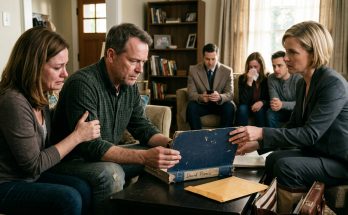
The Morning After Arthur’s Funeral, His Lawyer Brought a Blue Ledger That Made Twenty Years of Resentment Feel Suddenly Dangerous
Part 15 of 27