Police reached Kevin’s house before Raymond could leave.
He did not have a weapon.
That surprised me.
Perhaps Raymond had always understood that documents were more useful than guns.
He had arrived carrying a folder and demanding to speak.
Kevin let him onto the porch because, as he later told us, “I wanted to hear what an old coward sounds like when he runs out of younger people to hide behind.”
The emergency call began after Raymond mentioned Patricia’s statement.
Kevin went inside under the excuse of finding it.
Called 911.
Returned.
Kept Raymond talking.
Bell allowed none of us near the scene.
Not me.
Not Laura.
Certainly not Julian.
Raymond was taken into custody forty-one years after the first warehouse concealment and nine years after arranging his own fake death.
When Bell told me, I expected relief.
What I felt was fatigue.
One man in handcuffs did not reverse forty years.
It only stopped him from creating another day.
Kevin’s statement about the encounter was straightforward.
Raymond believed Patricia had written down everything she knew about Julian’s accident.
She had.
Kevin kept the original.
Bell secured it.
Julian asked to read it.
Kevin refused.
Not permanently.
Not yet.
I understood.
The document belonged to Patricia’s family before it became evidence in ours.
Julian did not argue.
That mattered.
The following afternoon Kevin called me.
“Can you come alone?”
Rebecca was sitting beside me.
“She will object.”
“I assumed.”
“What does alone mean?”
“No Julian.”
“That is different.”
“You can bring your lawyer.”
Rebecca raised one eyebrow.
“Thank you,” I said.
Kevin asked us to come to his home.
It was modest.
Single-story.
Ramps front and back.
A workshop behind the garage.
The living room walls held photographs of boats, children, grandchildren.
A life.
Not the frozen victim Julian carried in memory.
Kevin noticed me looking.
“I’ve had forty years, Evelyn.”
“I know.”
“People hear spinal injury and think everything afterward stayed in that hospital bed.”
“I did not.”
“You wondered.”
“Yes.”
He nodded.
Fair.
Rebecca remained near the kitchen while Kevin and I sat.
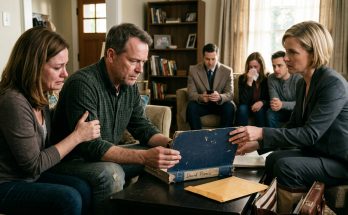
He placed Patricia’s statement between us.
“My mother wrote this eighteen years ago.”
“Why then?”
“Cancer diagnosis.”
“Did Arthur know?”
“Yes.”
“Of course.”
Kevin almost smiled.
“She mailed him a copy.”
“Where is his?”
“No idea.”
Arthur’s floor safe contained no copy.
Another missing piece.
“Did she want Julian to know?”
“Eventually.”
“Why didn’t you tell him?”
Kevin’s expression hardened.
“Because for years I didn’t want to hear his apology.”
“That is your right.”
“And later…”
He looked toward the workshop window.
“Later I realized I didn’t know whether the truth would help either of us.”
“That sounds like Arthur.”
“I know.”
He looked irritated by the comparison.
“Then Raymond resurfaced.”
“Yes.”
“And Meridian targeted me.”
“Yes.”
“And everything became evidence.”
“Yes.”
Kevin pushed the statement toward me.
“You can read it.”
“I want Julian to read it.”
“Not yet.”
I looked at him.
“Why?”
“Because there’s something else he needs to hear first.”
“From whom?”
“Me.”
I waited.
Kevin had known more about the accident than Julian realized.
Not only what happened afterward.
Before.
They had been friends.
Closer than Julian remembered.
Julian thought Kevin was a classmate who happened to be in the car.
Kevin said they spent nearly every day together that summer.
They worked at the warehouse loading trucks.
I had forgotten that.
Arthur called it temporary work.
Julian complained constantly about the heat.
“What happened that night?”
Kevin looked at his hands.
“We weren’t joyriding.”
That contradicted Peter’s early version.
“Where were you going?”
“The warehouse.”
“Why?”
“Julian wanted to confront Raymond.”
My chest tightened.
“About what?”
“Money.”
Julian had discovered cash hidden in Arthur’s car.
He thought Arthur was helping Raymond steal from the business.
Kevin tried to talk him out of going.
Julian drank two beers first.
Then they drove.
“Why doesn’t he remember this?”
“Concussion.”
“Anything else?”
“Your husband.”
Of course.
“Arthur told him a different story afterward.”
“Yes.”
“What was the truth?”
Julian was angry with Arthur.
Not reckless for entertainment.
Still reckless.
Still drinking.
Still speeding.
But his destination mattered.
“What had Julian seen?”
“Raymond taking envelopes from Edward.”
“Cash?”
“Yes.”
“And he thought Arthur was involved?”
“He found another envelope in Arthur’s car.”
I remembered Arthur’s habit of carrying financial documents in a leather case.
Julian must have searched it.
“He wanted to accuse Raymond.”
“Yes.”
“Why take you?”
“I was his friend.”
“Why not come to me?”
Kevin gave me a sad look.
“We were nineteen.”
Fair.
“Did you reach the warehouse?”
“No.”
The crash happened first.
Then Arthur arrived.
Then Raymond.
That was new.
“Raymond came to the hospital?”
“Not inside.”
“He spoke to Arthur?”
“Yes.”
“How do you know?”
“My father saw them.”
“Edward?”
“Later.”
Kevin’s father told Patricia that Raymond appeared before police finished their initial report.
Then Edward arrived.
Edward spoke to an officer he knew through county business dealings.
Within hours, the official narrative had begun changing.
“Did Arthur ask Edward to intervene?”
“That is what my mother believed.”
“Raymond says Edward orchestrated it.”
“They both may be true.”
I had learned that lesson too.
Patricia’s statement described Arthur offering to cover every medical cost and establish support.
She did not accuse him of threatening her.
That had been Raymond.
Arthur did ask for time.
Asked her not to sue immediately.
Promised Julian would accept responsibility privately.
She agreed to delay.
Then Edward appeared.
“He told her a lawsuit would expose Kevin too,” I said, reading.
“Yes.”
“For what?”
Kevin laughed bitterly.
“Stealing from the warehouse.”
I looked up.
“What?”
“I hadn’t.”
“Edward claimed you had?”
“Yes.”
“He had records?”
“Fake ones.”
There it was.
Edward knew how to manufacture leverage.
He told Patricia Kevin had participated in warehouse theft with Julian.
If she pursued Julian publicly, Kevin could face charges too.
“Did she believe him?”
“At first.”
“What did Arthur say?”
“He denied Kevin stole anything.”
“So Arthur defended you.”
“Yes.”
“Then why did Patricia settle?”
“Because she couldn’t prove Edward was lying.”
And Kevin’s medical bills were already crushing the family.
Arthur’s settlement became survival.
Not forgiveness.
Not true consent.
A choice under pressure.
The same mechanism appearing again and again.
“What is the statement Raymond wanted?”
Kevin opened the final page.
Patricia named the county official who altered the report.
Sheriff Malcolm Bellamy.
Laura’s granduncle.
Edward’s brother.
I closed my eyes.
“Another Bellamy.”
“Yes.”
Edward had called his brother.
The sheriff instructed the responding deputy to remove references to alcohol, speed estimates and Kevin’s statement that Julian caused the crash.
“Did Arthur know?”
“Eventually.”
“When?”
“That night.”
“Did he ask them to restore the truth?”
“No.”
There was no surprise left.
“What did he do?”
“He accepted the altered report.”
“And then paid you.”
“Yes.”
I nodded.
Arthur had not created every part of the cover-up.
But once it existed, he used it.
That distinction mattered legally.
Not morally enough.
“Why does Raymond want this destroyed?”
“Because Patricia also wrote that Raymond was present when Edward discussed the false report.”
“So Raymond knew Edward had leverage over Arthur before the loan.”
“Yes.”
“And helped use it.”
“Yes.”
The first loan was no longer simply Edward’s idea.
It was coercion built upon a prior cover-up.
Arthur entered the warehouse financing already compromised.
Still responsible.
Not equally free.
“What do you want from Julian?” I asked.
Kevin was silent.
“Nothing.”
“That is rarely true.”
He gave me a tired smile.
“I want him to stop believing the accident is the only thing that happened to me.”
That answer hurt.
“He sees you as the boy he injured.”
“Yes.”
“You became a man.”
“Yes.”
“A husband?”
“Was. Divorced.”
“Children?”
“Two.”
“Grandchildren?”
“Three.”
“Work?”
“Marine design. Retired.”
“Happy?”
“Some years.”
I nodded.
“What would you want him to understand?”
“That what he did mattered.”
“Yes.”
“And what Arthur did afterward mattered.”
“Yes.”
“And I still had a life.”
“Yes.”
“That one.”
I stood.
“Then tell him.”
Kevin looked toward the door.
“Not today.”
“Why?”
“I’m still angry.”
“Good.”
He seemed surprised.
“Good?”
“Anger is allowed. Just do not confuse delay with protection.”
He laughed.
“Arthur really trained you against his methods.”
“Eventually.”
Back home, Julian waited.
He did not ask what Kevin said.
That was new.
I sat opposite him.
“He wants to speak to you eventually.”
Julian’s eyes filled.
“Okay.”
“He is not ready.”
“Okay.”
“He does not want your apology to become the entire conversation.”
Julian nodded.
“What does he want?”
“For you to understand he had a life.”
My son looked down.
“I know that.”
“No. You know it as a fact. He wants you to see it.”
Julian was quiet.
Then he said, “I can do that.”
“Maybe.”
He looked up.
“Maybe?”
“You cannot promise the result before doing the work.”
He nodded.
Rebecca arrived later with news from Raymond’s first interrogation.
He denied involvement in modern Meridian operations beyond advising Natalie informally.
Bell did not believe him.
Neither did I.
He admitted knowing Martin Hale was Edward’s son.
He admitted introducing Hale to Natalie.
He admitted telling Natalie my house was “the hardest Mercer asset to crack.”
The phrase made Julian furious.
I felt almost detached.
Property language.
That was how Raymond saw the world.
Assets.
Leverage.
Pressure.
He also admitted contacting Stephen Hale recently.
“Why?” I asked.
“To recover old records.”
“For himself?”
“Yes.”
“Why burn medical files?”
“He says Stephen did that.”
“Convenient.”
“Very.”
“Did he drug Peter?”
“He denies it.”
“Did he enter the motel room?”
“Yes.”
“To steal the vault key.”
“Yes.”
“So he knew Peter was unconscious.”
“Yes.”
“Did he call for help?”
“No.”
That answer told me enough about him.
Then Bell found something in Raymond’s possessions.
A list of names.
Older than Meridian.
Some crossed out.
Some circled.
Arthur.
Edward.
Charles.
Susan.
Patricia.
Martin.
Helen.
Laura.
Peter.
Me.
Julian.
Candice.
Natalie.
Stephen.
Daniel.
Kevin.
“What is this?” Julian asked.
Raymond called it a dependency map.
People connected by secrets.
Bell found notes beside each.
What they feared.
What they wanted.
What they could be persuaded to do.
My name:
EVELYN — HOME / JULIAN / REPUTATION / ARTHUR
Julian stared.
“He studied everyone.”
“Yes.”
Kevin’s entry:
KEVIN — MOTHER / TRUTH / JULIAN
Laura:
LAURA — SUSAN / HELEN / PROTECT RECORDS
Candice:
CANDICE — MONEY / CONTROL / JULIAN
Natalie:
NATALIE — PROFIT / STATUS / AVOIDS DIRECT RISK
Arthur:
ARTHUR — EVERYONE
I almost laughed.
That one was painfully accurate.
“What did he write beside himself?” I asked.
Bell turned the page.
Nothing.
Of course.
People who spend their lives identifying everybody else’s weakness rarely write down their own.
“Did he have one?” Julian asked.
“Yes.”
“What?”
“Control.”
Rebecca nodded.
“And exposure.”
Raymond could tolerate being hated.
What he could not tolerate was becoming powerless.
The map proved Meridian was not random.
Natalie had used Raymond’s system.
Identify dependency.
Create pressure.
Offer a solution.
Convert fear into compliance.
Human beings reduced to movable pieces.
Bell’s phone rang.
He answered.
Listened.
Then looked at us.
“Martin Hale has been located.”
“Arrested?”
“Hospitalized.”
“What happened?”
“He attempted suicide.”
The room went quiet.
“Is he alive?”
“Yes.”
I felt no satisfaction.
No pity large enough to erase responsibility either.
“What did he leave?”
Bell’s expression changed.
“A recorded statement.”
“For police?”
“For Laura.”
Laura was called.
She arrived within the hour.
Bell played only the portion investigators had cleared.
Martin’s voice sounded thin.
He said Edward Bellamy told him the truth about his parentage when he was sixteen.
Paid for his education.
Demanded loyalty.
Raymond later inherited that leverage.
Martin wrote medical notes when Raymond asked.
First small ones.
Prescriptions.
Then the note after Julian’s crash.
He knew I had not signed the collateral document.
He also knew a false cognitive explanation might protect the transaction if challenged.
He hated himself for it.
Then he went on living.
Years later Natalie found him.
Showed him Edward’s ledger.
Threatened exposure.
He cooperated.
At first because of fear.
Later for money.
He admitted falsifying or exaggerating assessments.
Helen.
Dorothy.
Others.
Me.
Laura listened without moving.
Then Martin said one sentence that changed her face.
“Helen knew.”
Laura leaned toward the recorder.
Martin continued.
Helen discovered his connection to Edward before she entered rehabilitation.
She confronted him.
Threatened to expose Meridian.
That was why Natalie accelerated Helen’s placement.
Laura’s hand covered her mouth.
“They targeted her because she knew.”
“Yes,” Bell said.
Martin denied causing Helen’s death.
No evidence yet showed otherwise.
But he admitted that once Helen was in care, he documented decline in ways that made release nearly impossible.
Laura began crying.
Not loudly.
I moved beside her.
She leaned into me.
For a moment we sat that way.
Two women Arthur had tried to keep separated from the same history.
Then Martin’s recording reached its last statement.
“There is one person Natalie protected from Raymond.”
Bell paused.
“Who?” Rebecca asked.
He resumed.
Martin said Natalie had never fully trusted Raymond.
She kept one client file outside his reach.
One person whose case contained evidence strong enough to collapse the entire scheme.
“Who?” Julian whispered.
Martin named Samuel Price.
The elderly man still alive.
One of Meridian’s other clients.
Samuel had recorded every meeting.
Every call.
Every visit.
Because, Martin said, Samuel had spent thirty years as a court reporter.
He trusted transcripts more than people.
My kind of man.
Bell stopped the recording.
“Where is Samuel?”
“In assisted living.”
“Can he communicate?”
“Yes.”
“Does Natalie know the recordings survive?”
Bell’s expression tightened.
“We don’t know.”
“Then find out before she does.”
Natalie was in custody.
Raymond too.
Daniel cooperating.
Stephen located.
Hale hospitalized.
The obvious danger seemed contained.
But Bell looked troubled.
“What?”
“One person on Raymond’s dependency map has not been located.”
“Who?”
He turned the page.
There was a name none of us had focused on.
DOROTHY K.
Dorothy Keene.
The woman now in memory care.
Beside her name Raymond had written:
SISTER HAS ORIGINAL AUDIO.
Rebecca stared.
“Dorothy has a sister?”
Bell nodded.
“Apparently.”
“Name?”
He checked.
“Margaret Keene Lawson.”
“Where is she?”
Bell looked up.
“Missing since yesterday.”