I decided to write a statement.
Not because anyone told me to.
Not because I wanted revenge.
Because I had spent too much time hearing other people describe what happened to me.
Police reports.
School reports.
News stories.
Lawyers.
Ralph.
I wanted my own version to exist somewhere official.
I wrote it at Grandpa’s table.
The first draft was terrible.
Too angry.
Then too dramatic.
Then weirdly formal because I had copied words from a victim-services brochure.
Valeria read it.
“This doesn't sound like you.”
“I know.”
“Write what happened.”
“I did.”
“No. You wrote what you think court people want.”
She handed it back.
“Tell them about the door.”
So I did.
I wrote about hearing Ralph’s key enter the lock.
About running upstairs.
About holding the phone against my chest.
About knowing the person outside my bedroom had eaten dinner with us for years.
I wrote about how frightening it was to discover that danger could know where we kept cereal.
That line stayed.
Mom read the final version.
She didn't correct anything.
Valeria wrote her own statement.
Hers was shorter.
She described sitting in the principal’s office while adults emptied her backpack.
She described seeing the bottle.
She described knowing immediately that somebody had put it there and watching faces around her decide that her denial was exactly what a guilty person would say.
Her final sentence was:
Being believed later does not erase what it felt like when nobody believed me first.
Mom wrote for three nights.
She never showed us the whole thing.
Only one paragraph.
You did not fool me because I was stupid. You fooled me because I treated trust as something people deserved until they proved otherwise. I will not let what you did turn that into shame.
That sounded like Mom.
Ralph eventually accepted a plea agreement.
It covered the most serious provable conduct tied directly to our family and the theft conspiracy.
Other charges remained part of separate proceedings involving the larger operation.
We would not have to endure one enormous trial against everyone.
Kessler and Leonard were different.
Grandpa’s death remained contested enough that prosecutors prepared for court.
Trevor’s testimony would matter.
So would the cassette.
So would the prescription override.
So would Grandpa’s notebooks.
Raymond Bell’s cooperation strengthened the corporate conspiracy case.
The legal process would take months.
Maybe years.
Our lives could not wait for every verdict.
Ralph appeared in court for his plea hearing on a gray morning.
Mom chose to attend.
Valeria did too.
I almost stayed home.
Then I remembered the bedroom door.
I went.
Ralph looked smaller in court.
That surprised me.
No kitchen table to dominate.
No hallway to fill with footsteps.
No keys to our apartment.
Just a man in plain clothes sitting beside an attorney.
He turned once.
Saw us.
His face changed.
I couldn't tell whether it was shame, relief, or calculation.
Maybe all three.
He tried to smile at Mom.
She looked past him.
That seemed to hurt more than anger would have.
The judge asked Ralph questions.
Did he understand the agreement?
Yes.
Was he pleading voluntarily?
Yes.
Did he understand the rights he was giving up?
Yes.
Then prosecutors described his conduct.
The stolen medication.
The conspiracy.
The fraudulent property documents.
The evidence planted against Valeria.
The attempt to implicate me.
Hearing everything in calm legal language was strange.
The most frightening days of my life became numbered allegations.
Dates.
Acts.
Intent.
Ralph admitted enough for the plea.
When asked whether he had knowingly participated in placing controlled medication in Valeria’s backpack, he said:
“Yes.”
Valeria's hand tightened around mine.
That one word mattered.
No misunderstanding.
No vitamins.
No confused teenager.
Yes.
When asked whether he used Mom’s identifying information without authorization, he said:
“Yes.”
When asked whether he participated in creating fraudulent documents intended to obtain an interest in her property:
“Yes.”
Mom didn't move.
Then Ralph’s attorney asked permission for him to make a statement.
I felt Mom stiffen.
Ralph stood.
He apologized.
At first it sounded almost real.
He said he had made unforgivable choices.
He said fear and debt had pushed him toward people he should never have trusted.
He said he regretted hurting Ellen.
Regretted frightening Valeria.
Regretted what Sophia had witnessed.
Then he ruined it.
“I hope someday they understand I was also trying to protect them from people more dangerous than me.”
Mom closed her eyes.
There it was.
The last version of Ralph’s favorite story.
He caused harm.
Then described himself as the shield.
He created danger.
Then asked for credit because worse danger existed.
I thought of his letter.
Adults sometimes make terrible choices to protect people.
No.
Sometimes adults made terrible choices because they wanted money, control, or escape from consequences.
Calling it protection afterward didn't change the choice.
The judge did not ask us to respond.
Good.
I wasn't sure I could have stayed quiet.
Outside the courthouse, reporters waited.
Mom refused interviews.
Valeria kept walking.
I followed.
A woman shouted, “Sophia, do you forgive your stepfather?”
I stopped.
Mom turned.
She looked ready to pull me away.
Instead I answered.
“I’m thirteen.”
The reporter blinked.
“I don't have to decide that today.”
Then I walked on.
Valeria whispered, “That was good.”
“I stole it from Mom.”
“Still good.”
We ate lunch afterward.
Nothing fancy.
A diner where Grandpa used to take Mom when she was young.
She ordered coffee.
Valeria ordered fries.
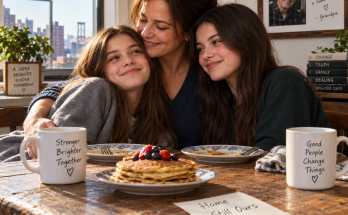
I ordered pancakes because it felt appropriate.
Mom watched me pour too much syrup.
“You know,” she said, “this all started because you didn't study fractions.”
I pointed my fork at her.
“That is an unfair interpretation.”
Valeria laughed.
“It is technically true.”
“I saved the family.”
“You also skipped a test.”
“Both things can be true.”
Mom smiled.
That sentence stayed with me.
Both things can be true.
I lied.
And being home saved us.
Mom missed warning signs.
And she protected us when she understood the danger.
Marianne helped hurt us.
And later helped expose the operation.
Trevor cooperated.
And remained responsible for terrible things.
Grandpa was afraid.
And kept going.
Truth wasn't simpler than lies.
It was just sturdier.
After lunch, Detective Shah called Mom.
Investigators had finished examining the original ledger.
There was enough documentary evidence to identify every major transfer route used during the early years of the scheme.
Several former employees would have disciplinary records reviewed.
The company had agreed to establish an independent process for correcting false findings against workers blamed for manipulated losses.
Mom sat quietly after hanging up.
“Grandpa did that.”
“What?”
“He gave those people their names back.”
I understood what she meant.
A person could lose money and replace it.
Lose a job and perhaps find another.
But being told you were dishonest when you weren't could stay inside you.
Grandpa’s records might finally remove that stain for people he never knew.
We returned home before sunset.
Mom unlocked the door.
For the first time, nobody flinched at the sound of the key.
Inside, Valeria dropped her backpack beside the stairs.
Then stopped.
She stared at it.
I knew exactly what she was thinking.
“You want a new one?”
“Yes.”
“Different color?”
“Absolutely.”
Mom overheard.
“Tomorrow.”
Valeria looked relieved.
The blue backpack had become evidence, then property returned by police, then an object she couldn't look at without remembering the principal’s office.
She didn't owe it loyalty.
Some things deserved replacing.
Others didn't.
Grandpa’s table stayed.
That night I studied fractions at it.
Mom sat across from me reviewing documents from her lawyer.
Valeria corrected my homework.
The apartment sounded ordinary.
Pencils.
Paper.
The refrigerator motor.
Traffic outside.
Then Mom’s phone rang.
She answered.
Her face changed.
I put down my pencil.
“What?”
She listened.
Then looked at us.
It was Detective Shah.
Police had completed another search connected to Leonard Voss.
They found records showing that Grandpa had not been the only employee who tried to expose the theft years earlier.
A second whistleblower had disappeared from company records shortly afterward.
Not physically disappeared.
Professionally.
Fired.
Discredited.
Forced out.
Her name was Avery Moss.
The woman who had spoken to us from Vermont.
But there was something Avery had never told investigators.
After Grandpa died, she had secretly kept one final copy of his evidence.
And she had just contacted Shah to say she was ready to bring it in.
Mom asked what it contained.
Shah’s answer made her sit down.
A signed statement from Grandpa.
Written the morning of the day he died.
And in that statement, Grandpa named the person he believed would come after Ellen next.
Click here to continue reading: PART 25: Grandpa’s Final Statement Named the Person He Feared Would Target Mom Next, and the Answer Forced One Last Reckoning With the Past
The Fever I Invented Kept Me Home Long Enough to Hear the One Conversation Ralph Never Expected Anyone Else to Hear
Part 24 of 26