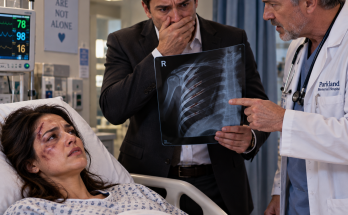
The photograph was taken from almost two hundred yards away.
The investigator determined that from the angle, whoever took it had been standing near an abandoned warehouse.
We went there the following morning.
The warehouse had been empty for years.
There was no sign that anyone lived inside.
But someone had been using the upper floor.
A folding chair stood beside a window.
A thermos sat on the floor.
There were cigarette ashes in a metal cup.
And on the wall was a collection of photographs.
My foundation.
My father.
Evelyn.
Claire.
David.
Jason.
Even Richard.
The photographs had been taken at different times.
Some were recent.
Some were years old.
I stared at them.
“This isn't Mercer.”
The investigator agreed.
“Mercer has been under constant surveillance.”
“Then who?”
We searched the room.
A filing cabinet contained copies of public records.
Nothing illegal.
Then we found a notebook.
The handwriting was unfamiliar.
The entries were brief.
Dates.
Locations.
Names.
One entry was circled.
“Sarah Bennett — independent.”
I looked at the investigator.
“What does that mean?”
He read the next line.
“Refuses settlement.”
My attorney had negotiated dozens of settlements.
I had rejected several.
People connected to the old network had offered money to close certain claims.
I had refused.
The notebook showed that someone had been tracking those decisions.
Another entry read:
“Foundation expanding.”
Then:
“Evelyn returned.”
Then:
“Thomas active.”
The last entry was dated two days earlier.
“Final contact.”
I felt cold.
“Contact with whom?”
We didn't know.
But the notebook contained an address.
A restaurant.
We went there.
The owner remembered a man asking questions about the foundation.
“He came alone.”
“Can you describe him?”
“Gray hair. Mid-sixties. Tall.”
“Did he give a name?”
“Mr. Hale.”
The investigator checked the name.
Nothing.
But the description matched someone in the old photographs.
Anton Vale.
My father recognized him immediately.
“He changed his name.”
“Apparently.”
“Why would he be watching me?”
“Because you inherited what he couldn't control.”
My attorney disagreed.
“Or because he wants to know whether the network is actually finished.”
Either explanation was possible.
We spent days tracing Hale.
Eventually we found a property.
Small.
Remote.
Registered to a company created forty years earlier.
The company had never conducted visible business.
The investigator obtained a warrant.
Inside, they found records.
Not financial records.
Personal ones.
Birth certificates.
Marriage records.
Death certificates.
Addresses.
The files covered hundreds of people.
The network had kept information on everyone who mattered.
Then I saw my own file.
It contained photographs of me as a child.
School records.
Addresses.
My mother's notes.
I felt sick.
“How did they get this?”
My father answered.
“Through people.”
People at schools.
Banks.
Hospitals.
Government offices.
Not necessarily conspirators.
Sometimes people simply did what they were paid to do.
My file included a note from the year I turned sixteen.
“Mother continues to resist.”
Another from when I turned twenty-one.
“Trust structure activated.”
Another from the year my mother died.
“Transfer expected.”
The final entry was dated the morning of the six a.m. confrontation.
“Beneficiary now accessible.”
I understood.
They had been waiting for the moment I became the central beneficiary.
The knock at the door had not been spontaneous.
It had been planned for years.
The investigator found one final folder.
It belonged to my mother.
Inside was a list of everyone she believed might eventually come after me.
Most names were crossed out.
Mercer.
Richard.
Thomas Reed.
Claire.
Others.
At the bottom was one uncrossed name.
Anton Vale.
Evelyn looked at the document.
“He never trusted anyone.”
“Did my mother fear him?”
“Yes.”
“Why?”
“Because he knew how to make people disappear without touching them.”
The phrase reminded me of my father's story.
I looked at my father.
“Was Vale behind the accident?”
He hesitated.
“We never proved it.”
The investigator said, “But the evidence suggests he had access.”
That was enough for me.
We did not need another confession.
The legal case against Vale would depend on evidence.
Not history.
Not suspicion.
The search continued.
Three days later, police located him.
He did not resist.
He was sitting in a small apartment reading a newspaper.
He looked ordinary.
That was the strangest part.
No dramatic hideout.
No weapons.
No stacks of cash.
Just an old man in a chair.
When I saw him, I expected anger.
Instead, I felt tired.
He looked at me.
“Your mother would have liked that expression.”
“What expression?”
“You're not frightened.”
“I was.”
“Not anymore.”
“No.”
He smiled faintly.
“Then she succeeded.”
I sat across from him.
“Why did you watch me?”
“To see whether you would become like her.”
“And?”
“You didn't.”
I waited.
“What did you want?”
“Nothing from you.”
“That isn't true.”
“No.”
He sighed.
“I wanted to know whether the structure could survive without us.”
“What structure?”
“The system.”
“It's gone.”
“No.”
His answer was immediate.
“It changed.”
I looked at him.
“You're admitting it exists?”
“I am telling you that systems don't disappear because one group is arrested.”
“Then what should I do?”
“Nothing.”
I frowned.
“That doesn't sound like advice.”
“It isn't.”
He looked toward the window.
“It's a warning.”
He explained that the old network had fractured.
Some people had been arrested.
Some had disappeared.
Some had simply changed professions.
The methods remained.
The temptation remained.
The money remained.
But the original organization was gone.
I asked him why he had not destroyed my mother.
He looked at me.
“Because she was useful.”
I felt anger rise.
“She was a person.”
“To you.”
“And to you?”
He said nothing.
That was answer enough.
I stood.
“You're going to prison.”
“Perhaps.”
“Do you regret anything?”
He considered it.
“No.”
I expected that.
Then he added:
“I regret underestimating your mother.”
That was the closest thing to remorse he offered.
The legal proceedings against him began.
The evidence was extensive.
The photographs.
The records.
The surveillance.
The financial links.
The old accident report.
The investigator built the case carefully.
I did not participate beyond providing documents and testimony.
That was intentional.
I did not want revenge to become part of the process.
I wanted facts.
Months later, the court recognized that the old network had operated through multiple entities and individuals.
Not every suspected connection could be proven.
Some questions remained unresolved.
That was acceptable.
Truth did not require every mystery to have a dramatic answer.
Some things remained unknown because there was not enough evidence.
I learned to live with that.
The foundation continued growing.
Evelyn helped establish a scholarship for people whose families had been damaged by financial fraud.
My father created a small legal fund.
Michael joined the board.
Claire eventually began working with a financial-crime nonprofit after completing her legal obligations.
She and I never became close.
But we spoke occasionally.
That was enough.
David apologized once.
I accepted the apology.
I did not restore the relationship.
Forgiveness did not require returning someone to the same place in your life.
That was another lesson my mother had left me without saying it directly.
One evening, I returned to the warehouse where the photographs had been found.
It had been cleared out.
The walls were bare.
I stood where my own photograph had once hung.
There was nothing there now.
I felt strangely relieved.
The watchers were gone.
Or at least, the ones we knew about.
I walked outside.
The sun was setting over the railway line.
My phone vibrated.
A message from Evelyn.
“Your father wants you at dinner.”
I smiled.
For most of my life, family had meant secrets.
Now it meant someone asking whether I would come to dinner.
I typed back.
“Yes.”
Then I looked toward the road.
No one was waiting.
No camera flashed.
No black sedan moved away.
I breathed slowly.
The past had not vanished.
It had simply stopped controlling the present.
And that, I realized, was enough.
Click here to continue reading: PART 23: On the Night We Finally Gathered Without Fear, My Father Told Me the One Truth He Had Kept Even From My Mother
Six Months After My Mother’s Death, My Husband Arrived Before Sunrise With a Demand That Revealed More Than He Intended
Part 22 of 24