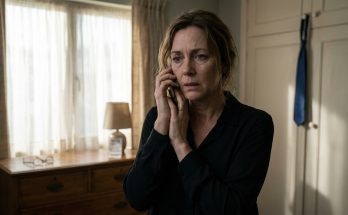
Four years after Dad died, Mark stopped asking about me.
I learned that from Ben, though not because I asked.
By then Ben visited him three or four times a year. Sometimes they wrote between visits. Sometimes months passed without contact.
I had become comfortable with the arrangement because it was no longer an arrangement involving me.
Ben did not report on Mark.
Mark did not send messages through Ben.
I did not ask what they discussed.
Those boundaries had taken time to establish, but once established they became ordinary.
Then one Sunday afternoon Ben came to my house carrying groceries and a question.
He put tomatoes on the counter.
“Dad asked me something.”
I looked at him.
“About me?”
“Yes.”
I waited.
“He said I didn’t have to ask you.”
“That’s new.”
Ben smiled faintly.
“He said if I thought it would bother you, forget it.”
“What did he want to know?”
Ben unpacked the rest of the bag before answering.
“He asked whether you’re happy.”
The question was so simple I almost distrusted it.
Not whether I hated him.
Not whether I forgave him.
Not whether Daniel and I were serious.
Not whether I still had the inheritance.
Happy.
“What did you tell him?”
“That it wasn’t my question to answer.”
I smiled.
“You’ve learned.”
“Unfortunately.”
He placed a carton of eggs in the refrigerator.
“So?”
“So what?”
“Are you?”
I leaned against the counter.
“Yes.”
Ben nodded.
Then he reached for another bag.
“Okay.”
“You’re not going to tell him?”
“You tell me.”
That was the important part.
I thought about it.
Years earlier I might have refused simply because Mark wanted to know. Refusal would have felt like reclaiming power.
But choosing the opposite of what someone wants is still allowing their desire to shape your choice.
Did I care if Mark knew I was happy?
No.
Did telling him create a door?
No.
Did I want Ben placed in the middle?
Also no.
“You can tell him I’m doing well.”
Ben waited.
“That’s it?”
“That’s it.”
He nodded.
No message.
No lesson.
No forgiveness hidden between words.
Just a fact.
I was doing well.
Daniel and I had been together almost a year by then.
We still lived separately.
He kept a toothbrush at my house.
I kept hiking shoes at his.
That was the extent of our domestic merger.
Some friends found this amusing.
Melissa found it deeply sensible.
“You should make him submit quarterly financial statements.”
“I’m not doing that.”
“Background check?”
“Already did.”
She stared.
I laughed.
“Kidding.”
I was mostly kidding.
Caution had not vanished from my life.
I still read contracts.
I checked financial statements.
I refused to sign anything I had not read.
Those habits no longer felt pathological.
They felt adult.
The difference was fear.
I no longer believed every unanswered question concealed a crime.
Trust had returned in smaller units.
Earned.
Observed.
Revisable.
Daniel understood that better than anyone I had dated before Mark.
One evening he asked whether I ever wanted to marry again.
We were washing dishes.
No restaurant.
No ring.
No theatrical timing.
I dried a plate.
“I don’t know.”
“Okay.”
“That’s all?”
“What else?”
“Aren’t you supposed to look wounded?”
“Would that help you decide?”
“No.”
“Then I’ll save it.”
I laughed.
He handed me another plate.
Months later, I raised the subject myself.
“I think I might.”
Daniel turned down the television.
“Might what?”
“Get married again.”
He looked at me carefully.
“To me?”
“Preferably.”
That was how we became engaged.
No surprise proposal.
No audience.
No assumption that my hesitation needed conquering.
We chose the ring together.
Small.
Simple.
I paid half.
Daniel protested once.
I stared at him.
He said, “Right. Terrible audience for that argument.”
We laughed in the jewelry store.
When I told Ben and Sophie, their reactions differed.
Ben hugged me.
Sophie cried.
Then she apologized for crying.
“Why are you apologizing?”
“I don’t know.”
“Happy?”
“Yes.”
“Then cry.”
She hugged Daniel next.
Melissa brought champagne and announced that she had personally investigated him.
Daniel asked:
“Should I be worried?”
“Yes,” she said.
“No,” I said.
“Probably,” Sophie added.
It was the kind of family evening I once thought we might never have again.
Not because everyone had healed perfectly.
Because nobody was pretending.
Dad’s absence was present too.
That was allowed.
When Daniel and I discussed the wedding, I surprised myself.
I wanted it small.
Not secret.
There was a difference.
Mom and Dad had taught me what secrecy cost.
Privacy was chosen.
Secrecy was imposed.
We invited forty people.
Ben.
Sophie.
Melissa and Aaron.
Samuel.
Nora.
Jenna.
Rachel.
A few friends.
No press.
No elaborate venue.
A garden behind a restaurant Daniel loved.
The inheritance paid for none of it.
Not because I had a moral objection.
Because I wanted the wedding to fit our ordinary finances.
Dad’s money had already done enough strange work in my life.
The trust remained healthy.
The scholarships had expanded.
The legal-aid pilot became permanent after an independent review showed it was actually useful.
The hospital training program continued.
I had begun treating the trust less like Dad’s final instruction and more like a responsibility I happened to hold.
Samuel’s replacement handled administration.
I approved distributions.
Asked questions.
Then returned to work.
The money did not tell me who I was.
That may have been the greatest victory over Mark’s original assumption.
Why keep working?
Because work was not merely what people did until somebody died rich enough to rescue them.
Purpose could not be inherited.
At the wedding, Ben walked me through the garden.
I had told him I did not need anyone to give me away.
He agreed.
Then asked whether he could walk with me anyway.
That felt different.
Halfway down the path he whispered:
“Grandpa would’ve complained about the flowers.”
“He would’ve complained about the chairs.”
“And the food.”
“He hadn’t eaten it yet.”
“Wouldn’t matter.”
I smiled.
Dad would have found something wrong because that was how he participated.
Missing him hurt.
The hurt did not ruin the day.
Daniel waited at the end.
Nobody gave me away.
Ben kissed my cheek and sat beside Sophie.
I arrived under my own power.
Our vows were short.
Daniel promised honesty even when honesty was inconvenient.
I had not asked him to include that.
My throat tightened.
My own promise was simpler.
“I will tell you what I know, ask when I don’t, and never mistake love for ownership.”
Daniel’s eyes filled.
So did mine.
We signed the marriage license afterward.
I read every line.
Daniel watched.
“Anything suspicious?”
“Your handwriting.”
“Too late.”
“No forged LLC?”
“Not this week.”
The joke should have been impossible.
Instead it made me laugh.
Humor had become another way the past lost its authority.
We did not combine all our finances.
We created one household account and kept separate personal accounts.
Daniel had suggested it before I did.
No drama.
No symbolism.
Just structure that made both of us comfortable.
I kept the surname Hail.
Daniel never asked me to change it.
At work on Monday, Jenna looked at my badge.
“Still Hail?”
“Still Hail.”
“Good.”
That was that.
Several months after the wedding, Melissa received notice that Diane had become eligible for a supervised family program.
She wanted Melissa to attend counseling with her.
Melissa asked what I thought.
“What do you want?”
“I knew you’d say that.”
“You keep asking.”
She rolled her eyes.
Then grew serious.
“I think I want to go.”
“Then go.”
“I’m afraid she’ll think that means I forgive everything.”
“Tell her before you start.”
Melissa did.
The counseling was difficult.
Sometimes she came out angry.
Sometimes sad.
Once she called me from the parking lot laughing.
“What happened?”
“Mom spent twenty minutes explaining why she hates prison meatloaf.”
“That sounds useful.”
“It was weirdly normal.”
Normality could exist even inside consequences.
Diane remained incarcerated.
Her relationship with Melissa did not erase that.
Neither did her remorse.
She was simply learning how to be a mother without using fear as an excuse for control.
Late, but not meaningless.
Richard’s health deteriorated.
I heard through the victim-notification system that he had been transferred to a prison medical facility.
I did not visit.
He sent no request.
That surprised me.
Perhaps his attorneys advised against it.
Perhaps age changed him.
Perhaps he finally understood I would not come.
I did not investigate.
His inner life no longer belonged on my list of unanswered questions.
Then one morning I received a call from Ortiz.
We had not spoken in nearly a year.
“I thought you were done with me,” I said.
“I was hoping.”
“What happened?”
“Nothing bad.”
That was an excellent opening.
She told me an evidence-retention review had uncovered one personal object belonging to Dad.
Not legally significant anymore.
A pocket notebook recovered from his safe-deposit materials.
Most pages contained mechanical measurements, phone numbers, and grocery items.
One page mentioned me.
Ortiz could mail it.
I asked her to.
The notebook arrived in a padded envelope.
Dad’s handwriting filled the pages.
Valve dimensions.
A plumber’s number.
Buy coffee.
Call Clare.
Near the back was a list dated six months before his death.
Things I need to tell her.
Richard.
Mark.
Trust.
Elaine.
Apologize.
Then, beneath those:
Ask about her garden.
I sat at the kitchen table and laughed until I cried.
Dad had been preparing to confess the most consequential secrets of my life.
And somewhere in the middle of that fear, he remembered he wanted to ask about tomatoes.
That line gave him back to me more completely than any recording.
He had not spent his final months only investigating danger.
He still wondered about my garden.
I framed that page.
Not the trust.
Not the adoption order.
Not his final apology.
Ask about her garden.
Daniel hung it near the back door.
The following spring, we planted tomatoes.
I was terrible at it.
Dad had been too.
The plants grew sideways.
One collapsed after a storm.
Daniel suggested stakes.
I said:
“Dad considered stakes an insult to the plant’s character.”
“Your father sounds exhausting.”
“He was.”
We stood in the dirt laughing.
A week later, Ben visited Mark again.
When he came home, he told me he had passed along my answer from months earlier.
“What answer?”
“That you’re doing well.”
I had forgotten.
“What did he say?”
“Nothing for a while.”
Ben opened the refrigerator.
“Then he said he was glad.”
I waited for some reaction inside myself.
There was none.
Not anger.
Not satisfaction.
Not tenderness.
Just information.
Ben took out water.
“He also said something else.”
I looked at him.
“He said he used to imagine you being miserable without him because that would prove you needed him.”
That sounded like Mark.
“He said now he hopes he never mattered that much.”
I considered the sentence.
“He mattered.”
Ben looked at me.
“I know.”
“He just doesn’t get to decide how.”
That was the answer.
Mark mattered because twenty-two years happened.
Because Ben and Sophie existed.
Because memories existed.
Because harm existed.
Because love once existed too.
Erasing him would require erasing pieces of my own life.
I had no interest in doing that.
But importance was not ownership.
History was not entitlement.
The next time I visited Dad’s grave, I told him about Daniel.
About the wedding.
About the crooked tomatoes.
I did not mention Mark.
Not because I was avoiding him.
Because he was no longer the most interesting thing happening.
Before leaving, I placed the pocket notebook page against the stone for a moment.
“Garden’s terrible.”
A breeze moved through the grass.
“Your fault genetically, probably.”
I smiled.
Then I went home.
That evening Daniel was cooking.
Badly.
Smoke came from a pan.
The alarm sounded.
For one second my body froze.
Ventilator alarms.
Carbon monoxide alarms.
The detector Mark disabled.
All of it flashed through me.
Daniel turned off the burner.
“Sorry.”
I looked at the ceiling.
The smoke detector kept shrieking.
Loud.
Functional.
Annoying.
I started laughing.
Daniel stared.
“What?”
“Nothing.”
“You’re laughing at my cooking.”
“Yes.”
“That’s fair.”
He opened a window.
The alarm stopped.
I stood beneath it after the room cleared.
A machine had detected danger.
Made noise.
Someone responded.
Nothing was hidden.
Nothing had been silenced.
It was such a small thing.
It felt enormous.
Click here to continue reading: PART 26: Dad Left Me Eight Million Dollars, but the Real Inheritance Was the Life I Finally Learned No One Else Could Claim
Three Days After Dad Died, My Husband Started Spending an Inheritance Neither of Us Had Even Seen Yet
Part 25 of 26