
“Videos of you doing what?”
Hannah did not answer immediately.
I could hear her breathing through the phone, too fast and shallow.
“Hannah?”
“Just… me.”
“What does that mean?”
“Homework. Sitting in my room. Talking to Emma.”
My hand closed around the edge of Melissa’s desk.
“Are you alone?”
“Yes.”
“Do not open anything else.”
“I already opened some.”
“That’s okay. Close the laptop.”
“Mom—”
“Please.”
She went quiet.
Then I heard the faint click of a computer lid.
“It’s closed.”
“Take the drive out.”
“I don’t want to touch it.”
“You don’t have to. Leave everything where it is. I’m coming home.”
Melissa was already gathering her things.
“We should preserve the device before anyone changes anything.”
I nodded.
Rachel stood beside the conference table looking sick.
“Mark gave that to her as a birthday present.”
“Yes.”
“I watched him wrap it.”
“So did I.”
We drove separately.
By the time I reached the house, Hannah was sitting on the staircase with her arms wrapped around her knees.
The laptop remained on her desk upstairs.
The silver drive protruded from its side.
I stopped at the bedroom door.
For months, this room had become the center of everything we had failed to notice.
The papers under the mattress.
The conversations with Emma and Jayden.
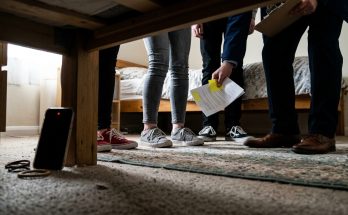
Me hiding beneath the bed.
Mark entering.
Now another secret waited on the desk.
Hannah remained behind me.
“Did Dad record those?”
“I don’t know yet.”
“I saw myself sleeping.”
I turned.
“What?”
Her face had lost all color.
“There’s a video where I’m asleep.”
“When?”
“I don’t know.”
“Where?”
“In here.”
I looked at the room differently.
Bookshelf.
Lamp.
Desk.
Closet.
Every object became a possible hiding place.
“Hannah, did you see where the camera was?”
“No.”
“How could you tell it was this room?”
“My blanket. The old green one.”
She had stopped using it almost two years ago.
That pushed the recording backward again.
Melissa arrived with a forensic technician named Aaron Pike, whom she had used in other cases.
He photographed the laptop and drive before touching either.
Then he asked Hannah exactly what she had done.
She answered carefully.
“I plugged it in because I needed space for a school video.”
“Did anything open automatically?”
“No.”
“What did you click?”
“A folder with my initials.”
“HC?”
“Yes.”
“What did you open?”
“A folder called Home.”
“How many files?”
“I don’t know. A lot.”
“Did you rename, move, or delete anything?”
“No.”
“Did you copy anything?”
“No.”
Aaron nodded.
“That helps.”
Hannah looked at me.
“Am I in trouble?”
“No.”
Aaron answered too.
“Not at all.”
He removed the drive using a protective storage process I did not understand and took a forensic copy.
The original went into an evidence bag.
Seeing Hannah’s birthday present sealed in plastic made my stomach twist.
Melissa asked whether Hannah should stay with Rachel that evening.
Hannah immediately refused.
“I want to know what’s on it.”
“You may not want to see everything.”
“It’s me.”
“That doesn’t mean you should have to watch it.”
She looked at Melissa.
“Everyone keeps deciding what I should know about my own life.”
Nobody answered quickly enough.
Hannah’s eyes filled.
“I know I’m thirteen. I know there are legal things I don’t understand. But those are videos of me.”
Melissa softened.
“You’re right.”
“Then don’t hide them from me.”
“We won’t hide what affects you. But we’re also not going to make you watch material that may be upsetting just because it exists.”
Hannah considered that.
“Can you tell me what it is?”
“Yes.”
“Honestly?”
“Yes.”
She nodded.
That was the agreement.
Aaron called the following afternoon.
The drive contained considerably more than Hannah had seen.
There were ordinary folders too.
School projects.
Photos.
Music.
Videos Hannah had saved herself.
But beneath a hidden directory was an archive she had never created.
HC_Observation.
My stomach turned when Melissa read the name aloud.
Inside were subfolders labeled by month.
The oldest dated back twenty months.
Hannah had been eleven.
Some recordings were harmless family videos Mark had apparently copied from phones.
Others were not.
Short clips filmed without obvious consent.
Hannah arguing about bedtime.
Hannah crying after a fight with Emma.
Hannah telling me I was unfair.
Hannah slamming a bedroom door.
Hannah refusing to speak to Mark after he confiscated her phone.
Individual moments.
Selected.
Categorized.
Tagged.
“What were the categories?” I asked.
Melissa hesitated.
“Defiance.”
I closed my eyes.
“Maternal Alignment.”
My nails pressed into my palms.
“Peer Influence.”
Of course.
“And one called Separation Response.”
I looked at her.
“What does that mean?”
“We don’t know yet.”
Aaron had also found copies of my recordings.
Kitchen_full_01 was there.
Complete.
Twenty-nine minutes.
Not the shortened excerpt Mark submitted.
The full recording began with my mother asking why I was crying.
My voice answered.
Because Mark told me that if I ever leave, he’ll make Hannah understand I chose to break the family.
I remembered the conversation with painful clarity now.
My mother said, “Did he threaten to keep her from you?”
I answered, “Not exactly. He keeps saying she’ll have to know the truth about who left.”
Then came the missing context.
“He told me children eventually figure out which parent is loyal.”
My mother’s voice sharpened.
“That’s not normal.”
“I know.”
“What did you say?”
“I told him I won’t let Hannah become a weapon.”
A pause.
Then my own voice cracked.
“Sometimes I think Hannah and I would be calmer if it were just the two of us.”
That was where Mark’s exhibit had begun.
Without the first twenty-three minutes, it sounded like a mother contemplating taking her daughter.
With them, it sounded like a wife afraid her husband was already turning separation into a loyalty test.
Melissa listened twice.
“Did Mark know this full recording existed when he submitted the excerpt?”
“It was on his archive.”
“That doesn’t prove he personally made the export.”
“Who else would?”
“We establish before assuming.”
Facts before explanations.
I hated how often I needed that reminder.
The metadata helped.
The trimmed version had been created on Mark’s laptop six days before his attorney submitted it.
The full version had been accessed the same evening.
Melissa called Mark’s attorney.
I was not on the call.
When she called me afterward, her voice was controlled.
“They say they were given the edited file by their client.”
“Meaning Mark.”
“Yes.”
“Did they know it was edited?”
“They say no.”
“Do you believe them?”
“It doesn’t matter what I believe yet.”
“What happens?”
“We disclose the full version and forensic findings.”
“And the videos of Hannah?”
“That is more serious.”
“How serious?”
“Potentially very.”
Some recordings appeared to come from fixed positions inside the house.
Aaron was still determining devices.
One clip showed Hannah sleeping.
Another showed her talking privately to Emma.
Another captured me sitting at the edge of Hannah’s bed after an argument with Mark.
The angle came from high on a shelf.
I remembered an old phone Mark kept there once, supposedly because he used it as a music player.
Hannah had asked why it was always plugged in.
Mark said the battery was bad.
The camera had a clear view of the room.
My chest tightened.
“How many recordings came from that phone?”
Aaron estimated dozens.
“Audio too?”
“Yes.”
“Did Mark record our daughter’s bedroom?”
“It appears so.”
I felt physically ill.
There are forms of betrayal that anger can hold.
This one produced something quieter.
Violation.
Hannah’s room had been the one place she believed belonged to her.
Even during the worst months, she closed the door and thought she was alone.
She had not been.
When we told her, she walked upstairs without speaking.
Ten minutes later I heard drawers opening.
Then shelves.
Then furniture scraping.
I found her pulling books off the bookcase.
“What are you doing?”
“Looking.”
“For what?”
“Cameras.”
“There aren’t any now.”
“How do you know?”
The question stopped me.
“I don’t.”
She ripped another stack of books down.
“Hannah.”
“Don’t tell me to calm down.”
“I wasn’t going to.”
“Everybody keeps telling me what Dad did was because he was scared.”
“I haven’t said that.”
“You said maybe he was scared when he heard the kitchen recording.”
“That’s different.”
“Is it?”
She turned toward me.
“He recorded me sleeping.”
Her face crumpled.
“He watched me when I thought I was alone.”
I moved closer.
She stepped back.
I stopped.
“I don’t want anyone touching me.”
“Okay.”
“I don’t want anyone in here.”
“Okay.”
“Even you.”
That hurt.
I nodded.
“Okay.”
I left.
For the next three nights, Hannah slept on the sofa.
Not because she was afraid of Mark entering the house.
Because she could not tolerate her bedroom.
Dr. Ruiz was informed.
So was Hannah’s advocate.
The supervised visits were suspended pending review.
Mark objected immediately.
He claimed the recordings were for documenting behavioral concerns.
His attorney wrote that he had used old phones as household monitoring devices during periods of family conflict.
Melissa read that sentence aloud.
“Household monitoring devices.”
“In Hannah’s bedroom.”
“Yes.”
“Did I consent?”
“No.”
“Did she?”
“No.”
“Then what exactly are we discussing?”
“His explanation.”
I stood by the window.
“He always has one.”
“Yes.”
“Does an explanation ever stop mattering?”
“No. But sometimes it stops helping.”
The hidden archive contained a text file.
Not one of Mark’s narrative summaries.
A plain list.
Dates.
File names.
Notes.
Aaron recovered several deleted entries.
One referred to a video of Hannah crying after a disagreement with Mark.
Beside it:
Useful if H later denies emotional volatility around boundaries.
Another:
C comforts H after discipline. Reinforces rescue dynamic.
Another:
H tells E she wishes Dad would leave her alone. Peer influence evident.
He had watched their private conversation.
Then interpreted it in real time.
The final recovered note was different.
Prepare for transition before filing.
I stared at the words.
“What transition?”
Melissa scrolled.
Below it:
H room attachment high. Consider relocating belongings gradually if primary residence changes.
My entire body went cold.
He had planned how to move her.
Not legally.
Emotionally.
Her belongings.
Her room.
Her resistance.
Hannah’s attachment to her own bedroom had become a logistical problem.
Melissa closed the file.
“That is enough for today.”
“No.”
“Claire.”
“No. Keep going.”
The next entry:
Reduce C-centered photos in new environment.
I stopped breathing.
“What?”
Melissa looked at me.
“Hannah’s photos of you.”
“He planned to remove them?”
“It appears he considered limiting them.”
“Why?”
“Read the next line.”
She did.
Avoid reinforcing separation distress through visual triggers.
I sat down.
Mark had not simply prepared for custody.
He had planned the atmosphere afterward.
Fewer photographs of me.
Less reinforcement of grief.
Gradual relocation of Hannah’s belongings.
Neutral framing.
Time.
The same logic from the Narrative files.
Emotional certainty weakens when isolated from confirmation.
He had intended to isolate her from reminders of me until missing me became easier to reinterpret.
I finally understood the folder called Separation Response.
It contained clips of Hannah reacting whenever Mark mentioned trips, sleepovers, or time away from home.
He had been measuring how she handled absence.
Not because separation had occurred.
Because he anticipated it.
That evening, I sat on the floor outside Hannah’s bedroom.
The door stayed closed.
“I know you don’t want me inside.”
No answer.
“I’m not coming in.”
Silence.
“I need to tell you one thing.”
The door opened a few inches.
Hannah’s face appeared.
“What?”
“Your dad kept notes about how you might react if you lived apart from me.”
Her eyes narrowed.
“What kind of notes?”
“He thought you might miss me and that the feelings could change over time.”
“That’s obvious.”
“Yes.”
“There’s more.”
“Yes.”
“Tell me.”
“He considered removing some pictures of me from wherever you lived.”
Her face went blank.
“Why?”
“He wrote that they could make separation harder.”
The door opened wider.
“So he was going to make me forget you?”
“No.”
“Sounds like it.”
“I don’t know what he intended beyond what he wrote.”
Hannah looked furious.
“I do.”
I waited.
“He wanted me to stop trusting how I felt.”
She understood it faster than I had.
“If I missed you, that meant I was attached.”
“Yes.”
“If I wanted to come home, that meant I was influenced.”
“That appears to be how he described it.”
“If I got used to living with him, that meant he was right.”
I did not answer.
She laughed once.
There was no humor in it.
“He always wins.”
“Not if other people refuse the rules.”
She looked at me.
That sentence seemed to reach her.
The next morning, Dr. Ruiz requested an emergency status conference.
Mark’s attorney opposed it.
The court scheduled it anyway.
Before we left, Hannah stopped me at the door.
“Mom?”
“Yes?”
“If they ask why I don’t want to see Dad right now, can I tell them?”
“Yes.”
“What if it hurts him?”
I thought of every adult who had taught her to carry responsibility for Mark’s reactions.
“That belongs to him.”
At the conference, Dr. Ruiz spoke first.
She did not use dramatic language.
She described the undisclosed bedroom recordings as a significant boundary violation.
She noted that some recordings had later been categorized for custody-related use.
She expressed concern about Mark’s repeated tendency to treat normal developmental independence as evidence of external influence.
Then Mark asked to speak.
His attorney looked unhappy but allowed it.
“I love my daughter.”
Nobody challenged that.
“I was terrified I was losing her.”
His voice cracked.
“I made mistakes.”
For the first time, he used the word.
Mistakes.
Not concerns.
Not misunderstandings.
Not necessary precautions.
“I recorded things I should not have recorded.”
Hannah looked at him from across the room.
Mark continued.
“But I never intended to harm her.”
Dr. Ruiz asked, “Why were photographs of Claire described as visual triggers?”
His face tightened.
“That was theoretical planning.”
“For what?”
“In case Hannah needed a period of stability.”
“Away from her mother?”
“Yes.”
“And you believed reducing reminders of Claire would help?”
“I was advised that children sometimes need transition support.”
“By whom?”
Mark hesitated.
Melissa noticed.
So did I.
“By whom?” Ruiz repeated.
Mark looked at his attorney.
“I read extensively.”
“That isn’t what you said.”
He swallowed.
“There was someone I consulted.”
My pulse jumped.
“Who?”
His attorney requested a brief recess.
The judge denied it.
Mark stared at the table.
Finally:
“Daniel Mercer.”
Melissa turned toward me.
I did not recognize the name.
Dr. Ruiz apparently did.
Her expression changed.
“Daniel Mercer the family consultant?”
“Yes.”
“When did you consult him?”
Mark did not answer immediately.
“Before Dr. Vale.”
“How long before?”
Another pause.
“About two years.”
The room went silent.
Two years.
Hannah had been eleven.
Dr. Ruiz asked the next question.
“Was Mr. Mercer the person who advised you to document Hannah’s responses to separation and reduce visual reminders of Claire if custody changed?”
Mark looked trapped.
Then he said:
“He helped me understand how children detach from unhealthy parental dependence.”
Hannah made a small sound beside her advocate.
I turned.
She was staring at Mark.
Not crying.
Not frightened.
Disbelieving.
Dr. Ruiz asked, “Had you told Mr. Mercer Claire was an unhealthy parental influence?”
Mark answered:
“Yes.”
“When?”
He looked toward me.
Then away.
“Before any of this started.”
And just like that, the beginning moved backward one final time.
Not to the birthday.
Not to the kitchen recording.
Not to Mrs. Donnelly.
Two years earlier.
Before I had ever considered leaving.
Before Hannah had begun pulling away from Mark.
Before there was a custody case to prepare.
Mark had already found someone willing to help him imagine one.
Click here to continue reading: PART 14: Daniel Mercer Explained the Advice He Gave Mark Two Years Earlier, and One Email Exposed the Fear Mark Had Never Admitted
When the School Called About Hannah’s Absences, I Followed Her Home and Found a Secret She Had Been Protecting
Part 13 of 20

0 Comments on “PART 13 – The Silver Drive Contained Years of Hannah’s Private Moments, but One Hidden Folder Revealed Why Mark Had Been Recording Her at All”