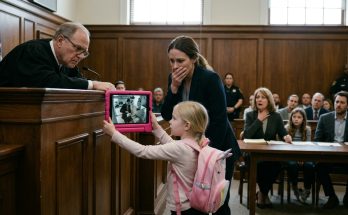
A year after the courtroom video, the carriage house looked almost exactly the same from the outside.
That surprised me.
So much had changed that part of me expected the building to reflect it.
The roof remained the roof I had paid for.
The porch still tilted slightly near the left corner.
The garden fence still needed repainting.
Norah’s bedroom window still stuck during humid weather.
Home had not transformed into a symbol.
It remained a place requiring maintenance.
I liked that.
The deed was securely recorded.
My trust was substantially restored.
The commercial-property sale had closed months earlier, with validated claims distributed under the settlement and court orders.
Natalie’s estate received its portion.
Grandma’s estate matters finally approached closure.
Dad retained whatever lawful interest survived the claims and consequences.
Nobody got everything they wanted.
Everyone got more truth than we had before.
Ava still worked in medical billing.
She had received the promotion.
Her repayment envelopes continued arriving.
Sometimes two hundred dollars.
Sometimes one hundred when money was tight.
Once fifty.
I never commented on the amount.
Consistency mattered more.
She still complained constantly.
That was how I knew she was doing well.
Jacob used part of the money connected to Natalie’s investment to pay off debt and establish savings.
He kept his mechanic job.
“I thought you might quit,” I told him.
“I like cars.”
“Dad would have turned the money into a business.”
“I know.”
“That wasn’t advice.”
“I know.”
He smiled.
His relationship with Dad remained uncertain.
Jacob had agreed to exchange letters.
No visits yet.
I did not ask what the letters said unless he volunteered.
That was his relationship.
Not mine to manage.
Ethan visited twice during the year.
The first time, he and Jacob met properly.
They spent twenty minutes trying to determine what to call one another.
“Step-half-brother?”
“No.”
“Half-sister’s half-brother?”
“Absolutely not.”
“Guy related through Megan?”
“That sounds like a legal warning.”
Eventually Norah solved it.
“You’re both my uncles.”
They accepted her ruling.
Claire visited carefully.
She stayed at hotels.
Then, months later, I invited her to stay in the carriage house for one weekend.
I barely slept the night before.
Not because I feared her.
Because letting my biological mother sleep under my roof felt enormous.
She treated it as ordinary.
Made coffee.
Folded her towels.
Asked before taking Norah to the bookstore downtown.
Left when planned.
That helped more than any dramatic promise could have.
Mom’s visits remained shorter.
More difficult.
She had continued therapy.
She and Dad were no longer living together.
Their marriage had changed under the weight of everything revealed.
Whether it would legally end was their decision.
I did not ask.
Mom rented a small place nearby.
The first time she told me, I almost offered to help move.
Then stopped.
She hired movers.
Everyone survived.
Our relationship developed in cautious increments.
Coffee.
A school recital.
One lunch.
A short visit.
She never used Norah to reach me.
She never entered without permission.
Once she arrived five minutes early and waited in her car until the agreed time.
That tiny act meant more to me than another apology.
Dad remained absent from the house.
We exchanged occasional letters.
I had not visited him.
He had not seen Norah directly.
Sometimes I questioned that boundary.
Then I reminded myself questioning did not require changing it.
Maybe someday.
Maybe never.
I was allowed not to know.
The one-year anniversary of the courtroom passed without ceremony.
Norah remembered.
“Today is video day.”
I looked up from breakfast.
“What?”
“The day we showed Grandma signing your name.”
“That is not a holiday.”
“It should be.”
“No.”
“Can we have cake?”
“Absolutely not.”
She looked betrayed.
“You hate history.”
“I hate unnecessary cake.”
“That’s worse.”
We compromised on cookies.
Later that week, the garden filled again for a smaller gathering.
Not another birthday.
Just dinner.
Claire and Ethan were visiting.
Jacob came after work.
Ava brought salad she claimed to have made herself.
I suspected a grocery store.
Mom arrived with bread.
She stopped at the gate.
It was open.
She still waited until she saw me.
I waved her in.
She smiled.
Progress could become ordinary too.
Nobody had assigned seats.
That produced an unexpected problem.
Mom and Claire ended up beside each other.
Both noticed.
Neither moved.
I watched from the kitchen window.
A year earlier, I would have rushed outside.
Rearranged chairs.
Created a task.
Protected everyone from discomfort.
Instead, I kept slicing tomatoes.
They were adults.
They could survive a chair.
Later I heard Mom say, “I’m sorry about the letter.”
Claire answered, “I know.”
Mom said something quieter.
Claire responded.
I could not hear.
I did not move closer.
Their relationship was not mine to mediate.
Ava and Jacob argued over the grill.
Ethan sided with whoever seemed funniest.
Norah ran between them carrying Horse Evelyn, now slightly flattened from overuse.
At dinner, Claire asked Mom about a recipe from their college years.
Mom remembered.
They laughed once.
Then conversation moved on.
No reconciliation speech.
No announcement that the past was forgiven.
Just a shared memory allowed to exist without controlling the future.
After dinner, Ava cornered me near the porch.
“You’re doing it.”
“What?”
“Nothing.”
“That sounds insulting.”
“No. You’re actually doing nothing.”
I looked around.
Jacob was washing dishes.
Ethan was drying.
Mom and Claire were clearing the table.
Norah was supervising everyone badly.
“I’m hosting.”
“You usually would have reorganized the entire kitchen by now.”
“I have matured.”
“You’re lazy.”
“Leave my property.”
She laughed.
Then hugged me.
I stiffened automatically.
Ava noticed.
“Still weird?”
“Sometimes.”
“Okay.”
She released me immediately.
Another small thing.
No guilt.
No “I’m your sister.”
No demand.
Just okay.
Later, after everyone left, Norah and I sat in the garden.
She had grown taller.
Eight was becoming nine too quickly.
“Do you miss Grandpa?” she asked.
“Sometimes.”
“Me too.”
I looked at her.
“Do you want to write him?”
“Maybe.”
“You can.”
“Will you read it?”
“If you want.”
“Do I have to?”
“No.”
She thought.
“I want you to.”
“Okay.”
The next day she wrote:
Dear Grandpa,
I am good. School is good except fractions. Horse Robert is still alive. Mom says he is not alive because he is stuffed but she is wrong. I miss you. I hope you are learning not to lie.
Love, Norah.
I stared at the last sentence.
“Do you want to change anything?”
“No.”
“Okay.”
We sent it through the approved channel.
Dad replied three weeks later.
He wrote only to Norah.
He told her fractions were terrible but useful.
He was glad Horse Robert remained “alive.”
He said he was trying to become more honest, especially with himself.
No request to see her.
No message to me hidden inside.
I let Norah keep the letter.
That did not mean a visit was next.
A healthy boundary could have a window without becoming an open door.
My financial life became boring.
I loved it.
Quarterly statements.
Independent adviser.
Taxes.
Trust oversight.
No mysterious transfers.
No fake signatures.
No family company.
I knew where the money was.
Norah’s protections were documented.
She would eventually be told what existed and why.
No secret fortune.
No surprise inheritance beneath a floor.
I sometimes wondered what Grandma would think.
She would probably approve of the safeguards.
She might dislike my criticism of her secrecy.
I hoped she would survive it.
People did not need to be perfect to be loved after death either.
One evening Patricia called.
Grandma’s remaining estate administration had finally concluded.
There was one personal item for me.
“Please tell me it isn’t another lockbox.”
Patricia laughed.
“No.”
It was Grandma’s old house key.
Not the carriage-house key.
The main house.
She had carried it for decades.
“Why me?”
“Evelyn left several small personal effects without specific instructions. I thought you might want it.”
I held the key when it arrived.
Heavy brass.
Worn teeth.
A key to a house that had once represented family authority.
Dad’s house.
Mom’s house.
Grandma’s before them.
I did not need it.
I placed it beside the new keys to my carriage house.
The contrast made me smile.
One key represented inherited access.
The other represented chosen access.
A week later, Mom asked whether I wanted the old key returned to the main property.
“No.”
“What will you do with it?”
“I don’t know.”
I eventually put it in the box with Grandma’s letters and recorder.
Not because I wanted to preserve control.
Because history deserved labels.
I wrote:
GRANDMA EVELYN’S KEY — NOT FOR USE.
Then I laughed at myself.
Rachel would have been proud.
By autumn, I realized several weeks had passed without a call from any lawyer.
Then several more.
The silence felt strange.
I called Rachel.
“Is something wrong?”
“With what?”
“The cases.”
“No.”
“Nothing happened?”
“Nothing requiring you.”
I sat back.
“Oh.”
Rachel laughed.
“You are allowed to have a life after litigation, Megan.”
“I know.”
“Do you?”
I looked through the window.
Norah was drawing at the kitchen table.
Ava had sent her monthly payment.
Claire had mailed a postcard.
Mom was coming Sunday for coffee.
Jacob had texted a photograph of an engine I did not understand.
Ethan had sent a joke.
Dad remained outside my daily life.
The trust statement sat unopened because I already knew nothing dramatic had happened.
“Yes,” I said.
“I think I’m starting to.”
That night I checked the front door before bed.
Locked.
Then the back.
Locked.
The security camera blinked quietly above the kitchen.
For months I had seen it as the device that exposed Mom.
Now it was simply a camera again.
Norah appeared in the hallway.
“Mom?”
“You should be asleep.”
“I need water.”
“You needed water ten minutes ago.”
“I’m very hydrated.”
She got a drink.
Then looked at the camera.
“Do we still need that?”
“Yes.”
“Because people lie?”
“Because cameras are useful.”
She nodded.
Then asked, “Are we safe?”
The question was simple.
A year earlier I might have answered too quickly.
Now I looked around.
At the home I legally owned.
At the locks I controlled.
At the documents stored properly.
At the child who knew she could ask questions.
“Yes.”
Norah smiled.
“Good.”
She went back to bed.
I turned off the kitchen light.
For the first time, safety did not mean believing nobody I loved would ever hurt me.
It meant knowing I would no longer cooperate with the harm just to keep them close.
Click here to continue reading: PART 27: The Last Door I Locked Was My Own, and Norah Learned She Would Never Have to Accept Harm to Earn a Place Inside
My Parents Called Me an Ungrateful Guest Until My Daughter Found Something Their Lawsuit Could Never Survive
Part 26 of 27