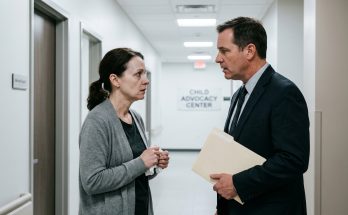
The plea proposal arrived through attorneys.
Mark would accept responsibility for certain offenses involving evidence recovered from the cabin and storage unit.
In exchange, other counts would be dismissed or consolidated.
The language was legal.
Careful.
Almost bloodless.
Ruiz explained it to me first.
Then to Hailey with a victim advocate present.
Hailey listened without interrupting.
When Ruiz finished, she asked, “Does he say he did it?”
“He would enter a guilty plea to specified charges.”
“That’s not what I asked.”
Ruiz waited.
Hailey looked at the document.
“Does he say he hurt me?”
“The written proposal does not use that wording.”
“Why?”
“His attorney drafted it.”
“So Dad gets to admit something without saying what he did.”
Ruiz did not defend the language.
“That is one issue we can negotiate.”
“What does he say happened?”
Ruiz hesitated.
“He accepts that medication was improperly provided and that inappropriate material was created and retained.”
Hailey’s face hardened.
“Improperly provided.”
I felt the same anger.
As though Mark had filled out the wrong form.
“What about the cabin?” Hailey asked.
“The proposal addresses conduct there.”
“Does he say I was afraid?”
“No.”
“Does he say he lied to Mom?”
“Not specifically.”
“Does he say he told everyone I was crazy?”
“No.”
Hailey pushed the paper away.
“Then it sounds like him.”
Ruiz leaned forward.
“What do you mean?”
“He always admits the smallest thing.”
The room went quiet.
“If he screams, he admits he raised his voice.”
I knew.
“If he lies, he says he explained it badly.”
I knew.
“If he hurts somebody, he says they misunderstood.”
Ruiz listened.
Hailey looked at me.
“He’s doing it again.”
“Yes.”
Her eyes filled, but her voice remained steady.
“I don’t want to agree to his version just because it means I don’t have to see him.”
Ruiz nodded.
“You are not required to support this proposal.”
“Can you change it?”
“We can respond.”
“Then change it.”
“What matters most to you?”
Hailey thought.
“That he admits he knew.”
“Knew what?”
“That I was sick.”
My throat tightened.
“That he knew the pills were making me sick and kept telling Mom I was pretending.”
Ruiz made a note.
“Anything else?”
“That he took me to the cabin.”
Another note.
“That the pictures were real.”
Another.
“That he lied.”
She swallowed.
“And that I didn’t ruin the family.”
Ruiz stopped writing.
“That last point may not fit as a criminal admission in exactly those words.”
“I know.”
Hailey looked down.
“But that’s the part I care about.”
Afterward, we sat in the car.
She did not ask me to drive.
“What are you thinking?”
“That lawyers make everything sound like furniture instructions.”
I laughed.
“So does Detective Morris.”
“Definitely.”
Then she became quiet.
“Would you rather I take the deal?”
“I’d rather you never had to make this choice.”
“Mom.”
“I know.”
I thought carefully.
“If there is a resolution that keeps you from having to testify and still holds him meaningfully responsible, I would be relieved.”
She nodded.
“But?”
“But I don’t want relief badly enough to tell you that you should accept language that makes you feel erased.”
She stared through the windshield.
“Okay.”
“Is that an answer?”
“Kind of.”
Progress.
Over the next week, Ruiz negotiated.
Mark’s attorney resisted admissions concerning intent.
The defense wanted language suggesting Mark believed he was managing Hailey’s symptoms.
The prosecution rejected it.
Toxicology.
Search history.
Notebook.
Hospital messages.
Peter’s statement.
The evidence contradicted innocent medical concern.
Pike then argued that the photographs had been mischaracterized.
Again, digital evidence pushed back.
Metadata.
Device ownership.
Dates.
Storage.
Mark’s attempts to delete files.
The clues no longer existed separately.
They reinforced one another.
Meanwhile, Hailey continued counseling.
Some days she talked.
Some days she drew.
One afternoon she came home furious.
“What happened?”
“Lauren asked what I want my life to look like.”
“That seems reasonable.”
“It’s annoying.”
“Why?”
“How am I supposed to know?”
“You’re fifteen.”
“Exactly.”
I smiled.
She did not.
Then she said, “Everybody keeps acting like I need some huge future plan because something terrible happened.”
I understood.
“You don’t.”
“I want to pass chemistry.”
“Ambitious.”
“And maybe join photography club again someday.”
“Good.”
“And I want Sophie to stop dating Tyler because he’s an idiot.”
“Now we’re setting realistic goals.”
She laughed despite herself.
Then sat at the kitchen table.
“I don’t want my whole life to be meaningful.”
The sentence surprised me.
“What do you want?”
“Sometimes I want it to be stupid.”
I sat opposite her.
“That sounds excellent.”
She looked relieved.
Two days later, Morris came by with news about the older cassette labeled Evelyn.
The recording contained a conversation between Mark and my mother.
Mom had confronted him about the bracelet.
Her voice was younger.
Shaky.
Certain.
Mark denied taking it.
Then he gradually turned the conversation toward her memory.
Grief.
Stress.
Confusion.
At one point my mother said clearly, “I know where I left it.”
Mark answered, “You think you know.”
That sentence mattered.
Not because it proved every later offense.
Because it documented his method.
He did not merely deny.
He attacked certainty.
When Mom heard the recording, she cried.
“I wasn’t imagining it.”
Hailey sat beside her.
“No.”
Mom looked at her granddaughter.
“I wish I had trusted myself.”
Hailey took her hand.
“So do I.”
No comforting lie.
No “you couldn’t have known.”
Just two generations acknowledging what silence had cost.
Morris also confirmed the bracelet, the ring and other older objects were unrelated to the later criminal counts involving Hailey except as possible contextual evidence.
That distinction mattered.
Not every troubling act needed to become part of one giant conspiracy.
Mark had behaved badly in different ways across decades.
The case against him would focus on what could actually be proved.
I appreciated that more than I expected.
Truth did not become stronger by exaggeration.
The strongest facts were already enough.
Another week passed.
Then Ruiz called us back.
A revised proposal existed.
This one required Mark to admit that he knowingly administered medication to Hailey without legitimate medical authorization, transported her to the cabin, created and retained unlawful material, concealed evidence, and attempted to prevent medical discovery.
The exact charges remained complicated.
The meaning did not.
Hailey read the document twice.
“Does he admit I told him I was sick?”
Ruiz pointed to a section.
“Yes.”
“Does he admit he told Mom I was pretending?”
“That conduct is included in the factual basis.”
Hailey read it.
Her hands trembled.
“He knew.”
“Yes.”
“Will he have to say this in court?”
“If the agreement is finalized, the judge will require him to acknowledge the factual basis.”
“Out loud?”
“Some portions, yes.”
Hailey looked at me.
For weeks she had wanted proof that Mark believed her symptoms.
Now the proof existed in the language he would have to accept.
“What happens to the other girls?” she asked.
Ruiz’s expression changed.
“Some matters may proceed separately. Some individuals do not want prosecution. Others are still being evaluated.”
“So my deal doesn’t erase them?”
“No.”
That mattered.
“What about Madison?”
“Her choices remain hers.”
“Emily?”
“Her choices remain hers.”
Hailey nodded.
Then asked, “Do I have to agree?”
“No.”
“Do you think it’s a good deal?”
Ruiz answered carefully.
“I think it provides substantial accountability while reducing uncertainty and the likelihood that you will need to testify extensively.”
Hailey stared at the paper.
“What happens to Dad?”
“Sentencing would come later. The judge ultimately decides within legal limits.”
“Could he come home?”
“Not now.”
“To us?”
“No.”
The answer loosened something in her face.
She looked at me.
“I think I can live with this.”
“Are you sure?”
“No.”
A tiny smile.
I smiled too.
“But I think I can.”
Ruiz did not ask for a final answer immediately.
Hailey had several days.
On the second day, Mark attempted one last change through Pike.
He wanted language removed concerning his efforts to discourage the hospital visit.
When Ruiz told us, Hailey’s expression hardened.
“Why that part?”
“We can’t know his private reasoning.”
“I do.”
She looked at me.
“That’s the part where Mom chose me instead of him.”
The sentence stopped me.
Hailey continued.
“He wants it gone because that’s when he lost control.”
I had not thought of it that way.
The hospital morning had been the hinge.
Mark ordered me not to take her.
I took her.
He told me not to authorize tests.
I authorized them.
He came to retrieve her.
Security stopped him.
Hailey spoke.
I believed her.
Everything after had become possible because one sequence of his instructions finally failed.
“Tell them no,” Hailey said.
Ruiz nodded.
“The prosecution already intends to reject that change.”
“Good.”
The final agreement kept the language.
Mark accepted.
The hearing was scheduled for three weeks later.
Hailey would not be required to give full testimony.
She could submit a statement if she wished.
That evening she sat at Amanda’s kitchen table with a blank notebook page.
“What are you writing?”
“I don’t know.”
“Statement?”
“Maybe.”
I started to leave.
“Mom.”
I turned.
“What would you say?”
“To him?”
She nodded.
I thought for a long time.
Then said, “I would tell him he was wrong about one thing.”
“What?”
“He thought protecting the family meant protecting the structure around him.”
Hailey waited.
“I know now it means protecting the people inside it.”
She looked at the blank page.
“That sounds like a mom statement.”
“I am unfortunately a mom.”
She smiled.
Then wrote something.
I did not ask to read it.
An hour later she found me on the porch.
“I figured out my first line.”
“Want to tell me?”
“Yes.”
She stood beside me, looking toward the dark yard.
“I’m not going to spend my whole statement telling him what he did.”
I waited.
“I’m going to tell him what happens next.”
“What happens next?”
She looked at me.
“I do.”
The answer was so simple that I almost missed its weight.
Mark’s actions would remain part of her history.
The court would address them.
The evidence would preserve them.
But her future did not need to remain organized around his choices.
Three weeks later, Hailey would walk into a courtroom not because Mark demanded her presence, but because she had chosen how she wanted to be heard.
And for the first time since the hospital, the next consequential decision belonged entirely to her.
Click here to continue reading: PART 17: Hailey Entered the Courtroom With One Page in Her Hand and Refused to Let Mark Decide What Her Story Was About
The Morning Hailey Finally Told Me Why She Had Stopped Asking Her Father for Help
Part 16 of 26