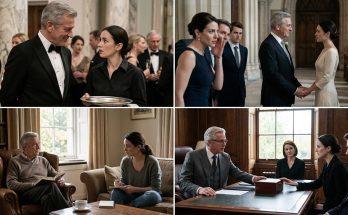
Charles Ward did not look like a man preparing to confess.
He sat behind the interview-room table in a fresh white shirt his attorney had apparently brought him, his silver hair combed neatly back, his hands folded as though he were waiting for a quarterly meeting to begin.
Detective Ruiz sat across from him.
I was in a separate hospital conference room watching through a secure video connection. Daniel stood beside me. Graham had been told Charles wanted to discuss his paternity, but not which child.
He refused to leave.
Evelyn stayed too.
“You wanted Isabelle,” Ruiz said.
Charles looked toward the camera.
“I wanted her attention.”
“You have it.”
His mouth curved slightly.
“Do I?”
I leaned toward the microphone.
“Talk.”
Charles’s smile disappeared.
“Good morning, Isabelle.”
“Which child isn’t Graham’s?”
Graham flinched beside me.
Charles leaned back.
“You have always been impatient with context.”
“My daughter is fighting an infection while doctors prepare to destroy what remains of her bone marrow. You get one chance to be useful.”
That landed.
His eyes narrowed.
Then he said, “Ruby.”
The room went completely still.
I heard Graham breathe.
Nothing else.
“No.”
The word came from him.
Charles ignored him.
I looked at Daniel.
“Ruby’s testing showed Graham is her biological father.”
“Yes,” Daniel said.
Charles smiled again.
“Did it?”
Dr. Patel had explained the result herself.
The profile matched.
The inherited markers aligned.
There had been no uncertainty.
“You’re lying,” I said.
“Possibly.”
“Then this conversation is over.”
I reached for the control.
“Ask your geneticist to compare Ruby’s full genome rather than the relationship panel.”
My hand stopped.
Graham stepped toward the screen.
“What did you do?”
Charles looked almost pleased to hear fear in his voice.
“You were always so certain biology would obey paperwork.”
“What did you do to my daughter?”
“Your daughter?”
Graham’s face hardened.
“Ruby is my daughter.”
“Yes,” Charles said. “That is the interesting part.”
Evelyn whispered, “What does that mean?”
Charles looked toward the camera.
“The embryo labeled HAYES-I/HAYES-G was not created from Graham’s sperm.”
My mouth went dry.
“Whose?”
“Mine.”
For several seconds, nobody moved.
Then Evelyn laughed.
A horrified, disbelieving sound.
“You’re lying.”
Charles did not look at her.
“You used your sperm in my embryo?” I asked.
“Yes.”
Graham lunged toward the screen as though glass and distance no longer mattered.
Daniel caught his arm.
“You stay away from her.”
Charles smiled faintly.
“I have been nowhere near Ruby in years.”
“I’ll kill you.”
“Graham.”
Daniel shoved him backward.
“Do not give this man exactly what he wants.”
Graham tore his arm free but stopped.
I felt strangely calm.
Maybe the mind could only absorb so many violations before it stopped reacting in recognizable ways.
“My egg.”
“Yes.”
“Your sperm.”
“Yes.”
“Without my consent.”
“Obviously.”
“Why?”
Charles folded his hands again.
“Control.”
Evelyn made a disgusted sound.
“That’s not science.”
“No.”
His answer surprised her.
“It was never only science.”
He looked directly into the camera.
“Graham’s genetic contribution was useful. Mine was superior for the comparison I wanted.”
“You wanted a child.”
“I wanted data.”
“Ruby is not data.”
“I’m aware of your view.”
“My view?”
Anger finally reached me.
“She is ten years old. She draws horses in the margins of her homework. She hates mushrooms. She pretends she doesn’t cry during movies and then gets angry if anyone notices. That is not my view. That is a person.”
Charles’s expression barely changed.
“Sentiment does not alter genetics.”
“No. But genetics does not erase personhood.”
Graham sat down heavily.
He stared at nothing.
Evelyn looked toward him.
For all the things he had done, I saw genuine devastation in his face.
Ruby had been his daughter every day of her life.
If Charles was telling the truth, biology had changed nothing except Graham’s understanding of himself.
Which was precisely why Charles had saved the secret.
Not science.
Leverage.
“Why tell us now?” Daniel asked.
“Because the investigation will discover it.”
“So you want to control the timing.”
“Yes.”
At least he admitted that.
“What does this buy you?”
“A conversation.”
“You’re already getting one.”
“And afterward, my cooperation.”
Ruiz spoke from the interview room.
“Your cooperation does not erase criminal exposure.”
“I know.”
“Then what do you want?”
Charles looked toward me.
“For Isabelle to understand why Sophie became ill.”
My anger sharpened.
“You already knew the modification was dangerous.”
“We knew it was uncertain.”
“You watched her instead of warning us.”
“Yes.”
“Why?”
“Because Sophie was the comparison.”
“With Lily.”
“Yes.”
“Explain.”
Charles hesitated.
Then for the first time, the scientist displaced the manipulator.
His voice became precise.
“The embryos that became Sophie and Lily were genetically near-identical in the regions we altered.”
“Near-identical?”
“They were separate embryos created from Evelyn and Graham. We introduced the same targeted change into both.”
“Then why is Lily healthy?”
“The gestational environments diverged.”
My stomach turned.
“You removed Lily from me to test whether artificial gestation changed expression.”
“Yes.”
“And Sophie stayed inside me.”
“Yes.”
“What were you trying to change?”
“Marrow regeneration.”
Dr. Patel had joined us silently at the door.
She stepped closer.
“Which pathway?”
Charles named a gene cluster.
Her expression changed.
“That could affect stem-cell self-renewal.”
“Exactly.”
“And malignant transformation.”
Charles said nothing.
Dr. Patel stared at him.
“You knew leukemia was a foreseeable risk.”
“A theoretical one.”
“You had animal data.”
“Yes.”
“How many developed malignancies?”
His silence answered.
“How many?”
“Enough.”
Evelyn turned away.
I wanted to vomit.
“You transferred the embryos anyway.”
Charles looked at me.
“Yes.”
“And you left Sophie inside me knowing she could someday develop leukemia.”
“We did not know.”
“You knew enough to monitor her for ten years.”
He said nothing.
Graham stood again.
“Why wasn’t I told?”
Charles finally looked at him.
“You were told what you needed to know.”
“I gave you access to my family.”
“You sold access.”
The sentence hit harder because it was true.
Graham’s face collapsed.
Charles continued.
“You accepted investment after investment. You asked remarkably few questions when the answers threatened your lifestyle.”
“I never agreed to hurt children.”
“You agreed not to look.”
Graham had no response.
Neither did I.
Because that was the most accurate description of his guilt I had heard.
Not mastermind.
Not innocent dupe.
A man who had repeatedly chosen not to look because ignorance was profitable.
I returned to Ruby.
“Prove what you said.”
Charles nodded.
“There is a file on the server. Project designation R-1.”
Daniel typed the information to investigators.
“Anything else?”
“Yes.”
“What?”
“Ruby’s biological relationship to me creates a problem.”
I almost laughed.
“For you?”
“For Sophie.”
Dr. Patel stepped closer to the microphone.
“How?”
“R-1 was the control embryo.”
“What control?”
“No modification.”
Dr. Patel frowned.
“That shouldn’t affect Sophie’s treatment.”
“It does if you intend to use Lily’s marrow.”
“Why?”
Charles hesitated.
For the first time, he seemed reluctant.
“Because Lily’s compensating variant is not natural either.”
Dr. Patel went still.
“You created it.”
“Not intentionally.”
“What happened?”
“The artificial gestation system altered expression unpredictably.”
“That is not a genetic variant.”
“No. But during stabilization, Vale intervened.”
Everyone looked toward the screen.
“What intervention?”
Charles said, “Ask him.”
I almost shouted.
“No more scavenger hunts.”
“Vale performed it. I did not.”
“What did he do?”
“He used material from the control line.”
Dr. Patel’s face changed.
“R-1?”
“Yes.”
My skin went cold.
“Ruby?”
Charles nodded.
“Cells derived from the embryo that became Ruby were used during Lily’s rescue protocol.”
I stared at him.
“Before Ruby was born?”
“Yes.”
“How?”
“Preimplantation samples.”
Dr. Patel was already thinking ahead.
“Then Lily may carry cellular material genetically related to Ruby.”
“Yes.”
“And Ruby is Charles’s biological daughter.”
“Yes.”
“So Lily’s marrow could contain mosaic cell lines.”
Charles smiled slightly.
“Now you understand why I requested a conversation.”
Dr. Patel looked furious.
“You withheld this while a child is being prepared as a donor.”
“I was arrested.”
“You had ten years.”
Charles said nothing.
Dr. Patel turned to me.
“We stop Lily’s donor clearance until we characterize this.”
My stomach dropped.
“No.”
“We have to.”
“Sophie doesn’t have time.”
“And I will not transplant marrow we do not understand.”
The hospital room suddenly felt too small.
We had found a donor.
Lost her.
Found another possibility.
Lost certainty again.
Every path toward Sophie ran through a decision somebody had made before she was born.
Daniel’s phone buzzed.
He looked at the screen.
“Investigators found R-1.”
Graham closed his eyes.
“Is Charles telling the truth?”
Daniel read silently.
Then looked at me.
“The stored genetic profile does not identify Graham as the sperm source.”
I could not speak.
“It identifies Charles Ward.”
Evelyn whispered, “Ruby.”
I thought of her outside Sophie’s room, telling Graham he did not get to apologize yet.
She had already lost one version of her father.
Now biology threatened to take another.
“No one tells her.”
Graham looked at me.
“Isabelle—”
“No one tells Ruby until we have a child psychologist and a plan.”
He nodded.
“She has enough.”
“Yes.”
Charles’s voice came through the speaker.
“She deserves the truth.”
I turned toward the screen.
“You don’t get to use that word.”
He looked almost amused.
“You have spent all night demanding it.”
“Truth given to heal is different from truth used as a weapon.”
For once, Charles had no immediate answer.
I leaned toward the microphone.
“You said you would confess.”
“Yes.”
“Then start.”
“To what?”
“Everything.”
He looked at Ruiz.
Then at his attorney, who had finally entered and was whispering urgently beside him.
Charles ignored the lawyer.
“I financed unauthorized embryo modification.”
Ruiz began taking notes.
“I directed Vale to substitute embryos without the carrier’s informed consent.”
My hands tightened.
“I authorized the use of Isabelle Hayes as an unwitting gestational participant.”
Evelyn closed her eyes.
“I authorized removal of fetus C.”
“Lily.”
Charles paused.
“Yes. Lily.”
“Say her name.”
“Lily.”
I did not feel better.
But I needed him to say it.
He continued.
“I arranged medical surveillance of Sophie. I funded Mercer’s psychological profiling. I provided information later used in Isabelle’s custody evaluation.”
Graham looked at me.
I did not look back.
“And Noah?”
Charles’s expression changed.
“He was created separately.”
“Was he modified?”
“Yes.”
“Did you know the alteration could hurt him?”
“Yes.”
Noah was downstairs.
Ten years old.
Healthy today.
Maybe not tomorrow.
“And Mara?”
Charles looked away.
“What about Mara?”
“She was the first.”
Evelyn stiffened.
“The first what?”
“Human embryo we altered.”
Her face went white.
“What did you change?”
“The same pathway.”
“Does she have the dangerous variant?”
“I don’t know.”
“You monitored her for years.”
“Yes.”
“Then you know.”
“Her expression was different.”
“How?”
Charles hesitated.
“More stable.”
Dr. Patel stepped closer.
“Could Mara donate to Sophie?”
“Possibly.”
“Better than Lily?”
“I don’t know.”
“Where are her records?”
Charles looked at the camera.
“Not on the warehouse server.”
“Where?”
“Hawthorne.”
Daniel frowned.
“The facility closed.”
“The public facility did.”
My stomach tightened.
“What does that mean?”
Charles’s attorney finally interrupted.
“My client will answer no further questions.”
Charles turned toward him.
“Sit down.”
“Charles—”
“Sit.”
The attorney actually did.
Charles looked back at us.
“Hawthorne continued elsewhere.”
“Where?”
He gave an address.
Evelyn stared at him.
“That’s your research foundation.”
“Yes.”
“In Bellevue.”
“Yes.”
“You moved the program into the city?”
“Parts of it.”
“What is there now?”
“Records.”
“Children?”
Charles paused.
My heart began pounding.
“Are there children there now?”
“No.”
“Then why hesitate?”
“Because there is one adult participant.”
“Who?”
Charles looked toward Graham.
“Dr. Nathan Mercer.”
Graham frowned.
“What does Mercer have to do with the genetic program?”
Charles answered quietly.
“He was never merely the psychiatrist.”
Dr. Patel stepped forward.
“What was he?”
Charles looked directly at me.
“The physician who performed Lily’s extraction.”
Click here to continue reading: PART 14: Mercer Had Built His Custody Case Against Me Years After He Helped Remove Lily From My Body Without My Consent
The Hospital Called After Two Years of Silence, and the First Thing They Asked Me Was Whether I Could Save Sophie
Part 13 of 20