
PART 4: THE DAY I STOPPED SAVING MY DAUGHTER
My daughter had not simply stood beside the crime.
She had helped design it.
Sarah looked at the printed messages in my hands.
“Mom, I was desperate.”
“So you used Leo?”
“I only told David to take him somewhere for an hour.”
“You told him I would sign anything if I thought I might lose my grandson.”
“I didn’t think David would scare him.”
“You wanted him to scare me.”
Her mouth opened.
No denial came out.
Detective Morales stepped forward.
“Mrs. Carter, you need to come with me for a formal interview.”
Sarah’s face went white.
“Am I being arrested?”
“You are being detained while we investigate your involvement in the fraud and the threats against your mother.”
“You can’t do this.”
“I need you to get dressed and come with me.”
Sarah turned toward me.
“Mom, tell her this is a family misunderstanding.”
I stared at the daughter I had protected for forty years.
When she skipped school at sixteen, I convinced the principal to give her another chance.
When she damaged a friend’s car in college, I paid for the repair.
When she left her first job without notice, I called the manager and apologized.
Every time Sarah faced a consequence, I stepped between her and the full weight of it.
I told myself that was what mothers did.
Now she was asking me to do it again.
But this time, the consequence was not a school suspension or an angry employer.
It was a frightened ten-year-old boy and a forged loan against my home.
“This was not a misunderstanding,” I said.
“Mom, please.”
“You understood exactly what you were doing.”
Her face crumpled.
“You’re going to let them take me?”
“I didn’t bring them here, Sarah.”
I placed the messages on the kitchen table.
“Your choices did.”
A floorboard creaked behind us.
Leo stood in the hallway wearing dinosaur pajamas.
His hair was messy, and one cheek still carried the red mark from his pillow.
“Why are the police here?” he asked.
Sarah rushed toward him, but Detective Morales gently raised one hand.
“Mrs. Carter, wait.”
Leo looked from his mother to me.
“Is Dad coming back?”
I crossed the room and knelt in front of him.
“Your mom needs to answer some questions.”
“Did she do something bad?”
“That is for the police to determine.”
Sarah began sobbing.
“Leo, I love you.”
He stepped closer to me.
“Are they taking Mom too?”
I held his shoulders.
“She is going with the detective for a while.”
His lower lip trembled.
“Am I going somewhere?”
“You’re staying with me.”
“Promise?”
“I promise.”
Detective Morales allowed Sarah to change her clothes and gather her medication.
When she returned, she tried to hug Leo.
He let her, but his arms remained at his sides.
“I’ll be home soon,” she whispered.
The detective looked at her.
“Do not make promises you may not be able to keep.”
Sarah glanced at me one last time.
There was fear in her eyes.
There was also anger.
Some part of her still believed I should rescue her.
I did not.
I watched from the front window as Detective Morales led my daughter toward an unmarked police car.
Sarah was not handcuffed.
But she moved like someone who had finally reached the end of a road she had believed would continue forever.
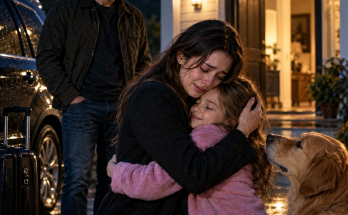
Leo appeared beside me.
“Grandma?”
“Yes?”
“Is this because I didn’t cry enough on the phone?”
The question nearly broke me.
I turned and pulled him into my arms.
“No, sweetheart.”
“Dad kept saying I had to sound more scared.”
“None of this is your fault.”
“He said if I helped him, we could keep our house.”
“Adults are responsible for houses and money. Children are not.”
“But if I had cried, maybe you would have signed.”
I held his face between my hands.
“Listen to me carefully. Nobody who loves you will ever ask you to frighten someone for money.”
He nodded, but the guilt did not leave his eyes.
I realized then that David and Sarah had taken something from Leo that no bank could return.
They had taken his trust in the people who were supposed to make him feel safe.
That morning, I made pancakes.
Leo ate only half of one.
At ten, a child-services worker named Michelle Reed arrived.
She inspected my home, asked about my health, checked the guest room, and spoke privately with Leo.
When she returned to the kitchen, her expression was gentle.
“Leo says he feels safe here.”
“He is safe here.”
“Do you have any concerns about caring for him temporarily?”
“I’m sixty-seven, not ninety-seven.”
She smiled slightly.
“I had to ask.”
“How temporary is temporary?”
“That depends on the court and the criminal investigation. We’ll request an emergency placement order this afternoon.”
“What if Sarah is released?”
“She may be permitted supervised visits, but Leo will not be returned while investigators believe he could be used as leverage again.”
I looked through the doorway.
Leo was sitting on the living-room floor with Michael’s old measuring tape, stretching it between two chair legs.
“I’ll do whatever he needs.”
Michelle closed her folder.
“One more question. Are Sarah and David financially dependent on you?”
“They were.”
“Were?”
“They asked me to leave their lives, so I took my money with me.”
For the first time that day, I did not feel guilty saying it.
After Michelle left, Martha arrived carrying groceries.
She placed milk, bread, fruit, and a roasted chicken on my counter.
“I didn’t know what you needed,” she said. “So I brought everything.”
I hugged her.
It was the first time I had allowed myself to cry.
“I gave them everything, Martha.”
“I know.”
“It still wasn’t enough.”
“For people like that, enough is always one payment away.”
She stayed with Leo while I met an attorney.
Her name was Elaine Porter.
She was a small woman with silver hair and a voice that made every word sound permanent.
I placed the loan application, forged power of attorney, vehicle documents, messages, and four years of bank records on her desk.
She read in silence.
When she finished, she removed her glasses.
“Amber, we need to protect three things immediately.”
“What?”
“Your home, your credit, and your legal independence.”
The third answer surprised me.
“My legal independence?”
Elaine tapped the forged power of attorney.
“Once someone is willing to manufacture a document giving them control of your property, we must assume they may attempt something else.”
“What else could they do?”
“Claim you authorized the loan verbally. Create a gift agreement. Attempt another power of attorney. In extreme cases, petition the court and claim you are unable to manage your own finances.”
“My daughter knows I’m not incompetent.”
“This is no longer about what she knows. It is about what she may be willing to say.”
Elaine ordered an urgent title search on my house.
Then she helped me file a formal identity-theft report, notify every lender, freeze my credit completely, and place an alert on the property records.
Two hours later, the title company called.
No lien had been recorded.
The $85,000 loan had been stopped in time.
For the first time in two days, I received good news.
My house was still mine.
The vehicle was more complicated.
Because I was the guarantor, a missed payment would damage my credit.
Elaine advised me to make one payment directly to the lender while she requested a court order requiring Sarah and David to refinance or sell it.
“You are not paying for their lifestyle,” she said. “You are protecting your own credit while we force a legal solution.”
That distinction mattered.
I paid the lender, not Sarah.
I documented every dollar.
And I made it clear that it would be the last voluntary payment connected to them.
That evening, my sister Joanne called.
Sarah had apparently contacted her from the police station.
“What is happening?” Joanne demanded. “Sarah says you had her arrested over a loan.”
“I did not have her arrested.”
“She says David forced her.”
“I have messages showing that she helped him.”
“She’s your daughter.”
“And Leo is her son.”
“Families handle these things privately.”
“Fraud does not become private because the person committing it shares your blood.”
“She could lose everything.”
I looked at Leo asleep beneath a blanket on my sofa.
“She was willing to make me lose everything.”
Joanne lowered her voice.
“Michael would hate seeing the family torn apart.”
That sentence hurt more than I expected.
But pain no longer made me surrender.
“Michael would hate what they did to his wife and grandson.”
Joanne had no answer.
I ended the call.
By the following morning, David had been charged with attempted financial fraud, identity theft, forgery, and coercion.
Sarah was charged with conspiracy, identity theft, and contributing to the coercion involving Leo.
Both pleaded not guilty.
David remained in custody because investigators believed he might run.
Sarah was released after posting bond.
A temporary order prohibited both of them from contacting me directly.
Sarah was allowed one supervised visit with Leo each week.
At the emergency custody hearing, she sat across the courtroom wearing the same black dress she had worn to Michael’s funeral.
I wondered whether she had chosen it because she thought it made her look respectful.
Her attorney argued that she had been manipulated by a controlling husband.
The prosecutor placed the printed messages before the judge.
The room became silent.
The judge read Sarah’s words aloud.
“Take Leo somewhere for an hour. Mom will sign anything if she thinks she might lose him.”
Sarah lowered her head.
The judge granted me temporary custody.
When the gavel fell, Sarah began crying.
I felt no victory.
Only grief.
Outside the courtroom, her attorney approached me.
“Mrs. Mitchell, Sarah would like you to know that she is deeply sorry.”
“She has my attorney’s address.”
“She believes David manipulated her.”
“She provided my documents.”
“She was under significant emotional pressure.”
“She planned to use her own child to frighten me.”
The attorney sighed.
“She made a terrible mistake.”
“No.”
I looked through the courthouse doors at Sarah.
“She made a series of choices. Calling it one mistake hides all the moments when she could have stopped.”
Three days later, David’s lawyer sent Elaine an offer.
If I signed a statement calling the loan application a family misunderstanding, David would agree to sell the SUV and surrender his share of the house to Sarah.
Elaine read the offer aloud.
“What do you want to do?” she asked.
“Can my statement stop the criminal case?”
“No. The prosecutor decides that. But it could weaken the evidence.”
“Then my answer is no.”
“Even if selling the SUV protects your credit?”
“We will protect my credit honestly.”
Elaine smiled for the first time.
“That is the correct answer.”
The storage manager called the same afternoon.
Sarah and David had not paid for the next month.
Their kayaks, furniture, exercise equipment, and abandoned business supplies would be sold if the balance remained unpaid.
“Would you like to cover it temporarily?” he asked.
“No.”
“But some of the belongings may be sentimental.”
“Then the owners should pay for them.”
I ended the call without guilt.
Every bill I returned to them felt like removing another stone from my back.
The following weeks were difficult.
Leo had nightmares.
Sometimes he woke convinced that the police were coming to take me too.
I found a child therapist named Dr. Patel and paid her directly.
That was the difference I finally understood.
Helping Leo did not require giving his parents unrestricted money.
Love could buy a child therapy without buying his father a theater.
Love could provide school lunches without covering a luxury car.
Love could be generous and still have a lock on the door.
Sarah’s supervised visits were painful.
During the first one, she spent most of the hour apologizing to Leo.
He asked why she told Dad to take him.
Sarah said she had been confused.
Leo looked at her with the brutal honesty of a child.
“You typed it. How can you be confused when you type something?”
She began crying.
He moved closer to the supervisor.
During the second visit, Sarah asked whether she could speak to me.
I refused.
She sent a letter through Elaine instead.
Mom, I know you hate me. David made me believe we were about to lose everything. I thought the loan would save our family. I never wanted to hurt you or Leo. Please remember that I am still your daughter.
I read the letter twice.
Then I placed it in the evidence folder.
She had apologized for the result.
She had not apologized for deciding that my home, my identity, and my fear belonged to her.
A month after the arrest, Detective Morales called.
“We recovered additional evidence from the office at the warehouse,” she said.
“What kind of evidence?”
“David installed security cameras after some equipment went missing. The recordings uploaded automatically to a cloud account.”
“Did the cameras record the night he took Leo?”
“Yes, but there is something else you need to see.”
The following morning, Elaine and I met Detective Morales at the police station.
She led us into a small room with a monitor mounted on the wall.
Sarah’s attorney was not present.
Neither was Sarah.
“This recording was made six weeks before the loan application,” the detective explained.
The screen showed a home office in Sarah’s basement.
The new television had not been installed yet.
My property deed, driver’s license, and tax statement were spread across the desk.
Sarah sat in front of them.
She held a pen in her right hand.
For ten minutes, I watched my daughter practice my signature.
Amber Mitchell.
Amber Mitchell.
Amber Mitchell.
She filled an entire page.
David walked into view.
“What if she notices?” he asked.
“She won’t,” Sarah replied.
“How do you know?”
“Because she trusts me.”
David picked up the forged power-of-attorney form.
“And if the bank calls her?”
“I’ll tell her it’s part of the car refinancing.”
“What if she goes to the police?”
Sarah laughed.
The sound made my skin cold.
“She won’t.”
“You seem very sure.”
“I’ll cry. I’ll tell her you forced me. Mom always forgives me before I even ask.”
I thought of Sarah standing in my kitchen, tears rolling down her face as she said David controlled everything.
She had not invented that defense after the arrest.
She had planned it six weeks earlier.
The video continued.
David placed another folder on the desk.
“What is this?” he asked.
“Our backup plan.”
The label on the folder faced the camera.
EMERGENCY GUARDIANSHIP—AMBER MITCHELL.
I stopped breathing.
Sarah opened it.
Inside was a petition claiming that I suffered from confusion, memory loss, and poor financial judgment.
It requested that Sarah be granted emergency control over my bank accounts and property.
Attached was a letter carrying the name of a doctor I had never met.
“If she refuses to sign the loan,” Sarah said, “we file this.”
David looked uncertain.
“You really think a judge will declare her incompetent?”
“Not immediately. But once the accusation is made, her accounts could be frozen while they investigate.”
“And then?”
“I become temporary guardian.”
Sarah tapped the forged power of attorney.
“Once I control the accounts, we won’t need her permission.”
The recording ended.
I sat completely still.
For four years, I had believed my daughter needed my help.
The truth was worse.
She had studied my love, measured my trust, and prepared a legal weapon for the day I finally said no.
Detective Morales placed the guardianship petition in front of me.
“There’s one final page,” she said quietly.
I turned it over.
Attached to the petition was a typed statement supposedly written by Leo.
It claimed he had seen me leave the stove burning, forget his name, and become confused while driving.
None of it was true.
At the bottom was my grandson’s name, written in a child’s uneven handwriting.
“Did Leo sign this?” I whispered.
“We asked him,” the detective said.
“He remembers his mother giving him a blank piece of paper and telling him to practice signing his name.”
My daughter had not only stolen my identity.
She had stolen her own child’s signature to prove I was losing my mind.
Elaine reached for my hand.
But I kept staring at Sarah’s final sentence in the recorded transcript.
If Mom fights us, nobody will believe a confused old woman over her own daughter.
That was the moment my grief disappeared.
In its place came something colder and stronger.
Sarah believed nobody would believe me.
She was about to learn what happened when the “confused old woman” walked into court carrying every receipt, every message, every forgery, and the voice of her daughter explaining the entire plan….

One Comment on “PART4: My daughter texted me, “We’ve decided to distance ourselves from you. Please don’t contact us anymore.” I didn’t argue or ask her to change her mind”