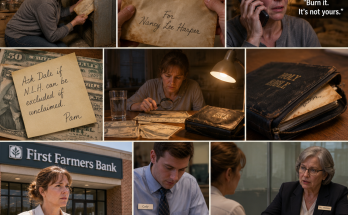
“Stop being dramatic, It’s Just Gas,” My Mom Said Like It Was Nothing—Then My Real Dad Pulled Out 18 Years of Bank Statements and Everyone Went Silent
Part 1
I was halfway through arithmetic when my body tried to warn me that something was seriously wrong.
It did not begin politely. It did not tap me on the shoulder or give me a dull ache I could reason with. It came as a bright, sharp stab low on the right side of my stomach, so sudden that my pencil jerked across the worksheet and left a dark slash through a fraction I had already stopped understanding.
I froze.
Then, because I was trained to do it, I pretended nothing had happened.
My name is Ethan Parker, and by the time I turned eighteen, I had become very good at being quiet about pain.
In the Parker house, pain was not treated like a medical signal. Pain was treated like an inconvenience that had better justify itself quickly. If my younger half sister Samantha had a headache, my mother dimmed lights, Greg drove to CVS, and the whole house softened around her. If I said my throat hurt, my mother stood in my doorway with her arms crossed and asked if I had a test the next day.
So I stayed still in Mr. Henson’s math class while the heater rattled against the December cold and the room smelled like pencil shavings, cheap body spray, and that dusty metallic warmth old school vents spit out in winter.
Mr. Henson was writing rational expressions on the board. Behind me, someone kept tapping a pen. Outside, the sky over the football field was flat gray, the kind that made Ohio look like it had been erased with a dirty cloth.
The pain pulsed again.
I pressed my hand under the desk against my side.
Maybe gas, I told myself.
That was the first excuse I made for them before they even had the chance.
Maybe I had eaten too fast. Maybe gym class. Maybe stress. Maybe if I ignored it, my body would get the message and stop needing things.
That was the rule I had learned at home.
Need less.
Want less.
Hurt quietly.
My mother, Kelly Parker, had me when she was young, back before she married Greg and had Samantha. My biological father, David Miller, was a story told in different versions depending on how angry she was. Sometimes he abandoned us. Sometimes he was unstable. Sometimes he was dangerous. Sometimes he was simply “a mistake I survived,” which was a strange thing to say while looking directly at your son.
I knew his name. I knew I had his dark eyes, his thick hair, and the chin my mother called “stubborn” when she was annoyed.
That was all I was allowed to know.
Greg entered my life when I was eight, bringing boxes, power tools, and a talent for making cruelty sound like common sense.
“Don’t be soft.”
“Stop acting like a victim.”
“You always need something.”
“You’re just like your father.”
He never had to explain what that meant. My mother had already built the mythology. My father was selfish, so my needs were selfish. My father was dramatic, so my pain was dramatic. My father supposedly vanished, so any fear I had of being left behind was just proof that something broken had come from his side.
When Sam was born, the house finally had the child it wanted.
She had Greg’s blond hair, Mom’s blue eyes, and the kind of charm adults rewarded before she learned how to use it. I do not blame her for being loved. She was a child. But by the time she was old enough to notice the difference, she had also become old enough to benefit from it.
Sam got dance classes, soccer, braces, a new phone, birthday parties with balloon arches, and a used Honda Civic because “she needed independence.”
I got a movie theater job and lectures about gratitude.
Sam’s group chats were emergencies. Sam’s school stress was serious. Sam’s heartbreaks required ice cream, Target runs, and family meetings. I learned to handle my own laundry, my own meals when dinner “ran out,” my own rides, my own disappointment.
So when the pain came in math class, I did not raise my hand.
I stared at the worksheet until the numbers blurred.
Five minutes passed.
Then ten.
The pain settled lower, sharper, meaner. A hot nail in my abdomen. Sweat slipped down my spine even though the room was overheated. My stomach rolled, and I swallowed hard, afraid I would throw up in front of everyone.
Mr. Henson turned from the board. “Ethan, you with us?”
The whole room looked over.
I forced myself upright. “Yeah.”
His eyes narrowed. “You need the nurse?”
Every survival instinct screamed no.
“No, I’m okay.”
I was not okay.
Seven minutes later, my vision went grainy around the edges. I slid my phone out under the desk and opened the family group chat.
The Parkers .
.
That little heart always felt like a joke someone had forgotten to finish.
I typed with one shaking thumb.
Me: I’m not feeling good. Bad stomach pain. Can someone pick me up?
Three dots appeared under Mom’s name.
Then disappeared.
Then appeared again.
Mom: Again?
One word.
That was her first response to me telling her something was wrong.
Greg: Trying to skip?
Sam: Ugh we’re literally out.
The pain stabbed hard enough that I made a small sound. The girl beside me glanced over and then quickly looked away, because high school teaches people how to pretend private suffering is not happening.
I typed again.
Me: It’s really bad. Please.
No answer.
The bell rang eventually. I stood and almost fell. Kevin Hayes, my best friend since freshman year, appeared beside me in the hallway.
“Dude,” he said. “You look awful.”
“I’m fine.”
“You’re gray.”
“My mom’s coming.”
Kevin did not look relieved. He knew enough about my family to understand that sentence did not mean what it should.
“You want me to walk with you?”
I wanted to say yes.
Instead, I shook my head.
I made it to the front office by leaning on walls between waves of pain. Mrs. Carver, the receptionist, saw my face and stood.
“Ethan, honey, do you need the nurse?”
“My mom’s picking me up.”
“Are you sure?”
The office phone rang. I used her distraction to lower myself into a plastic chair near the window.
At 11:03, my phone buzzed.
Mom: Fine. Coming.
Fine.
As if I had won an argument instead of asked for help.
They arrived at 11:31.
Greg was driving the black SUV. Mom sat beside him in sunglasses even though the sky was dark with snow clouds. Sam was in the back, earbuds in, phone glowing in her hand.
I dragged myself outside into the cold.
Greg rolled the passenger window halfway down. “Were you trying to skip school?”
Not are you okay.
Not what happened.
Not you look sick.
I tried to answer, but my stomach clenched and only a breath came out.
Mom turned in her seat. “Get in, Ethan. You’re letting cold air in.”
I climbed in beside Sam.
The movement sent a bolt of pain through me so intense that my vision flashed white. I gripped the front seat and tried not to cry out.
Sam pulled one earbud free. “You smell like sweat.”
The SUV smelled like vanilla air freshener, fries, and Sam’s coconut spray. Nausea rose in my throat.
“It hurts,” I said. “Really bad. Lower right side.”
Greg glanced at me in the mirror. “Appendicitis now? That what we’re doing?”
“I don’t know. I need a doctor.”
Mom sighed. “It’s probably just gas.”
She said it like it was nothing.
Like my body was an inconvenience she had already explained away.
Then we drove past the first urgent care, and I realized they were not taking me there.
They were taking Sam to buy a phone charger.
Part 2
The urgent care sign slid past my window in red and white.
Open.
Walk-ins welcome.
I pressed one hand to the glass like I could slow the car by wanting hard enough.
“Mom,” I whispered. “There.”
She glanced back. “What?”
“Urgent care.”
Greg laughed under his breath. “Emergency rooms cost money. You got emergency room money?”
“It’s urgent care,” I said, though even talking hurt now.
Mom gave him an annoyed look, but not because of me. “We have insurance.”
“Then use it when something’s actually wrong,” he said.
“Something is wrong,” I said.
No one answered.
Sam’s phone dinged, and she made a sound like someone had shot her.
“No, no, no.”
Mom turned toward her immediately. “What?”
“My phone’s at ten percent. Owen’s going to FaceTime before practice, and if I don’t answer, he’ll think I’m mad. Madison said Brooke from Chemistry has been liking his posts again.”
Greg snorted. “Teenage crisis.”
But his tone was fond.
Mom pointed ahead. “There’s a Best Buy right there. We’ll grab a portable charger.”
I thought I had misheard.
“No.”
Everyone went silent.
It was the loudest word I had said in months.
Mom turned around slowly. “Excuse me?”
“No,” I said again, and pain made my voice shake. “Please. I need to go to the hospital.”
Sam leaned forward between the seats. “Ethan, it’ll literally take five minutes.”
Greg looked at me through the mirror. His eyes were flat. “Stop being dramatic. Five minutes won’t kill you.”
That sentence would come back later in reports, in witness statements, in court filings, in family whispers.
Five minutes won’t kill you.
The terrible thing was, he believed it. He was not making a threat. He was dismissing my reality because believing me would require changing his plans.
Greg turned into the Best Buy parking lot.
Snow flurries spun in the air. The store glowed huge and blue against the gray day. People pushed carts loaded with televisions and printers, ordinary shoppers moving through an ordinary afternoon.
Mom unbuckled.
“Please don’t leave me,” I said.
Something flickered across her face.
For one second, I thought she might see me.
Then Greg opened his door. “Kelly, come on.”
Sam was already out, clutching her dying phone.
Mom’s mouth tightened. “We’ll be right back.”
Greg clicked the lock button.
The sound was small and final.
The doors sealed.
The windows stayed up.
They walked away.
At first, disbelief kept me awake.
I watched them cross the parking lot: Greg ahead, Mom pulling her coat tight, Sam hurrying like the real emergency was inside the store. They looked like any family running an errand. Nothing about them said they had left someone curled in the back seat with a medical emergency.
I tried the door.
Locked.
I hit the unlock button. Nothing. The rear lock had always been weird, and Greg had the key fob.
I reached for my phone. My fingers were slick with sweat. I opened the calculator by mistake, then messages, then finally the emergency call screen, but the pain surged so hard I dropped it to the floor.
Through the Best Buy window, I could see them.
Mom held two charger boxes, comparing prices.
Greg drifted toward a wall of televisions showing basketball highlights.
Sam stood near the counter, face lit by her phone.
I pressed my forehead to the cold window.
“Please,” I whispered.
To them.
To anyone.
To my own body.
Then the pain changed.
It had been sharp before, focused low on the right side. Suddenly it spread. Not relief. Worse. A deep internal tearing, like pressure had forced its way through something that should have stayed sealed. Heat flooded my abdomen, then cold chased it across my skin. My heart raced too fast and too weak at once.
I had no medical training.
I still knew something inside me had ruptured.
The lights outside stretched thin.
I thought of the family chat. The Parkers.
I thought of Kevin telling me to text him.
I thought of the father I had been told abandoned me, the man whose face I wore like a crime.
Then my mother laughed.
Through the store window, I saw it clearly. Greg said something, and she tilted her head back and laughed while I folded sideways in the back seat.
That detail stayed with me longer than the pain.
Neglect, I would learn, often looks like normal life continuing around a person who has stopped being seen.
My phone slid farther under the seat.
The store lights stretched into white lines.
Then everything went black.
I do not remember the ambulance.
I do not remember the paramedics breaking the SUV window.
I do not remember Melissa Grant, the woman loading a printer into her minivan who noticed me slumped sideways in the back seat and called 911 when I would not respond.
I do not remember my mother coming out of Best Buy and screaming, not because I was unconscious, according to Melissa later, but because glass was all over the seat.
I am grateful I do not remember that part.
What I remember is waking to light.
Too much light.
White ceiling. White walls. A steady beep. Something taped to my arm. My throat raw, my mouth dry, my whole body heavy and wrong.
A face appeared above me.
Male nurse, late twenties maybe, navy scrubs, dark skin, calm eyes.
“Hey,” he said. “Ethan? Can you hear me?”
I blinked.
“You’re in the ICU at Kettering Memorial. You had surgery. You’re safe.”
Safe.
The word did not belong to any room I knew.
I tried to speak, but only a dry scrape came out.
The nurse lifted a cup with a sponge swab. “Your throat’s going to hurt. You were intubated. I’m Tyler, your nurse tonight.”
He touched the sponge to my lips.
Water.
Barely any, but enough to make my eyes burn.
“How are you feeling?” he asked.
Most people say that without wanting an answer. Tyler said it like my answer had weight.
“Hurts,” I rasped.
“I know. I’ll check your pain meds. You were very sick when you came in.”
Very sick.
Later, other words arrived.
Ruptured appendix.
Peritonitis.
Sepsis.
Emergency surgery.
Delay in care.
At that moment, I only understood that machines had cared more about my body than my family had.
Mom came in sometime later. I smelled her perfume before I saw her face. Greg stood behind her with his arms folded. Sam hovered near the door, pale and quiet.
“You scared us,” Mom said.
I turned my head slightly.
Greg clicked his tongue. “Doctors say you’re lucky.”
Mom reached toward my hand, then stopped when she saw the IV. “You should have told us it was that bad.”
Even drugged and half awake, I understood.
She was moving the blame before I could speak.
You should have told us.
Not we should have listened.
Tyler entered then with a tablet, and Mom’s voice immediately softened.
“We’re just so worried,” she said.
Tyler looked from her to me. “He needs rest.”
“Of course. We’ve been here the whole time.”
The whole time.
A lie smooth enough to skate on.
After they left, I stared at the ceiling and cried silently because my throat hurt too much to make sound.
Tyler waited a long moment before speaking.
“Ethan,” he said quietly, “do you feel safe with your family?”
The question opened something in me.
No adult had ever asked it that directly.
I turned my head toward him.
He pulled a chair close and sat at eye level. “You don’t have to answer right now. But if the answer is no, you can say it.”
My lips trembled.
“I’m scared to go home,” I whispered.
Tyler’s face did not change with shock. It changed with recognition.
“Can you tell me why?”
The truth had lived inside me so long that once the first sentence came out, the rest followed in broken pieces.
I told him about school.
The texts.
The wait.
The SUV.
Urgent care.
Best Buy.
The locked doors.
The pain changing.
The laughter.
Tyler listened without interrupting. When I finished, his jaw was tight.
“Thank you for telling me,” he said. “I’m going to ask hospital social services to come speak with you. Is that okay?”
“Yes,” I whispered. “Please.”
He typed it into his tablet right there.
Not later.
Not when he had time.
Right there.
And for the first time since the pain began, help did not feel like a favor I had to earn.
It felt like something already moving toward me.
Part 3
The next morning, a hospital social worker walked into my room carrying a tablet and a folder.
Her badge read Samantha Burns, LSW.
She had dark hair pulled into a neat bun, practical shoes, and the kind of calm that did not feel fake. She introduced herself, pulled a chair beside my bed, and asked if I felt up to talking.
I said yes because I was afraid if I waited, I would lose the courage.
She began gently. “Tyler told me you had concerns about returning home.”
Concerns.
That word sounded too polite for what I felt.
I looked down at the IV in my arm. “They left me in the car.”
“Can you walk me through it?”
So I did.
This time, the story came in order.
Second-period math. The pain. The family chat. Mom’s “Again?” Greg asking if I was skipping. Forty-five minutes in the office chair. The ride. Vomiting into a grocery bag. Passing urgent care. Best Buy. The locked doors. The pain spreading. Blackout.
Samantha asked questions that felt precise, not suspicious.
What time did the pain start?
What time did you text?
Who was in the vehicle?
Did you ask directly for medical care?
Could you exit the vehicle?
Had anything like this happened before?
Anything like this opened older doors.
I told her about being left at school after activities because Mom “forgot.” About dental pain ignored until a teacher called home. About Greg refusing to pick up my bronchitis medication because he said walking would “clear my lungs.” About being told my needs were expensive, dramatic, selfish. About Sam’s needs becoming family emergencies while mine became proof of bad character.
Samantha took notes.
At one point, she said, “Ethan, medical neglect can include delaying necessary care when a reasonable caregiver would recognize urgency. What you’re describing is serious.”
The word neglect was both too small and too huge.
I was eighteen, technically an adult, but still in high school, on my mother’s insurance, dependent during recovery. Samantha explained that made things complicated but not impossible.
“Do you feel safe returning to your mother’s home after discharge?” she asked.
The honest answer was no.
But no felt like stepping off a cliff.
Where would I go? What would Greg do? Would Mom cry and tell everyone I destroyed the family? Would Sam say I was making it about myself? Would relatives believe them the way people usually did?
“I don’t know,” I said.
Samantha nodded. “That’s an acceptable answer. You don’t have to solve everything today.”
She placed her card on my bedside table.
“You are not alone in this now.”
After she left, I stared at the card for a long time.
Proof.
That was what it felt like.
Proof that someone had written my fear down where it could not be rolled over with sarcasm.
My phone was on the rolling table beside the bed, charged with a hospital cord Tyler had found. The screen was cracked from where it had fallen in the SUV. I unlocked it with trembling fingers.
There were messages.
Mom: They say you were unconscious. Why didn’t you answer us?
Greg: Don’t start telling people we did something wrong.
Sam: Are you awake?
Kevin: Dude answer me. Mr Henson said ambulance?? Are you ok???
I stared at Kevin’s message until my eyes blurred.
Then I opened a contact saved under Dave From School.
Eight months earlier, I had found my biological father’s number in an old phone buried in Mom’s junk drawer. I had been looking for a charger cable under expired coupons and batteries, and there it was, wrapped in a rubber band.
Curiosity is dangerous in a house built on secrets.
But I turned it on anyway.
One thread had a name attached.
David.
The last message, dated almost twelve years earlier, said:
Kelly, please let me speak to him on his birthday. I sent the support payment and the card. You don’t have to talk to me. Just please let me hear his voice.
I had read it so many times the words felt burned into me.
Earlier messages were worse.
I’ll be at the visitation center at 10.
No one is here. Is Ethan sick?
The court order says first Saturday.
I don’t want to fight. I just want to see my son.
Please.
My mother had always said David vanished. Those messages said someone had been waiting in rooms where we never showed up.
I copied the number months ago and saved it under a fake name.
I had never used it.
Now, lying in the ICU with staples in my abdomen and antibiotics dripping into my arm, I opened that contact.
I typed and deleted three messages before sending one.
Me: This is Ethan. I almost died. Mom wouldn’t take me to the hospital. I’m in ICU at Kettering Memorial. Please help.
The bubble turned blue.
For a few seconds, nothing happened.
Then three dots appeared.
My breath caught.
Dave From School: Ethan? This is David. Are you safe right now?
I started crying so suddenly that pain tore across my stomach.
Me: I’m in hospital.
David: I’m leaving now.
Me: You live far?
David: Pittsburgh. I’ll drive.
Me: You believe me?
The dots appeared. Disappeared. Appeared again.
David: I have been waiting eighteen years for you to ask me for anything. I believe you.
I put the phone down and covered my face with my hand.
That afternoon, Mom arrived wearing her performance face.
Soft cardigan. Worried mouth. Coffee cup she did not drink. Greg came behind her looking annoyed at the entire hospital. Sam trailed in last, quieter than usual.
Mom leaned over me. “Hi, honey.”
Honey.
She only called me that when people might hear.
“How are you feeling?”
“Bad.”
“Well, of course. You gave us quite a scare.”
“You left me in the car,” I said.
Her face tightened.
Greg stepped forward. “Careful.”
Sam looked down.
Mom smiled without warmth. “You were conscious when we went in. You said you were fine.”
“No, I didn’t.”
Click Here to continuous Read Full Ending Story👉Part2:My Mom Said Like It Was Nothing “Stop being dramatic, It’s Just Gas,” —Then My Real Dad Pulled Out 18 Years of Bank Statements and Everyone Went Silent
My Mom Said Like It Was Nothing “Stop being dramatic, It’s Just Gas,” —Then My Real Dad Pulled Out 18 Years of Bank Statements and Everyone Went Silent
Part 1 of 2