I bought my father a truck six weeks before his sixtieth birthday, and even as I did it, I knew it was a mistake.
Not because he wouldn’t use it. He adored trucks the way some men cling to power tools and public approval—loudly, specifically, and with unsolicited opinions. But because in my family, gifts were never just gifts. They were evaluations. Evidence. Benchmarks. If you gave too little, you were selfish. If you gave too much, you were showing off. And if you gave exactly what someone wanted, they’d still find a way to make you regret understanding them that well.
Even so, I bought it.
A black King Ranch F-250 with leather seats, a towing package, custom wheels, and the exact engine my father had spent three Thanksgivings hinting at while pretending he never asked for anything. I paid in cash through my company’s preferred auto broker and kept the title paperwork pending until the birthday dinner so I could present it properly. Not because I thought a truck would repair my relationship with him. I was thirty-six, not sixteen. I knew better. But some small, uncomfortable part of me still hoped for one evening where I gave my father something undeniable and he reacted like a father instead of a judge.
The dinner was at my parents’ house outside Fort Worth. A long walnut table, expensive steaks, too much red wine, my brother Dean already boasting about his bonus before the salad plates were cleared. My mother wore emerald silk and the smile she used when she expected others to admire her family more than they actually did. My aunts and uncles had driven in from Plano and Arlington. My cousins were recording clips for social media. Balloons filled the den, and a giant gold foil “60” stood by the fireplace.
When I slid the key box across the table, the room actually fell silent.
My father opened it, saw the logo, and for one perfect second I thought maybe I had finally gotten something right. His expression shifted. Not softer, exactly—but surprised. Genuine.
Then everyone went outside.
The truck sat under the driveway lights with a red bow stretched across the hood. My uncle whistled. My brother muttered a low, impressed curse. Even my mother looked impressed, which for her was the emotional equivalent of a standing ovation.
My father circled it slowly, one hand brushing the paint. “This is mine?”
I nodded. “Happy birthday, Dad.”
Dinner picked back up an hour later with more wine and louder conversation. I should have left while the moment was still intact.
Instead, I stayed.
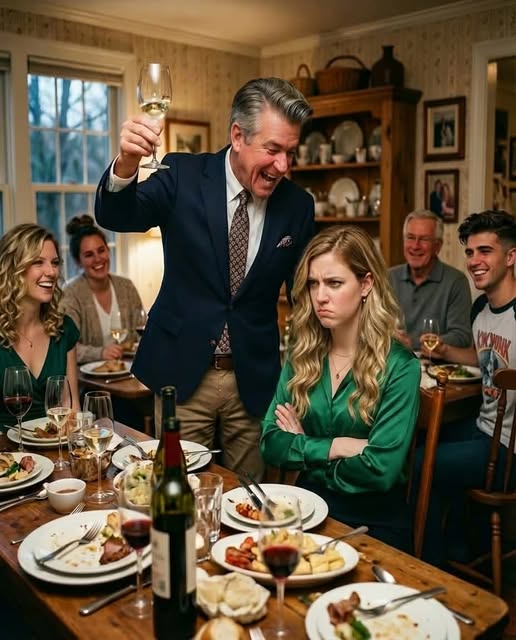
Halfway through dessert, my father stood with his glass. Everyone followed. He looked around the table, smiled in that hard, amused way of his, and said, “Well. Here’s to my idiot daughter.”
The room froze, then broke into laughter before I could even process it.
He raised his glass toward me.
“Trying to buy love with money.”
My brother laughed the loudest. My aunt Cheryl covered her mouth, still smiling. My mother looked down at her plate, not in shame—more like she was waiting to see how I’d respond before deciding which version of the story to support.
I felt every eye turn toward me.
And suddenly the truck made perfect sense.
Not as a gift.
As a lesson.
I stood slowly, folded my napkin, smiled at my father like he’d just confirmed something useful, and left without a word.
The next morning, his driveway was empty.
And by 8:12 a.m., my phone showed 108 missed calls.
The first voicemail was from my mother.
“Savannah, call me right now.”
Not please. Not what happened. Just that same command voice she used when I was thirteen and hadn’t folded laundry to her standards.
The second was my brother Dean, already furious.
“What the hell did you do?”
I didn’t listen to either all the way through. I sat at my kitchen island in my townhouse, coffee untouched, phone buzzing every few seconds, and stared out at the pale Texas morning while the silence inside me settled into something clean.
I hadn’t stolen the truck.
That was the best part.
I had protected myself.
Because while my family liked to call me dramatic, they never paid enough attention to notice I was careful. Careful with contracts. Careful with receipts. Careful with anything involving people who enjoy humiliating others and then calling it a joke. So when I bought the truck, I did what I always do with high-value assets: I left the title transfer incomplete until formal acceptance and registration. The truck had been delivered for presentation, insured temporarily under my holding policy, and parked at my parents’ house with dealer tags pending final signed assignment.
My father never signed.
He mocked me first.
So at 6:40 that morning, I called the broker, then the dealership’s legal delivery coordinator, then the transport service on retainer for my company fleet account. Since the vehicle was still legally mine, retrieving it was simple. Professional. Quiet. By 7:30, the truck was loaded and gone.
No scene. No argument. No broken law.
Just consequence with paperwork.
At 8:21, I finally answered Dean.
He skipped hello.
“You took Dad’s truck.”
“No,” I said. “I took back mine.”
He made a disgusted noise. “Are you actually insane?”
I leaned back in my chair. “Was Dad insane when he called me an idiot in front of thirty people?”
“It was a joke.”
“Then he should be laughing.”
Silence.
Then the expected pivot. “You embarrassed him.”
I almost smiled. “Good. Maybe now he remembers what it feels like.”
Dean exhaled sharply. “You gave it to him.”
“I presented it to him. He rejected the spirit of the gift before accepting the legal transfer.”
“That’s the most lawyer-brained nonsense I’ve ever heard.”
“Interesting, since the dealership agrees with me.”
That stopped him for a moment.
Because here was what my family never understood about me: I wasn’t a lawyer, but I managed procurement and vendor contracts for a large energy services company. Eight-figure equipment agreements, asset custody language, delivery liability, transfer conditions. I read every line because people get generous with other people’s money and careless with their own pride.
My father had built his identity around treating me like the oversensitive daughter with “some office numbers job.” He never noticed that the same skill set he mocked was exactly why the truck disappeared legally before breakfast.
When I hung up, my mother called again immediately.
This time her voice was different. Tighter. Colder. “Bring it back.”
“No.”
“Your father is humiliated.”
I laughed once. “Now he cares?”
Her tone sharpened. “You do not punish your father over one stupid toast.”
I stood and walked to the window. “No. I respond to a lifetime of them.”
That quieted her.
Because she knew it was true.
The jokes had started when I was fourteen and earned a scholarship to a private summer program Dean didn’t get into. My father called me “the family calculator.” When I bought my first condo at twenty-eight, he asked if I planned to marry it. When I paid his medical bill after back surgery, he told relatives I was “auditioning for sainthood.” Every achievement became either luck, overcompensation, or emotional bribery.
Last night wasn’t unusual.
It was just public enough to end something.
My mother lowered her voice. “What do you want?”
Finally.
Not denial. Not orders.
Terms.
“I want him to understand that gifts are voluntary, and disrespect has a cost.”
She paused.
Then carefully asked, “How much will it take to fix this?”
That’s when I knew they still didn’t understand anything.
By noon, my father showed up at my house.
I saw his SUV pull into the driveway and felt no panic, just irritation that he’d chosen the middle of a workday. He came to the door dressed the way he always did when he wanted to look authoritative: pressed jeans, polished boots, starched button-down, sunglasses pushed up on his head.
I opened the door but didn’t invite him in.
For a moment, he just looked at me.
Not angry in the explosive way I expected. Worse. Controlled. Quiet humiliation is more dangerous.
“You made your point,” he said.
“No,” I replied. “You did, last night.”
His jaw tightened. “I was drinking.”
“There’s always a reason when it’s you.”
Click Here to continuous Read Full Ending Story👉 Part2: I Gave My Dad a New Truck for His 60th—At Dinner, He Mocked Me, So I Walked Away and Took It Back
I Gave My Dad a New Truck for His 60th—At Dinner, He Mocked Me, So I Walked Away and Took It Back
Part 1 of 2