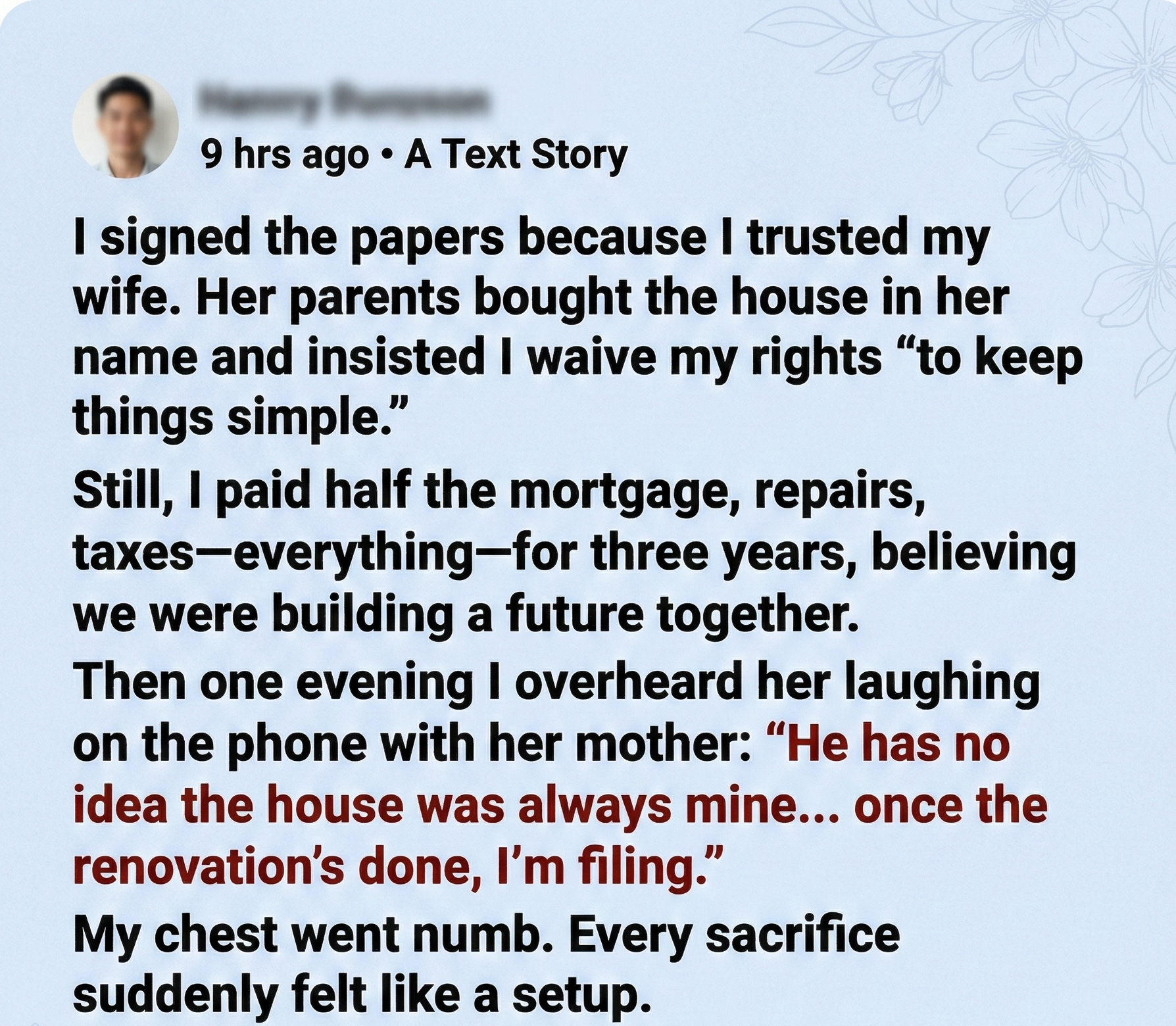
When my in-laws helped my wife purchase our home, they made one thing very clear from the beginning: the house would be entirely in her name. I would not appear anywhere on the paperwork. To reinforce that decision, they insisted on a strict prenup to ensure it stayed that way.
I didn’t argue.
Instead, I hired my own lawyer, reviewed every document carefully, and signed. At the time, I trusted my wife completely. I truly believed we were partners, even if the legal paperwork didn’t reflect that reality.

I split all the costs 50/50.
Financially, we split everything 50/50. Once we were married, that meant dividing all household expenses evenly—mortgage payments, repairs, maintenance, upkeep. I believed we were building a future together. For three years, I paid my share consistently. I never missed a payment. I never asked questions. I didn’t keep receipts or track what I had contributed. I trusted that marriage meant we were on the same side.
I never questioned where my money went.
Whenever we upgraded furniture or handled repairs, I transferred my half to my wife and let her manage the rest. I didn’t monitor credit card statements or mortgage paperwork. Once I paid my portion, I considered my responsibility fulfilled. I wasn’t trying to control anything—I was simply trusting the system we had in place.
Looking back now, that trust made everything feel simple.
Too simple.
It only took one sentence to change how I saw everything.
Last week, I overheard my wife speaking to her mother on the phone. I wasn’t trying to eavesdrop, but then I heard my name. That’s when I paused.
She said I had no idea what was coming—that she had already spoken to a lawyer.
She laughed.
She said I’d paid off half the mortgage and wouldn’t get a penny back.
And then she said something I can’t forget: by spring, she’d be debt-free and single.

In that moment, the past three years came into sharp focus. Everything suddenly made sense—the insistence on sole ownership, the unwavering confidence around money, the way my financial contributions were treated as expected rather than shared.
I realized my role hadn’t been “partner.”
It had been “solution.”
My income wasn’t part of a shared future—it was part of a plan I had never been told about.
I needed to think quickly.
That night, I sat down and faced the reality in front of me. Legally, I had zero rights to the house. I had already paid half the mortgage for three years. But we weren’t finished yet. My money was still being counted on—even if my consent wasn’t.
So I made a decision.
I established new rules.
I told my wife that I would no longer contribute to the mortgage, repairs, or upgrades on the house. Not out of anger. Not as punishment. But because continuing to fund an asset I had been deliberately excluded from—especially knowing it was being used against me—no longer made sense.
Her reaction was immediate.
Her parents quickly stepped in.
I was told I was being selfish. Dramatic. Unfair. That I was “putting everyone in a difficult position.”
That was the moment I understood just how normalized my role as the financial backstop had become.

The future now feels uncertain.
Refusing to keep paying into a home I have zero legal rights to was, in some ways, the easy part. Leaving my wife—that is much harder. Despite everything I’ve discovered, letting go of the dream of a shared future has not been easy.
Now that I am no longer functioning as a financial asset, there’s a strong possibility my wife may serve me with divorce papers.
My decision may have cost me my marriage.
Did I do the right thing?
Source: brightside.me