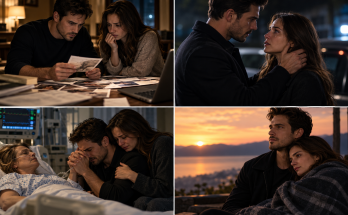
I’m a 29-year-old white guy.
My wife, Nia, is 30 and Black. We’ve been together almost nine years, married for six. We have two kids: our daughter Ava (3) and our son Micah (5).
I loved my wife more than anything. I still do, even after everything that happened.
But I’d be lying if I said I didn’t start feeling uneasy the day Micah was born.
Not because I didn’t love him.
But because… he didn’t look like me.
Not even a little.
When Ava was born, it was obvious she was ours. She had my nose. My lighter skin tone. Even my mother joked that she was my “mini-me.”
Micah was different.
He was noticeably darker than my wife. He didn’t look mixed at all. He had tight curls, deep brown skin, and features that didn’t resemble me in any way.
At first, I told myself genetics were complicated. I read articles online about how kids can inherit traits from grandparents, how mixed babies can come out in all shades.
And I wanted to believe it.
But every time I took him to the park, strangers would say things like:
“Wow, he looks just like his mama.”
Or worse…
“Is that your wife’s son?”
I would laugh it off. Smile. Pretend it didn’t sting.
But it did.
Because deep down, I felt something ugly growing in my chest.
Doubt.
THE THOUGHT I COULDN’T ESCAPE
Micah was 2 when the doubt became unbearable.
I was scrolling on my phone late one night and saw a post about paternity fraud. It was one of those viral posts where a man raised a kid for years, then found out it wasn’t his.
The comments were brutal.
“Always get a DNA test.”
“Women lie.”
“Never trust anyone.”
I put my phone down and stared at the ceiling.
I hated myself for even thinking it.
Nia had never given me a reason not to trust her. She wasn’t sneaky. She wasn’t distant. She was the kind of woman who would bring me coffee in bed and kiss my forehead like it was her daily mission.
But Micah’s face… kept haunting me.
So I did something I’m still ashamed of.
I ordered a paternity test online.
I told myself it wasn’t because I didn’t trust her.
I told myself it was for “peace of mind.”
But if I’m being honest…
It was because I couldn’t live with the question anymore.
THE SECRET TEST
The kit arrived in a plain brown envelope.
I waited until Nia was at work and the kids were napping. I took a cheek swab from Micah and one from myself.
My hands were shaking so badly I almost dropped it.
Then I mailed it.
And I waited.
Every day after that felt like I was carrying a brick in my stomach.
I would look at Micah while he played with his trucks and I would feel guilty. I’d feel like a monster.
He’d run to me and say, “Daddy, look!”
And I’d smile, but inside I was terrified.
Because what if he wasn’t mine?
What if I’d been living a lie?
THE RESULTS
Two weeks later, an email came in.
I waited until I was alone in my car. I couldn’t even breathe properly. My hands were sweating.
I clicked.
“Probability of paternity: 0%.”
Not a mistake.
Not “low probability.”
ZERO.
I stared at the screen until my vision blurred.
Then I started shaking so hard I thought I might vomit.
I felt like the ground dropped out from under my entire life.
I couldn’t hear anything except my own heartbeat pounding in my ears.
I read it again.
And again.
Still zero.
I sat in my car and cried like I hadn’t cried since I was a child.
Not because I didn’t love Micah.
But because in that moment, it felt like my whole marriage was a lie. My wife. My home. My family.
I went inside that night and looked at Nia differently. Like she was a stranger wearing my wife’s face.
And the worst part?
She didn’t even know.
She kissed me. She asked about my day. She joked about dinner.
And I sat there pretending everything was fine while my world was collapsing.
THE CONFRONTATION
Two days later, I couldn’t take it anymore.
I waited until the kids were asleep.
Then I showed her the paper.
I didn’t scream. I didn’t throw things. I didn’t call her names.
I just placed it on the table and said quietly:
“I need you to tell me the truth.”
Nia looked down.
She read it.
And for a second, she just stared.
Then she started laughing.
Not a happy laugh.
A broken laugh.
Like her brain couldn’t process what she was seeing.
Then she whispered:
“What… what is this?”
I said, “It’s a paternity test.”
Her face went pale.
I expected tears. I expected excuses.
Instead… she looked horrified.
She grabbed the paper and reread it again and again.
Then she stood up so fast her chair fell backward.
“No,” she said. “No. This can’t be real.”
I stared at her.
“What do you mean it can’t be real?”
Her voice cracked.
“Because I have never cheated on you. Not once.”
I wanted to believe her.
But how could I?
The test didn’t lie.
So I asked the question that felt like swallowing glass:
“Then who is Micah’s father?”
Nia’s lips trembled.
Then she sat down slowly and covered her mouth.
And I realized something terrifying.
She wasn’t acting.
She was genuinely shocked.
THE TRUTH THAT CHANGED EVERYTHING
After a long silence, she whispered:
“There’s… something I never told you.”
My stomach tightened.
She looked at me with tears filling her eyes.
“When I was 19… before we met… I was assaulted.”
My entire body went cold.
She kept talking, her voice shaking.
“It happened at a party. I was drunk. I thought I was safe. And I… I never told anyone. Not even my mom.”
I couldn’t breathe.
“I got tested afterward. Everything was fine. I didn’t get pregnant.”
She wiped her face and continued.
“But when I got pregnant with Micah… I was terrified. Because I remembered… and I thought maybe… maybe it was from that.”
I stared at her.
“But the timing—”
She shook her head.
“I never told you because I convinced myself it was impossible. I told myself he was yours. I wanted him to be yours.”
Then she whispered something that shattered me:
“I didn’t cheat. I swear. But I also… never did a test. Because I was scared of what it would say.”
THE SECOND TEST
The next day, we went to a real clinic.
Not an online kit.
A proper lab.
We did another DNA test.
And while we waited, our house felt like a funeral home.
We barely spoke. We just existed in the same space, terrified of what the truth would confirm.
When the results came back…
I expected them to match the first test.
But they didn’t.
Not exactly.
The doctor sat down with us and said:
“There’s something unusual here. The child is not biologically related to you, sir… but he is biologically related to your wife.”
I blinked.
“What?”
The doctor looked at his notes.
“The DNA suggests the child is her biological son… but the paternal markers don’t match your profile. They match a profile that would indicate a close male relative.”
My blood drained from my face.
I turned slowly toward Nia.
She looked just as confused.
Then the doctor said the words that made the room spin:
“It is possible—rare, but possible—that your wife carries genetic material from a male twin that never fully developed. This is called chimerism.”
I didn’t even understand.
But the doctor explained.
Sometimes, a fetus absorbs a twin in the womb. The absorbed twin’s DNA remains in the body.
Meaning a woman could have eggs that carry DNA from her absorbed male twin.
Meaning…
Micah wasn’t my biological son.
But he also wasn’t the son of another man.
He was the son of… a genetic anomaly.
A biological impossibility that sounded like science fiction.
The doctor said he had only seen it once before.
THE AFTERMATH
I didn’t know whether to cry or laugh.
I felt sick.
I felt relieved.
I felt ashamed.
I felt everything at once.
Because the truth was…
My wife hadn’t betrayed me.
But I had betrayed her.
I had doubted her. Tested her. Judged her silently.
And she had been innocent the whole time.
When we got home, Nia sat on the couch and just stared at the wall.
Then she whispered:
“I thought you were going to leave me.”
I sat beside her.
And for the first time in weeks, I cried in front of her.
“I’m sorry,” I said.
“I’m so sorry.”
She didn’t forgive me instantly.
It took time.
But she did forgive me.
Because she understood the fear.
And because, despite my mistake…
I still loved Micah like he was my own.
And I still do.
THE MOMENT THAT HIT ME HARDEST
A few nights later, Micah climbed into my lap, wrapped his little arms around my neck, and said:
“Daddy, I love you.”
And something inside me broke open.
Not in pain.
In gratitude.
Because biology didn’t make me his father.
Love did.
I realized I didn’t need DNA to prove my bond with him.
I had been there for every scraped knee, every bedtime story, every fever, every laugh.
That was fatherhood.
Not genetics.
THE ENDING
We stayed together.
We went to counseling.
I learned to communicate instead of silently doubting.
Nia learned to trust that she didn’t have to carry her fears alone.
And Micah?
He grew up never knowing any of it.
Because he didn’t need to know the complicated science behind his existence.
He only needed to know one thing:
That he was loved.
And he was.
Every single day.