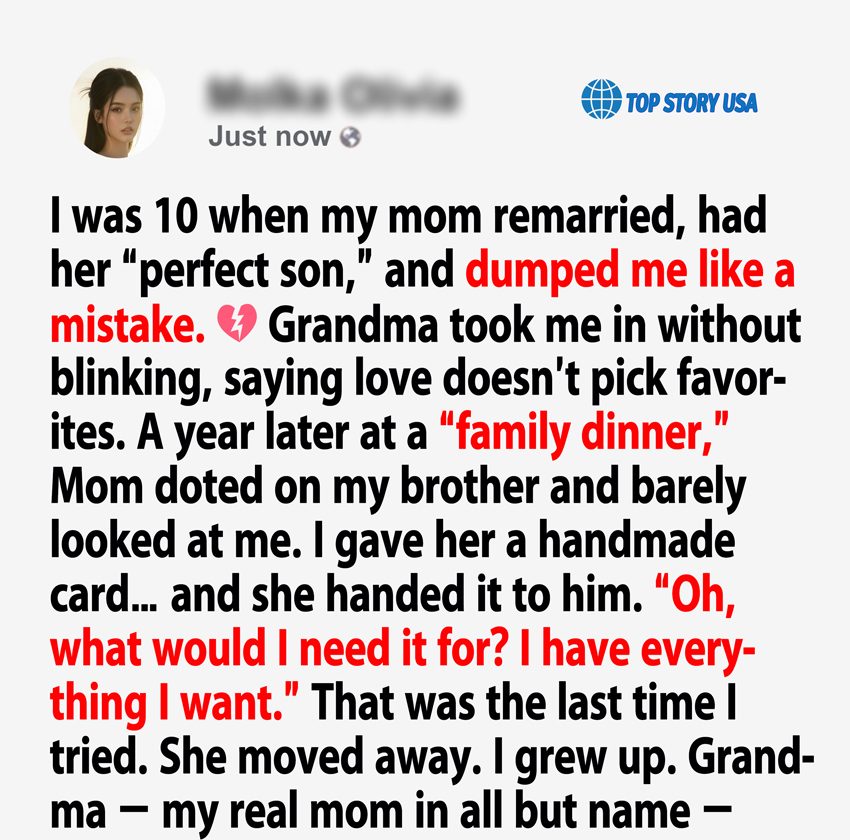
I was ten years old when my mother decided she was done being my mom.
It wasn’t a dramatic conversation. No tears. No explanation. Just a suitcase packed with my clothes, a plastic bag of school papers, and her hand on my shoulder guiding me toward the front door like I was a delivery she needed to drop off.
A month earlier, she’d married my stepfather—Rick. He was the kind of man who always smiled at strangers but never looked you in the eye long enough to feel human.
And when my mother got pregnant, everything about her changed.
She stopped calling me “sweetheart.” She stopped brushing my hair at night. She stopped asking how school was. It was like the baby inside her had erased me.
When my brother was born, she called him her “perfect miracle.”
And I became the problem she didn’t want in her new life.
So she drove me to my grandmother’s house one afternoon and knocked once.
My grandmother opened the door, took one look at my face, and her eyes filled with anger so sharp it scared me.
My mom didn’t even step inside.
“She’s… too much right now,” my mother said, as if I were a broken appliance. “You’ve always been good with kids.”
My grandmother didn’t argue.
She didn’t beg.
She didn’t plead for her daughter to stay.
She simply reached out, pulled me behind her, and said, calm as stone:
“Go.”
That was the last thing she ever said to my mother for years.
And it was the first time I felt safe.
Grandma Became My Real Mother
Grandma raised me like I was her own child.
She made me breakfast every morning. She braided my hair before school. She packed my lunch with little notes written in messy handwriting:
“You are loved.”
“Don’t forget who you are.”
“Love doesn’t pick favorites.”
Those words became my oxygen.
But even with Grandma’s love, I still carried a wound that never closed.
Because I didn’t understand what I had done wrong.
I was only ten.
How could a mother look at her child and decide she was unnecessary?
The Dinner That Broke Me
When I was eleven, Grandma said we were going to a “family dinner.”
I didn’t want to go. But part of me still hoped… maybe my mother missed me.
Maybe she would hug me. Maybe she would say she was sorry.
So I made her a handmade card at school. I drew flowers on the front, cut the edges in little zigzags, and wrote:
“I love you, Mom. I miss you.”
I held it the whole car ride like it was something fragile.
When we arrived, my mother opened the door holding my baby brother. She barely glanced at me.
The house smelled like roast chicken and expensive perfume. Everything looked clean and new, like my old life had been replaced.
My brother—her perfect son—was sitting in a high chair in the kitchen, giggling as my stepfather made funny faces at him.
My mother smiled at them like they were her entire universe.
Then she turned to me.
Her eyes were polite. Empty.
Not cold.
Worse.
Indifferent.
I handed her the card with shaking fingers.
“I—I got that for you,” I said.
She took it, looked at it for half a second, then casually handed it to my little brother like it was a toy wrapper.
“Oh,” she said, waving me off. “What would I need it for? I have everything I want.”
I remember the way my chest tightened.
I remember how my face burned.
I remember how my throat closed like I’d swallowed glass.
And I remember Grandma’s hand gripping mine under the table so tightly it hurt—like she was holding me together before I fell apart.
That was the last time I tried.
That was the moment I stopped hoping.
She Disappeared
After that dinner, my mother moved away with her new family.
No goodbye.
No letter.
No phone call.
I didn’t even know where they went.
Years passed.
I graduated high school. I went to college. I worked two jobs. I built a life out of survival.
And Grandma was there for every step.
She was the one who clapped at my graduation.
She was the one who cried when I got my first apartment.
She was the one who hugged me when I got engaged.
She was my mother in everything except blood.
And I never stopped being grateful.
Losing Grandma
When I was thirty-two, Grandma got sick.
It started as fatigue. Then dizziness. Then hospital visits that ended with doctors speaking softly in hallways.
Cancer.
Stage four.
She tried to hide how scared she was, but I could see it in her eyes at night when she thought I was asleep.
I took care of her the way she took care of me.
I fed her soup.
I brushed her hair.
I sat beside her bed and held her hand for hours, even when she couldn’t talk.
One night, a week before she died, she pulled me close and whispered:
“Promise me you’ll never beg for love from people who don’t know how to give it.”
I cried into her blanket and nodded.
And then she was gone.
Just like that.
The woman who saved my life.
The woman who raised me.
The only parent I ever truly had.
Gone.
The house felt like a hollow shell after the funeral.
I stayed up all night sitting at the kitchen table, staring at her mug, her knitting basket, her worn-out slippers by the door.
It felt like the world had finally taken everything.
The Knock at the Door
Three days after we buried Grandma, there was a knock at my door.
A sharp knock. Like someone was impatient.
I opened it expecting maybe a neighbor or a delivery.
Instead…
It was my mother.
She looked older. Thinner. Her hair was dyed blonde, but her roots were gray. She wore expensive sunglasses and a coat that looked like it cost more than my car.
Behind her stood my stepfather.
And beside him was my brother.
The “perfect son.”
He was twenty-two now. Tall. Well-dressed. Confident.
My mother smiled like we were family.
Like she hadn’t thrown me away.
“Hi,” she said softly. “Can we come in?”
My body froze.
I didn’t even know what to say.
All I could hear was Grandma’s voice:
Don’t beg for love.
I stepped aside and let them enter.
My mother looked around the house like she was inspecting property.
Then she sat down at Grandma’s dining table—the same table where Grandma used to serve pancakes and tell me I was enough.
And my mother said the words that made my stomach turn:
“I heard she left you everything.”
I stared at her.
That was it.
That was why she came.
Not grief.
Not guilt.
Not love.
Money.
My mother folded her hands and sighed dramatically.
“You know… your grandmother always held a grudge. She poisoned you against me. But I’m your real mother. And I think we should talk about what belongs to our family.”
I felt my hands shake.
My stepfather leaned back like he owned the room.
My brother looked at his phone, bored.
My mother continued:
“We want the house.”
I blinked. “What?”
My mother nodded like she was being reasonable.
“This house should’ve gone to me. I’m her daughter. I don’t care what the will says. We’re willing to be fair… you can take a small amount of money and we’ll take the property.”
Something inside me cracked open.
Not sadness.
Not fear.
Anger.
Pure, boiling anger.
I laughed once—sharp and bitter.
“You abandoned me,” I said. “You dumped me at ten years old. And you come back now… because Grandma died… and you want her house?”
My mother’s eyes hardened.
“Don’t be dramatic,” she snapped. “I was young. I had a new family. Things were complicated.”
I stood up slowly.
And I said something I had waited twenty-two years to say:
“No. Things weren’t complicated. You just didn’t want me.”
Silence filled the room.
Then my mother’s voice went cold.
“If you don’t give us what we’re owed,” she said, “we’ll take you to court.”
My stepfather smirked.
My brother finally looked up.
And that’s when I realized…
They truly thought I was still that little girl begging for a handmade card to be noticed.
They thought I was weak.
They thought I’d fold.
The Secret Grandma Left Behind
I walked to the drawer beside the kitchen counter.
I pulled out an envelope.
Grandma had told me to open it only after she was gone.
Inside was a letter.
A long one.
I had read it after her funeral, sobbing so hard I couldn’t breathe.
Now I placed it on the table.
And I slid it toward my mother.
My mother frowned. “What is this?”
I looked her dead in the eye.
“Grandma knew you would come.”
Her face stiffened.
I continued.
“She knew you’d show up after she died. She knew you’d pretend you cared. She knew you’d ask for money.”
My mother’s lips parted slightly.
I tapped the envelope.
“So she prepared something for you.”
My mother grabbed the letter and opened it.
As she read, her face changed.
At first, she smirked.
Then she blinked.
Then her hands started trembling.
Then her skin went pale.
Because Grandma’s letter wasn’t soft.
It wasn’t emotional.
It was a weapon.
It said:
“To my daughter:
If you are reading this, it means you came back after my death to take what you never earned.
You abandoned your child and left her with me like trash.
You did not visit. You did not help. You did not care.
You are not welcome in my home, in my legacy, or in her life.I have left you nothing.
And if you try to contest my will, you will lose even more.
Because I have documented everything.
Text messages. Dates. Witnesses. The day you left her here.
The day you said she was ‘too much.’I kept receipts.
I kept proof.And I have already sent copies to my attorney.”
My mother’s eyes widened.
Her fingers tightened on the paper like she wanted to tear it apart.
But she couldn’t.
Because Grandma wasn’t done.
The final paragraph said:
“And if you ever dare to call yourself her mother again, remember:
I was the one who raised her.
I was the one who loved her.And she is the best thing you ever threw away.”
My mother looked up at me, breathing hard.
Her lips trembled—not from sadness…
From rage.
“How dare she,” she hissed. “How dare she write that about me!”
And that’s when I realized something chilling:
Even now…
She still didn’t feel sorry.
She only felt insulted.
The Ending
My stepfather stood up.
“This is ridiculous,” he said. “We’ll sue you.”
I nodded calmly.
“Go ahead,” I said. “Her attorney is expecting you.”
My brother stared at me, suddenly uncertain.
My mother’s eyes darted around the room, like she was calculating.
Then she stood up so fast the chair scraped the floor.
“This is your fault,” she spat. “You turned her against me.”
I smiled. Not because it was funny.
But because it was over.
“No,” I said softly. “You did that yourself. Twenty-two years ago.”
She stormed toward the door.
Before leaving, she turned back one last time and said:
“You’ll regret this.”
I stepped forward and opened the door wider.
And I said the words that finally freed me:
“I regretted you a long time ago.”
They left.
And when the door shut behind them…
the silence felt different.
Not lonely.
Peaceful.
Like a storm had finally passed.
I walked back to the kitchen, sat at Grandma’s table, and ran my fingers across the wood.
For the first time since she died…
I felt her presence again.
Not in the house.
But in me.
Because Grandma didn’t just give me a home.
She gave me something stronger:
A spine.
A voice.
A life.
And that night, I stood in her kitchen and whispered into the empty air:
“Thank you for choosing me.”
Epilogue (Realistic Ending)
A month later, I got a call from her attorney.
My mother had tried to contest the will.
But she didn’t last long.
Because Grandma had done exactly what she promised.
She had documentation.
Witness statements.
Old letters.
Even a notarized timeline.
The lawyer told my mother’s side one thing:
“If you push this further, we will expose everything in court.”
They dropped the case within a week.
And I never saw my mother again.
But I didn’t feel sad.
I felt relief.
Because the truth is…
She stopped being my mother the day she abandoned me.
And Grandma…
Grandma was the only parent I ever needed.