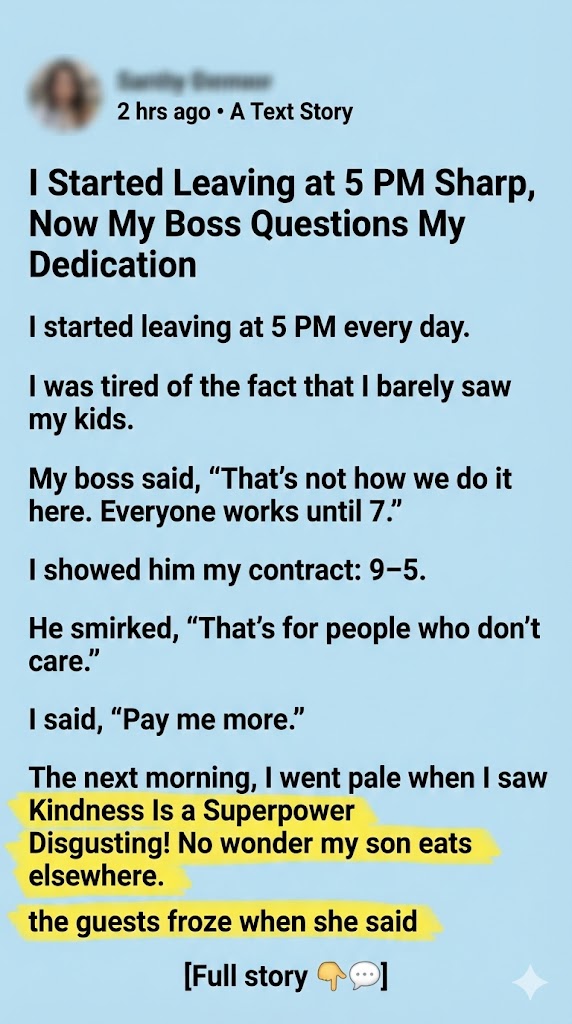
Work-life balance sounds great until you actually try to have one. When one working mom started clocking out at 5 PM sharp, her boss called her “uncommitted”—and what happened next sparked a workplace debate everyone needs to hear.


Hello, Bright Side,
Recently, I started leaving at 5 PM every day. I was tired of the fact that I barely saw my kids and husband.
But then my boss pulled me aside: “That’s not how we do it here. Everyone stays until 6 or 7.” I said, “My contract says 9–5.” He snapped, “5 PM is for the uncommitted people who don’t care.” I replied, “Then pay me more.” He just smirked.
The next morning, my stomach dropped when I saw the team meeting invite about the big project, and I wasn’t on it. The project I’d been working toward for months was reassigned to my coworker, “who has more availability.” When I asked why, my boss said, “We need people who can be flexible with hours. You’ve made it clear you can’t.”
Yeah, they didn’t fire me or demote me. They are going to slowly exclude me from anything important or career-advancing. At the end, I’ll be left with boring maintenance work while everyone else gets promoted around me.
So what do I even do now—play along and lose my family time, or stand my ground and lose my career?
Ashley


Well.. that’s how it actually works when you have a job
You can’t fully rely on the contract till you need to pay the bills
Hi, Ashley!
And welcome to the corporate classic: “We love work-life balance… as long as it doesn’t affect work.” If your contract is truly 9–5, then you’re not “leaving early.” You’re leaving on time.
But here’s the uncomfortable truth: Even if your boss is being petty, it’s often legal to reward people who work longer hours and sideline people who don’t—as long as it doesn’t cross certain lines.
✅ What’s probably legal (even if it’s unfair):
- Reassigning you from a “big project” because they claim you’re “less available.”
- Giving you less “stretch work.”
- Promoting the people who stay late.
🚩 What can become illegal:
- You’re paid hourly, and they expect unpaid overtime (wage theft).
- You’re being punished for using a protected right (like protected leave or accommodations).
- There’s discrimination involved.
- They retaliate because you raised legal concerns or asked about overtime pay.
🎯 What you can do now
Here are your realistic options, ranked from “least risky” to “most nuclear”:
1) Start documenting everything
- The meeting you were removed from
- The “more availability” comment
- Your boss says, “5 PM is for people who don’t care.”
- Any changes in duties, projects, performance feedback
2) Request expectations in writing
“Just to confirm expectations: my contract hours are 9–5. If the role now requires routine work past 5 PM, can you confirm the new expected schedule and whether compensation or time-off-in-lieu applies?”
This forces them into one of two uncomfortable positions: admit they expect unpaid overtime or admit they’re punishing you for not “volunteering” your time.

3) If you want to escalate internally, do it strategically
You can go to HR, but understand: HR often protects the company—not you. Still, it can help if you frame it like this:
✅ “I want to stay long-term, but I’m concerned that I’m being excluded from projects because I’m working my contractual hours.”
All in all, a workplace that punishes you for leaving on time will always punish you for having a life. So if you stay, you’ll spend your energy trying to earn respect from people who are structurally invested in you having none.
So instead:
- keep doing excellent work during your actual hours,
- update your resume quietly, and
- start planning an exit if the culture refuses to grow up.
Bright Side
If you’ve ever felt pressured to “chip in” at work, don’t miss I Refused to Pay a Fortune for My Boss’s Birthday Gift—And It Got Ugly, where one freelancer’s contribution turned into a full-office judgment moment.