My stepmom wore thrift-store jewelry with pride.
Every necklace, every ring, every bracelet had a story to her. She’d pick them up at flea markets and charity shops, polish them carefully, and wear them as if they were priceless. She believed beauty wasn’t about money—it was about meaning.
Her daughter never agreed.
I still remember the way she laughed once and said,
“Mom is sparkling like a cheap Christmas tree.”
My stepmom only smiled. She never argued. She never defended herself. She just kept wearing her jewelry, head high, unashamed.
After she died, everything changed fast.
Her daughter showed up with papers and cold eyes. Within days, she kicked my dad and me out of the house we’d shared for years. No discussion. No sympathy. No time to grieve.
I watched my father pack in silence, older overnight. I felt numb.
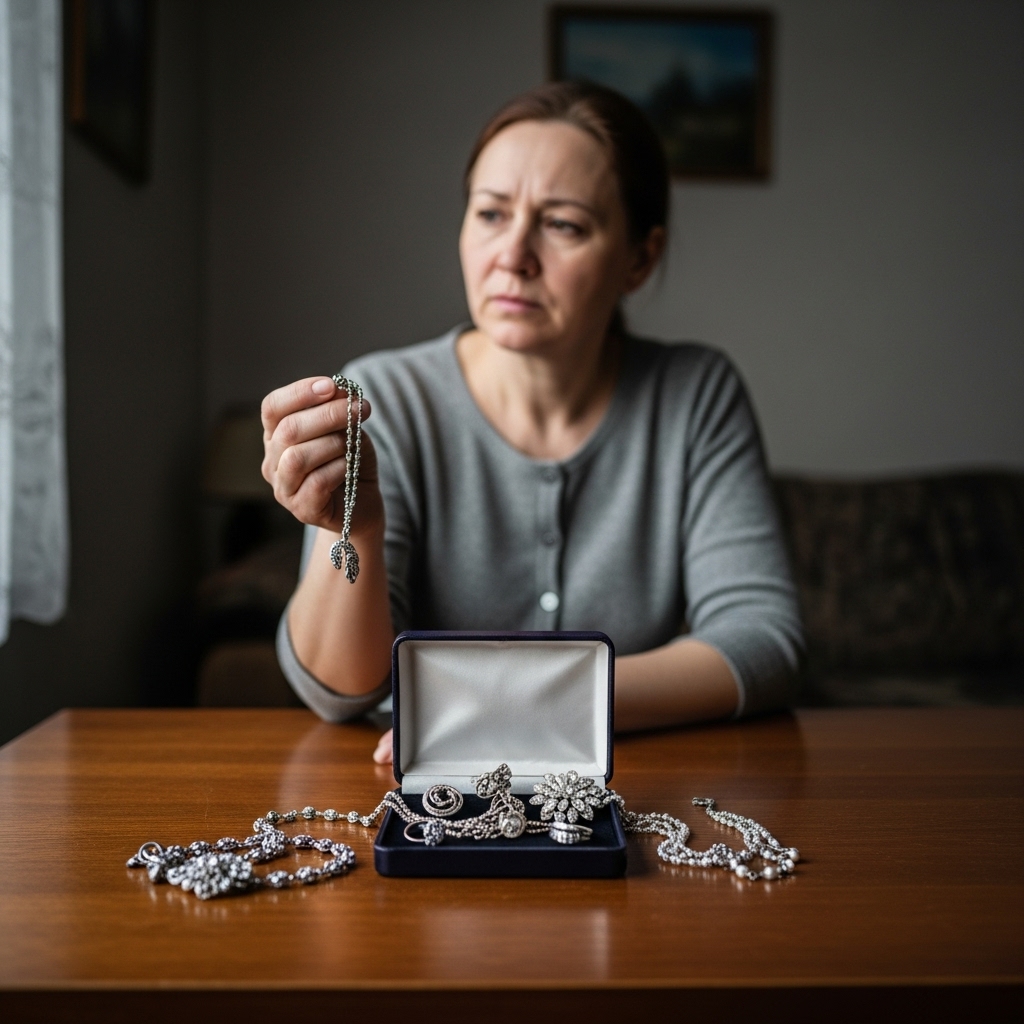
The only thing I took with me was a small box of my stepmom’s jewelry—the pieces everyone mocked. It felt wrong to leave them behind. They were her. They were proof she had existed, that she had mattered.
For years, the box sat untouched in a drawer. Life moved on. Pain dulls, but it never fully disappears.
Then one afternoon, my cousin came to visit.
He noticed the jewelry box while we were talking. Casually, he asked if he could look at it. I shrugged and handed it over.
The moment he opened it, his face changed.
He stopped breathing for a second. His hands froze.
“Do you even know what this is?” he whispered.
I laughed awkwardly. “Old costume jewelry. My stepmom loved it.”
He shook his head slowly. Carefully, almost reverently, he picked up a ring.
“This isn’t costume,” he said. “This is real. And not just real—this is antique.”
One by one, he examined the pieces. A necklace from a small European designer. A brooch made with real stones. A ring worth more than my car.
My stepmom hadn’t been wearing trash.
She had been wearing her past.
My cousin explained that some of these pieces dated back decades. Family heirlooms. Items that had likely been passed down and quietly protected. She’d never bragged. Never explained. Never corrected anyone who mocked her.
She didn’t need to.
When I realized the truth, I didn’t feel excited. I felt sick.
Her daughter had laughed at her. Kicked her out of memory. Thrown away what she didn’t understand.
And I had been the one who kept it—not because of value, but because of love.
I never told her daughter what the jewelry was worth. I didn’t need to.
Some losses can’t be recovered. Some truths come too late.
Now, the jewelry sits in a safe place. I wear one piece on special days—not to show wealth, but to honor a woman who taught me something quietly powerful:
You don’t need anyone’s approval to know your worth.
And the people who laugh the loudest often understand the least.
That jewelry was never cheap.
But even if it had been—
her dignity never was.