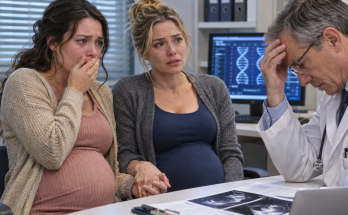
I didn't agree to Emily's idea the first time she explained it.
I laughed.
Then I asked her to explain it again.
It wasn't that I hadn't understood the words.
I understood them perfectly.
That was the problem.
She wanted us to have children with the help of the same sperm donor.
One biological father.
Two mothers.
Two babies who would grow up knowing they were related.
I remember sitting with that thought and wondering whether I was taking her seriously because the idea was sensible or because I wanted a baby so badly.
Those were not the same thing.
I knew that even then.
Emily was watching me carefully.
She knew I had spent years trying to accept that my marriage had not turned into the family I hoped for.
She also knew how much I hated the thought of allowing that disappointment to decide what happened next.
Still, this was different from anything we had discussed before.
We had talked about becoming mothers at the same time.
We had talked about our children playing together.
We had even imagined what it would feel like to watch them grow up as friends.
But we had never discussed sharing the same biological father for our babies.
That changed the conversation.
It made the dream feel less like a distant possibility and more like a decision we could actually make.
I asked Emily why she wanted our children to be biologically related.
She considered the question.
Then she said she wanted them to have something connecting them that would remain even as they grew older.
I understood what she meant.
We had always called each other family.
We had spent twenty-five years proving that friendship could last through all the changes life brought.
But we were not sisters.
We had no shared parents.
Our bond existed because we had chosen it, again and again.
Emily wanted our children to have that kind of closeness without having to begin as strangers.
She wanted them to know from the beginning that they belonged to one another.
It was an emotional argument.
I knew that.
There was no guarantee two children would become close simply because they shared a father.
There was no guarantee they would grow up with the same interests or personalities.
Even children raised in one household could turn out very differently.
I understood those things.
But I also understood why the idea mattered to Emily.
For most of our lives, we had been trying to explain a friendship that felt like a family relationship.
Now she was asking whether the next generation could share the kind of connection we had never possessed ourselves.
Biological siblings.
The words stayed with me.
I kept returning to them.
I would think about my own childhood and remember how naturally Emily had fit into it.
She had never seemed like an outsider.
Neither of us had to make special arrangements to understand the importance of the other.
We were simply there.
Year after year.
And I found myself imagining our children experiencing something similar.
I pictured two little ones growing up with their mothers close by.
I imagined them knowing that the woman they called their mother's best friend was also raising their half-sibling.
There would be no need to explain why we cared so much about one another.
Our families would be connected in a way nobody could mistake.
The more I thought about it, the more emotional the possibility became.
But I was also afraid.
I had already made one major decision about starting a family that hadn't turned out as I expected.
I didn't want to repeat that mistake simply because I was tired of waiting.
I had been divorced for five years.
That time had changed me.
I no longer believed that wanting something badly was enough to make it work.
I wanted to understand what I was agreeing to.
Emily wanted the same thing.
We weren't teenagers making promises about the future.
We were women in our thirties who knew that life could turn away from a plan without asking permission.
We had both experienced disappointment.
We had both spent years hoping things would happen differently.
And neither of us wanted to begin motherhood carelessly.
Still, the idea refused to leave us alone.
We talked about it again.
And again.
Sometimes we approached it with excitement.
Other times we found ourselves worrying about the responsibility.
It would not be a normal family arrangement.
We knew that.
Some people might not understand.
Others might think we were making the decision for the wrong reasons.
We couldn't control those reactions.
But we could decide whether the arrangement itself was right for us.
That became the question we kept returning to.
Did we truly want this?
Not just the imagined birthdays and shared memories.
Not just the pleasant thought of watching two related children grow up together.
Did we want to become mothers through the same donor, knowing that our decision would shape our children's lives long after the excitement of pregnancy had passed?
I tried to be practical.
I thought about the difference between being close friends and being responsible for children.
Friendship had carried us through difficult times.
But motherhood would be something else.
There would be needs we couldn't postpone.
Responsibilities we couldn't put aside.
Choices that would matter to people who had never been given a chance to make them.
I wanted to believe we were ready.
Emily wanted to believe it too.
And somehow, talking through our fears didn't make the idea disappear.
It made it stronger.
We began to understand that the decision wasn't really about avoiding relationships.
We were not trying to punish anyone who had disappointed us.
We simply didn't want our desire to become mothers to depend entirely on finding partners.
Our lives had taken different paths.
Mine had included a marriage and a divorce.
Emily's had never included a marriage.
But we had reached the same point.
We wanted children.
And we were prepared to consider a different way of having them.
One evening, after we had talked through the idea yet again, I realized something had changed.
I wasn't treating it like a surprising suggestion anymore.
I was treating it like a possibility that deserved a real answer.
I asked Emily whether she was certain.
She didn't pretend the decision was small.
She knew it wasn't.
But she told me she had thought about it seriously.
I could hear that in her voice.
This wasn't a passing thought.
She had been carrying it long enough to imagine what it might mean for both of us.
I wanted to give her an immediate answer.
Part of me already had one.
But I had learned to be cautious around important promises.
My marriage had taught me that.
There were things I once believed would last simply because I wanted them to.
I didn't want to approach motherhood that way.
I wanted to make a decision I could stand beside when life became difficult.
Because children deserved more than enthusiasm.
They deserved adults who understood the commitment they were making.
The thought stayed with me.
So did Emily's suggestion.
I began imagining the future in a way I hadn't allowed myself to for years.
I could see myself pregnant.
I could see Emily pregnant too.
I could imagine us entering motherhood with the kind of support we had always given one another.
And I could imagine two children who would have a biological connection because we had chosen the same donor.
It was an unusual arrangement.
I knew that.
But unusual didn't automatically mean wrong.
At least, that was what I believed.
I had no idea how often I would return to that thought later.
For the moment, we were still discussing possibilities.
There were no babies.
No confirmed pregnancies.
No donor had been selected.
We had only a decision to make.
But the decision began to feel real when we stopped asking whether the arrangement sounded strange and started asking how it could actually happen.
We would need medical help.
We would need consultations.
We would need testing.
And we would need to find a donor we were both comfortable choosing.
It was no longer enough to imagine our children sharing a father.
We had to understand how that choice would be made.
Emily and I agreed that we would not simply rush forward without speaking to medical professionals.
We needed information.
We needed to know what steps were required.
And we needed to take those steps properly.
I felt relieved when we agreed on that.
It made our idea feel less reckless.
More considered.
More like a plan.
Looking back, I can see how much reassurance I took from the thought that doctors would be involved.
I believed that if we followed the recommended process and completed the necessary tests, we would be making a responsible choice.
I trusted the process before I had even entered it.
I trusted that asking the right people would help us understand everything important.
That belief gave me confidence.
Perhaps too much.
But at that moment, there was no reason for me to expect what would happen later.
I was still a woman who had wanted to become a mother for years.
My best friend had offered me an idea that might finally make that possible.
And after many conversations, I reached the point where I could say that I wanted to pursue it.
Not as a joke.
Not as a distant fantasy.
As a real decision.
Emily and I agreed to move forward with the same donor plan.
We were going to seek medical guidance and find out whether we could both become pregnant.
For the first time in years, I felt that the future was moving again.
I had stopped waiting for someone else to build it for me.
I thought I was choosing a new beginning.
And at that point, it felt like one of the happiest decisions I had ever made.
Click here to continue reading: PART 3: We Spent Months Finding the Right Donor, Believing Every Medical Test Would Help Us Build the Family We Imagined
I Thought Sharing a Father Would Bring Our Children Closer, Until One Doctor Made Me Question Everything We Had Planned
Part 2 of 10