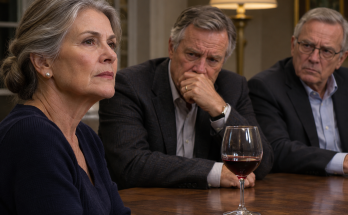
I had expected the evening to end with an argument.
Instead, it ended with a question nobody seemed willing to answer.
What did the agreement actually say?
Walter sat across from me.
Gerald remained beside him.
The wineglass was still on the table.
I looked at it and remembered how Walter had been holding it when I first mentioned Michael Bennett.
He had seemed so certain of himself then.
He had asked what agreement I meant.
As though he didn't remember.
As though the question itself were unreasonable.
But we had moved far beyond that.
He had acknowledged the meeting.
He had acknowledged his signature.
Gerald had acknowledged his.
And both men knew the agreement had been placed in a safe deposit box.
I looked at Walter.
He was watching me again.
I no longer felt the same need to explain myself.
I had explained enough.
Walter spoke quietly.
"Terry, I hope you understand what you're doing."
I considered him.
"I understand what I've said."
He looked down.
"That's not the same thing."
"No," I replied. "It isn't."
For a moment, I almost smiled.
We had spent much of the evening disagreeing about words.
Now we had agreed on something simple.
Understanding what I had said was not the same as knowing what might happen next.
I didn't know what would happen next.
I wasn't going to pretend otherwise.
Gerald leaned forward.
"This has gone far enough."
I turned toward him.
"Have I said something untrue?"
He paused.
"No."
"Then what has gone too far?"
He looked toward Walter.
Walter didn't answer for him.
Gerald shifted in his chair.
"You're making this into something it doesn't need to be."
I looked at him carefully.
I had heard that accusation all evening.
At first, it had made me question myself.
Was I being unreasonable?
Was I remembering something incorrectly?
Was I placing too much importance on old papers?
Those questions had troubled me.
But I had asked both men about the facts.
They had confirmed them.
I could no longer pretend that my memory was the problem.
"Then let's leave the agreement to speak for itself," I said.
Gerald looked down.
Walter remained silent.
I felt the room settle.
Not into peace.
Not into resolution.
Just into a silence that no longer frightened me.
I had spent years believing that silence meant something had gone wrong.
If Walter stopped speaking, I tried to make him comfortable.
If a discussion became tense, I searched for words that would soften it.
If I thought someone was disappointed in me, I often apologized before understanding why.
Looking back, that habit made me sad.
I had not always been wrong to apologize.
I had made mistakes like anyone else.
But I had also apologized for asking questions.
For remembering things differently.
For refusing to pretend I understood when I didn't.
That evening, I had not apologized once.
I noticed that.
Walter reached toward his glass.
His hand stopped.
Then he placed it flat against the table.
The movement was so familiar by then that it almost hurt to watch.
I knew the man sitting across from me.
Forty years of marriage had taught me how he looked when he was angry.
How he sounded when he was impatient.
How he behaved when he wanted to end a discussion.
But I was beginning to understand that knowing someone for a long time did not mean knowing everything they feared.
Walter spoke again.
"There's no reason to involve anyone else in this."
I looked at him.
I hadn't said I intended to involve anyone.
I hadn't asked Michael Bennett to do anything.
I had only mentioned the meeting in his office.
Walter was the one who kept returning to what might happen next.
I considered that before answering.
"I haven't made any arrangements."
He watched me.
"Then don't do anything rash."
"I don't intend to."
Gerald looked relieved.
But Walter didn't.
I understood why that might be.
Being careful was not the same as forgetting.
I could examine a document without acting recklessly.
I could ask questions without making accusations.
And I could acknowledge that I didn't know everything without surrendering what I did know.
Those distinctions had become important to me.
More important than winning an argument.
Gerald spoke.
"Then perhaps we can put this behind us."
I turned toward him.
I didn't answer immediately.
He had asked a reasonable question on its surface.
People couldn't discuss the same disagreement forever.
Eventually, they had to decide what came next.
But putting something behind us would not change what had been signed.
I looked at Gerald.
"Do you mean stop arguing about whether the agreement exists?"
He nodded.
"Yes."
"Then I agree."
His expression softened.
I continued.
"But that doesn't settle what it says."
The relief disappeared.
Walter closed his eyes briefly.
I watched him.
I wasn't enjoying the conversation.
I wasn't trying to make either man suffer.
I wanted the matter understood.
That was all.
And yet that simple desire seemed to have become the one thing neither man wanted to accommodate.
I looked at the table.
The glass.
The chairs.
Walter's hand.
Gerald's lowered eyes.
Those were the details I would remember afterward.
Not every sentence.
Not every pause.
But the way two men had reacted when I reminded them of their own signatures.
Walter finally said, "You're not going to forget about this."
I looked at him.
"No."
He stared at me.
I hadn't spoken angrily.
I hadn't needed to.
I couldn't forget the meeting simply because remembering it made him uncomfortable.
I couldn't pretend the papers didn't exist.
And I couldn't honestly tell him I would never ask another question about them.
Gerald shifted.
He looked as though he wanted to speak.
Then he changed his mind.
Walter studied me.
For a moment, his expression reminded me of the man I had known for most of my adult life.
Careful.
Reserved.
Accustomed to thinking before giving an answer.
But there was something unfamiliar beneath it.
He seemed to be waiting for reassurance.
I understood the feeling.
I had spent plenty of evenings wanting someone to reassure me.
Wanting to know a disagreement hadn't damaged everything.
Wanting a familiar voice to say the right thing.
But reassurance had to be honest.
I wasn't going to promise that the agreement didn't matter simply because Walter wanted to hear it.
I looked at him.
"We don't need to settle every question tonight."
He seemed to relax slightly.
"But I do want the questions answered honestly."
His expression tightened again.
I felt tired.
The same tiredness I had carried through the whole conversation.
Forty years of marriage sat behind us.
I couldn't dismiss them.
I couldn't pretend they meant nothing.
But neither could I use those years as a reason to doubt a memory both men had now confirmed.
Walter looked toward Gerald.
Gerald lowered his head.
The agreement was still somewhere beyond that room.
The actual pages.
The wording.
The signatures.
The details that would establish what the men had accepted when they signed.
I couldn't see those pages from where I sat.
I couldn't honestly claim to know exactly what every provision required.
And I couldn't invent an outcome simply because I wanted certainty.
The truth deserved more care than that.
Walter asked one last question.
"Is there anything else you want to say?"
I considered him.
There were many things I could have said.
I could have reminded him again of Michael Bennett.
I could have repeated that Gerald had signed beside him.
I could have mentioned the safe deposit box one more time.
But there was no need.
We had already established those facts.
Repeating them would not make the agreement clearer.
I shook my head.
"Not about what we already know."
Walter watched me.
Gerald remained still.
I felt the old urge to soften my answer.
To add something reassuring.
To say that I hadn't meant to upset anyone.
I resisted it.
I hadn't intended to upset them.
But that didn't mean I regretted asking.
For the first time that evening, I allowed myself to feel proud of how carefully I had spoken.
I had not accused them without proof.
I had not pretended to remember words I couldn't quote.
I had not raised my voice.
And I had not allowed their discomfort to replace the facts.
That mattered to me.
Walter finally looked away.
I followed his gaze toward the wineglass.
He had barely touched it since the conversation changed.
I thought again about the moment he set it down.
At the beginning, I had recognized something in his face that I rarely saw.
Fear.
Now I understood at least part of what made that moment so important.
He had expected the agreement to remain a subject nobody discussed.
I had spoken about it.
He had expected my memory to be uncertain.
Both men had confirmed it.
He had expected the conversation to end when he said it was over.
Instead, I had continued asking questions until we separated what we knew from what we still needed to establish.
That was the change I could honestly describe.
I did not know the full consequences of the agreement.
I did not know what would happen when its terms were examined.
I did know that Walter and Gerald had signed it.
I knew they remembered.
And I knew their acknowledgment could not be taken back merely because the evening had become uncomfortable.
I looked at Walter one last time.
He was quiet.
So was Gerald.
I had spent years interpreting silence as a command to retreat.
That evening, I finally stopped doing it.
There was no celebration.
No sudden explanation of every hidden detail.
No magical answer that settled everything.
There was only a document that still needed to be examined, two men who had admitted signing it, and a woman who no longer intended to deny her own memory.
I had not won a legal dispute that night.
I had not established the full meaning of the agreement.
Those answers remained in the document itself.
But I had stopped asking Walter to tell me whether something I remembered had really happened.
He had already admitted that it had.
I looked at the wineglass again.
Walter's hand rested beside it.
He did not pick it up.
And the expression I saw on his face was no longer something I needed him to explain before I could trust my own eyes.
He was afraid.
Of what the agreement might mean, I could not yet say.
But the papers were real.
The signatures were real.
And whatever the agreement provided would not change because Walter wished the conversation had never happened.
That was as far as the truth had taken us that evening.
I wasn't going to pretend it had taken us further.
The End
Read more original stories on Feel Every Story.
The Night Walter Asked About the Old Agreement, I Finally Saw the Fear He Had Been Trying So Hard to Hide
Part 8 of 8