
I wish I could say that everything became clear after that conversation.
It didn't.
Realizing that something was wrong was easier than deciding what to do about it.
I still loved my husband.
I still wanted Lily to grow up with two parents who loved her.
And I still hoped that Patricia might recognize the damage she had caused.
Hope can keep a person in a difficult situation longer than they should stay.
I know that now.
In the days that followed, I paid attention to things I had once dismissed.
I noticed how Patricia spoke to me when my husband was in the room.
I noticed how quickly her voice changed when he left.
I noticed that he seemed more concerned about whether we were arguing than about why I felt uncomfortable around his mother.
None of these things happened in a dramatic moment.
There was no single conversation that explained everything.
There were only ordinary days that kept showing me the same truth.
I was expected to adjust.
Patricia was expected to remain exactly as she was.
And my husband wanted the house to feel peaceful without asking what that peace was costing me.
I tried one more time to speak to him.
We were alone in the living room after Lily had gone to sleep.
I sat beside him on the sofa.
"I need to know how long your mother is staying."
He looked at me.
"Why?"
"Because I can't relax while she's here."
He rubbed his hands together.
"I thought things were getting better."
I shook my head.
"They're quieter. That's not the same thing."
He didn't answer immediately.
I explained that I wasn't asking him to stop loving his mother.
I wasn't asking him to choose whom he loved more.
I was asking him to recognize that hitting his wife was unacceptable, regardless of who did it.
He looked away.
"She's not going to hit you again."
I wanted to believe him.
But I couldn't understand how he knew that.
Had Patricia apologized?
Had she admitted that she was wrong?
Had he told her clearly that she could not remain in our home if she treated me that way?
I asked him those questions.
He didn't give me a direct answer.
Instead, he said he was tired of discussing it.
That hurt more than I expected.
Not because I wanted to argue.
Because I had been carrying the memory of that night by myself, while he treated the conversation as an inconvenience.
I looked toward the stairs.
Lily was sleeping in her crib.
I thought about how quickly she would grow.
One day, she would understand the words people used around her.
She would notice who was allowed to speak and who was expected to remain quiet.
She would learn what adults did when someone crossed a line.
I didn't want her first lessons about love to come from watching me accept mistreatment.
I had spent so much time worrying about whether my choices would upset the family.
I hadn't spent enough time asking what those choices were teaching my daughter.
That night, I made a decision.
I would stop pretending that everything was fine.
I would no longer apologize for needing basic respect.
And I would not leave Lily in a situation where I felt frightened simply because the person causing that fear was related to her father.
The next morning, I spoke to my husband again.
I told him that I needed a clear answer about Patricia's stay.
I told him that I wanted an apology and a firm understanding that nothing like the slap could happen again.
I also told him that if he could not support those boundaries, I would have to make other arrangements for myself and Lily.
He looked at me as though I had changed the rules without warning.
I hadn't.
I had simply stopped pretending that the old rules were fair.
For a while, he said nothing.
Then he asked whether I was really prepared to create a larger family problem over one incident.
I felt a familiar sadness settle over me.
He still thought the problem was the size of my reaction.
I had hoped that if I explained myself carefully enough, he would eventually see what I saw.
But I couldn't make him understand something he wasn't willing to face.
"I'm not trying to create a problem," I said. "I'm telling you that there already is one."
He looked down.
I waited.
I wanted him to say something that showed he finally understood.
Instead, he said he needed time to think.
I gave him time.
But I stopped treating his silence as a promise that things would improve.
I began making practical plans.
I spoke privately with someone I trusted about what had happened.
I thought about where Lily and I could stay if I needed some space.
I made sure I had access to the things I would need to care for her.
I didn't do any of this because I wanted to punish my husband.
I did it because I could no longer assume that he would protect me simply because we were married.
That was a painful thing to admit.
It was also necessary.
Patricia continued behaving as though the household belonged to her.
She offered opinions about Lily.
She moved things around.
She spoke to my husband as though the two of them were the only people whose comfort mattered.
But I stopped trying to earn her approval.
When she criticized something I did, I no longer felt obligated to defend every decision.
When she gave me an instruction I didn't agree with, I considered it instead of automatically obeying.
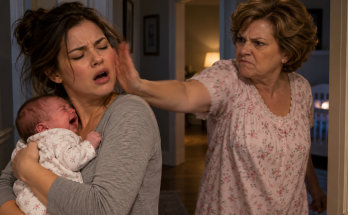
And when she made comments about the night she had slapped me, I refused to pretend that I had misunderstood what happened.
I didn't shout.
I didn't threaten her.
I simply stopped helping her erase it.
That change did not make our relationship warmer.
It made the tension more visible.
For the first time, I could see how much of the peace in our home had depended on my willingness to absorb whatever Patricia chose to do.
I had mistaken my silence for strength.
Sometimes, silence is a way to survive a difficult moment.
But when silence becomes the price of being allowed to belong, it can also keep a person trapped.
I began to understand the difference.
My husband and I still had difficult conversations.
We still disagreed about his mother.
I could not make him see everything from my perspective, and I could not force him to respond the way I believed a husband should.
Those choices belonged to him.
My choices belonged to me.
That was the part I had forgotten.
I could love him without agreeing to be mistreated.
I could respect his relationship with Patricia without allowing her to control my life.
And I could want a family for Lily while recognizing that a family was not healthy simply because everyone remained under the same roof.
I don't know whether my husband understood that immediately.
He may never have understood it in exactly the way I did.
What mattered was that I finally understood it for myself.
The slap did not become acceptable because the mark faded.
It did not become less serious because Patricia was older, because she was my husband's mother, or because she had once raised a child of her own.
And it did not become my responsibility to forgive her simply because everyone wanted the house to feel normal again.
I had wanted an apology.
I had wanted my husband to stand beside me without hesitation.
I had wanted the people I loved to recognize that I deserved the same care I gave them.
I did not receive every answer I hoped for.
That was part of the cost.
Sometimes the truth doesn't repair a relationship.
Sometimes it shows you what the relationship has been asking you to tolerate.
I still remember the nursery that night.
The soft light beside Lily's crib.
The little white onesie folded in my lap.
The sound of her crying while I tried to understand what had just happened to me.
For a long time, I remembered that night only as the moment Patricia struck me.
Now I remember something else, too.
It was the night I began to question the rules I had been living by.
I had believed that a good wife kept the peace.
That a good daughter-in-law accepted help without complaint.
That a good mother could protect her child by making everyone else happy.
I no longer believe those things are always true.
A good mother sometimes has to disappoint people.
A good wife sometimes has to say no.
And a person can love her family without giving them permission to hurt her.
Lily was too young to understand any of this.
She only knew the warmth of my arms and the sound of my voice.
I held her close and promised myself that, as she grew, I would teach her something better than the lesson I had nearly accepted.
She would learn that love should not require fear.
That respect should not depend on obedience.
And that nobody earns the right to hurt another person simply by being family.
I could not decide what my husband would do next.
I could not change Patricia into someone she had never shown herself to be.
But I could decide what I would accept in my own life.
That decision did not erase the pain.
It did not make the future simple.
It gave me something I had been missing since the night in the hallway.
A choice.
And for the first time in weeks, that felt like a place to begin.
The End
Read more original stories on Feel Every Story.
I Thought the Hardest Part of Motherhood Would Be the Sleepless Nights, Until My Husband’s Mother Hit Me While I Held My Newborn
Part 4 of 4

One Comment on “PART 4 – I Could No Longer Pretend the Slap Was Just One Bad Night, and I Had to Decide What Safety Meant for Me and My Daughter”