
The weather turned cooler a few days later.
Mom spent most of the morning near the living room window, reading the newspaper and drinking coffee.
She had begun to enjoy the freedom of an unplanned day.
Sometimes she still looked at the clock out of habit.
But she no longer jumped up when a certain hour arrived.
That was progress.
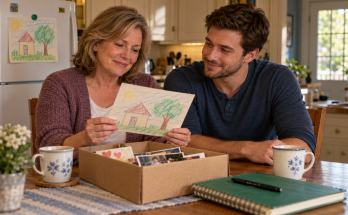
After lunch, I found her sorting through a small stack of papers.
She had brought home a few things from school that she wanted to keep.
The faded cafeteria schedule lay beside a photograph of the serving counter.
I sat across from her.
“Are you still organizing everything?”
“I'm trying to decide what belongs in the box.”
“What doesn't belong?”
She held up a sheet of paper covered with old notes.
“I don't even remember why I kept this.”
I laughed.
“Then perhaps you don't need it.”
She studied the page.
“You might be right.”
She set it aside.
For the next several minutes, we sorted papers into two piles.
Some were worth keeping.
Others were ordinary reminders of work that had already been finished.
The photograph stayed on the table.
It showed Mom standing behind the cafeteria counter years earlier.
She was younger, her hair neatly arranged, her expression serious but warm.
A row of trays sat in front of her.
Behind her, the kitchen looked busy.
I had seen the photograph before, but I had never looked at it for very long.
Now I tried to imagine the scene beyond the frame.
The noise.
The students moving through the line.
The steam rising from the food.
The questions she must have answered hundreds of times.
And somewhere in that daily movement, a boy named Daniel Brooks had stood with eleven cents in his hand.
I picked up the photograph.
“Do you remember this day?”
Mom leaned closer.
“Not the exact day.”
“Do you remember who took it?”
“I think one of the teachers did.”
She studied her younger face.
“I was probably trying to get everyone through the line before the bell.”
I smiled.
“That sounds like you.”
“It was a busy kitchen.”
She took the photograph from me and held it by the edges.
“I never thought much about having my picture taken there.”
“Why not?”
“Because I was working.”
She returned it to the table.
“There was always something else to do.”
I thought about that answer for a long time.
There had always been something else to do.
Another tray to fill.
Another student to serve.
Another surface to clean.
Another day to prepare for.
Mom had spent so much time doing the work that she had rarely stepped back to consider what it meant.
Even when people thanked her, she seemed to believe they were simply being polite.
Daniel's return had been different.
He had not offered a quick thank-you in passing.
He had stood in front of the teachers' break room and told her what she had meant to him.
He had explained that the meal she gave him had stayed in his memory for years.
He had brought the old receipt.
And he had allowed her to see the distance between the small act she remembered and the enormous place it had occupied in his life.
I wondered whether she had fully understood that yet.
“Mom, did you ever think about how the students saw you?”
She looked at me.
“Probably not enough.”
“What do you think they saw?”
She considered the question.
“Someone who served lunch.”
I waited.
“Someone who told them to keep the line moving,” she added with a smile.
I laughed.
“I'm sure you did that.”
“Sometimes.”
She looked toward the photograph.
“But I hope they also knew they could come to me if something was wrong.”
I nodded.
“I think they did.”
“Not every child would have wanted to talk.”
“No.”
“And that was all right.”
She placed the photograph in the box.
“You can't make someone tell you what they're going through.”
I remembered how Daniel had tried to leave the cafeteria.
He had not walked up to Mom and explained his circumstances.
He had not asked for sympathy.
He had tried to protect himself by saying he wasn't hungry.
Mom had recognized the possibility that his words did not tell the whole truth.
She had offered food without demanding an explanation.
Perhaps that was the most important part of the story.
She had left him room to accept help without revealing more than he was ready to share.
I looked at the box.
“Do you think Daniel was embarrassed when you fed him?”
“Maybe.”
She answered carefully.
“He was young. I imagine it wasn't easy.”
“Did you ever tell him he shouldn't be embarrassed?”
“I don't remember the exact words.”
She thought for a moment.
“But I would have wanted him to know that needing help wasn't something to be ashamed of.”
I looked at her.
“That's what he remembered.”
She smiled.
“Then I'm glad.”
We continued sorting.
At one point, Mom found a folded paper with a few handwritten reminders on it.
She read the words, then shook her head.
“I must have been in a hurry.”
“What does it say?”
She turned the paper toward me.
The notes concerned ordinary kitchen tasks.
There was nothing important on it.
I smiled.
“You really did keep everything.”
“Not everything.”
She placed it in the discard pile.
“Just enough to make a mess.”
We both laughed.
The afternoon passed quietly.
When we finished, the box held the retirement cards, the photograph, and the cafeteria schedule.
Mom closed the lid.
She ran her hand over the top before sliding it onto the shelf.
I knew she would probably open it again.
There would be a day when she wanted to reread a card.
There might be a morning when she wanted to look at the photograph.
And there might be another moment when Daniel's story returned to her without warning.
I hoped those memories would bring her comfort.
She had spent forty-two years doing work that rarely brought applause.
For most of that time, she had measured her success by whether the meals were ready and the children were fed.
She had not needed a crowd to tell her the work mattered.
Still, I was glad Daniel had come.
I was glad he had told his story in front of everyone.
And I was glad he had brought the receipt.
His gratitude had not made Mom's work valuable.
It had helped her see the value that had been there all along.
That evening, we ate dinner at home.
Mom prepared a simple meal, and I helped set the table.
We talked about the weather and a neighbor who had recently moved away.
Nothing about the conversation would have seemed unusual.
But when Mom placed the food on the table, I found myself watching her.
She had spent so many years making sure other people were fed.
Now she was learning to take her time.
She sat down without looking at a clock.
She ate slowly.
She laughed at something I said.
And for once, I did not feel the need to rush through the evening.
After dinner, I washed the dishes while she dried them.
“You know,” I said, “I think Daniel gave you something important when he came back.”
She looked at me.
“What do you mean?”
“He gave you the chance to see your work through his eyes.”
She considered that.
Then she folded the dish towel.
“I suppose he did.”
She did not say anything more.
She did not need to.
The gratitude had already been spoken.
The receipt had already been unfolded.
The memory had already crossed the years between a school cafeteria and a retirement party.
There was no need to turn it into a larger performance.
I put the last plate away.
Mom hung the towel over the oven handle.
Then we switched off the kitchen light.
As I walked toward the living room, I thought about how often I had assumed gratitude needed to be visible to be real.
A speech.
A public thank-you.
A gift.
An announcement.
Daniel had certainly given Mom a public moment at the retirement party.
But the heart of his gratitude was quieter than that.
He had remembered.
He had carried the lesson forward.
And when he finally had the chance, he had come back to tell her.
That was enough.
It was more than enough.
Click here to continue reading: PART 15: The Ordinary Conversation That Showed Me How Far Daniel’s Promise Had Traveled
I Thought My Mother’s Retirement Would Be Just Another School Gathering Until Someone Walked In and Asked for Her
Part 14 of 20

One Comment on “PART 14 – The Quiet Afternoon When I Learned That Gratitude Did Not Need an Audience”