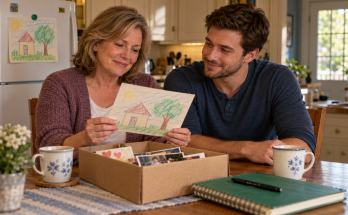
One afternoon, Mom and I took a short walk around the neighborhood.
She had been sitting inside for most of the morning, reading her cards and rearranging the things she had brought home from school.
I suggested some fresh air.
She agreed, although she reminded me that she had been walking these streets long before I learned how to drive.
We moved slowly along the sidewalk.
The air was warm, and a few leaves had collected near the curb.
Mom stopped to greet a neighbor who was watering plants beside her front steps.
They talked about the weather, the retirement party, and how strange it must feel for Mom not to have to wake before sunrise.
Mom laughed.
“I haven't figured out what to do with myself yet.”
The neighbor told her to enjoy the freedom.
Mom thanked her.
Then we continued down the street.
After a while, I asked the question I had been carrying around since Daniel's visit.
“How did you know he needed help?”
Mom glanced at me.
“Daniel?”
I nodded.
“You didn't know his whole situation. You didn't know what was happening at home. But you knew something was wrong.”
She thought about it as we walked.
“He was trying very hard not to be noticed.”
I waited for her to explain.
“When a child is hungry, sometimes they tell you. Sometimes they ask for more food. Sometimes they complain that the meal isn't enough.”
She stepped around a crack in the sidewalk.
“Other times, they do everything they can to make sure nobody realizes they're hungry.”
I remembered Daniel's words from the retirement party.
He had told everyone that he wasn't hungry and had tried to walk away.
At the time, I had imagined him as a frightened boy standing at the edge of the cafeteria.
Now I pictured Mom watching him from behind the serving counter.
She had probably seen dozens of students that morning.
She had meals to serve and a line to keep moving.
Yet she had noticed the one boy trying to leave.
“What made you stop him?” I asked.
Mom looked at me as though the answer were obvious.
“He needed lunch.”
“That was all?”
“What else would there have been?”
I smiled a little.
She did not understand why I kept asking.
For her, there had been no great decision.
There had been a boy who needed food.
She had food.
She gave it to him.
We reached the end of the block and turned toward home.
I asked whether she had ever worried about helping a student in the wrong way.
She nodded.
“Of course.”
That answer surprised me.
“I thought you always knew what to do.”
“No one always knows what to do.”
She adjusted the sleeve of her sweater.
“You try to help without making things worse. You try not to embarrass someone. You try to listen.”
She paused.
“And if you make a mistake, you learn from it.”
I thought about the eleven cents.
Daniel had offered the coins because he wanted to pay for the meal.
Mom had refused to take them.
I wondered whether he had felt relieved or embarrassed when she did.
“Do you think he was upset that you wouldn't take his money?” I asked.
“I don't know.”
She answered honestly.
“I just didn't want him to think he had to pay me back.”
We walked past a house with a small garden.
Mom glanced at the flowers growing near the fence.
“He was a student. He came to school to learn. He shouldn't have had to choose between keeping his pride and eating lunch.”
I slowed my steps.
That was the heart of it.
Mom had not simply fed Daniel.
She had made it possible for him to accept the food without standing in front of a room full of people explaining why he needed it.
She had not asked him to confess anything.
She had not made him promise to behave differently.
She had not told him he owed her gratitude.
She had given him a meal and allowed him to remain a person with dignity.
When we reached home, Mom sat on the porch for a few minutes.
I brought her a glass of water.
She thanked me and rested it on the small table beside her chair.
I sat across from her.
“Did you ever think about Daniel after he graduated?” I asked.
“Sometimes.”
“Did you wonder what happened to him?”
“Of course.”
She looked down the street.
“When you work in a school long enough, you see children grow up. Some come back to visit. Some you never see again.”
She lifted her glass.
“You hope they're doing all right.”
I pictured the years between Daniel's graduation and the retirement party.
He had gone from being a student who could not afford lunch to becoming a surgeon.
Mom had not watched that transformation.
She had not been there for his exams, his long hours of training, or the difficult days that came with his work.
She had simply given him a meal when he needed one.
The rest had belonged to him.
I realized that was another reason her kindness mattered.
She had not tried to become the center of his story.
She had helped him through a moment and then allowed him to continue.
Daniel had built his life with his own effort.
He had studied.
He had worked.
He had faced whatever challenges came his way.
Mom had never claimed credit for his success.
At the retirement party, she had listened to him with the same humble expression she wore whenever someone thanked her for doing her job.
She had not said that she had made him a surgeon.
She had not suggested that his achievements belonged to her.
She had simply looked grateful that he had come.
“I'm glad he found his way,” she said.
“So am I.”
“And I'm glad he remembered to be kind to other people.”
I thought about his promise to help someone else instead of looking away.
He had carried that lesson into a profession where people often met him on the worst days of their lives.
I wondered how many frightened patients had encountered a doctor who understood that needing help could make a person feel exposed.
I wondered whether Daniel remembered the cafeteria whenever he saw someone trying to hide their fear.
I hoped he did.
Mom finished her water.
Then she looked at me.
“You know, you don't have to do something extraordinary to be useful.”
I nodded.
“You can start by noticing what's happening around you.”
She said it gently.
There was no accusation in her voice.
Still, I thought about all the times I had been too busy to notice.
I thought about how easily I had described her job as serving lunch.
I had seen the trays and the food.
I had not seen the quiet decisions that happened between them.
I had not understood that the person behind the counter could be watching for a child who was trying to disappear.
“I wish I'd asked you more about your work before,” I said.
Mom reached across the table and touched my hand.
“You were busy living your own life.”
“That doesn't make it better.”
“No,” she said. “But you can pay attention now.”
I looked at her.
She was not asking me to feel guilty forever.
She was giving me something to do with the guilt.
I could listen more carefully.
I could stop assuming that people would ask if they needed help.
I could offer kindness without making someone explain why they deserved it.
I could remember that a small gesture might be carrying more weight than I could see.
We sat on the porch until the afternoon light began to fade.
Nothing dramatic happened.
No one arrived with another story.
No one handed Mom a letter or a photograph.
We simply sat together.
For once, I did not feel the need to fill the silence.
I had spent years thinking I understood my mother because I knew the ordinary details of her life.
I knew her routines.
I knew the foods she cooked.
I knew the hours she worked.
I knew how she liked her coffee.
But I had not understood the attention she gave to people who might never have thanked her.
Now I was beginning to see it.
And I knew that seeing it would change the way I looked at ordinary days.
Click here to continue reading: PART 12: The Promise She Never Asked Him to Make Became the Lesson I Carried Forward
I Thought My Mother’s Retirement Would Be Just Another School Gathering Until Someone Walked In and Asked for Her
Part 11 of 20