The next few weeks passed without any great change.
I still woke early.
I still made coffee in the kitchen.
I still found myself turning toward Walt's side of the bed before remembering that he was gone.
Grief did not disappear because I had begun making better decisions.
It simply stopped being the only thing I noticed.
One morning, I opened the curtains and let the sunlight fall across the kitchen table.
The notebook lay beside the folder of financial papers.
I had become accustomed to seeing them there.
They no longer looked like evidence of my failure.
They looked like things I could work through.
That was a difference I had not expected to feel so strongly.
I made a list of the calls I needed to make that week.
Then I made the first one.
The conversation was ordinary.
I asked questions.
I wrote down the answers.
When I did not understand something, I asked the person to explain it again.
Afterward, I sat at the table and read through my notes.
I had not solved every problem.
But I had taken another step.
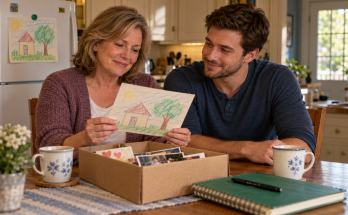
That afternoon, Michael arrived with a folder under his arm.
He had brought copies of the documents we had reviewed together.
He placed them on the table and took the chair beside me.
"I think we should look at what we know now," he said.
I opened my notebook.
We went through the list.
Some questions had been answered.
Others remained open.
Michael crossed out the ones we had settled and added a few new notes.
He did not rush me.
When I needed a break, we stopped.
We drank coffee and talked about something else.
I found myself telling him about a funny thing Walt had once done with a garden hose.
Michael laughed.
"That sounds exactly like Dad."
"It was exactly like your father."
For a moment, we were simply a mother and son remembering someone we both loved.
Then Michael looked at the papers again.
"Mom, I want you to know something."
I waited.
"I'm glad you're letting me help."
I looked at him.
"I am glad you're helping."
He shook his head.
"That's not quite what I mean. I think I used to assume that if you needed something, you would tell me. I didn't realize how hard it was for you to ask."
I thought about the first telephone call I had made after Walt died.
I remembered how I had tried to sound calm.
I remembered the shame I had felt when I admitted that the financial situation was worse than I had understood.
"I was embarrassed," I said.
Michael looked down.
"I wish you hadn't felt that way."
"So do I."
He took a breath.
"I can't promise I'll always know what to do. But I can try to be better about asking."
I reached for his hand.
"That is all I need."
He stayed for another hour.
Before leaving, he put the folder back into my hands instead of carrying it away.
"You keep these," he said. "It's your information."
I smiled.
"I know."
After he left, I placed the folder in the drawer.
Then I opened the notebook and wrote down the date.
Beside it, I wrote one sentence.
Help should make my life easier to manage, not make me feel that it belongs to someone else.
I closed the notebook.
The next day, Stephanie called and asked whether I wanted to come over for dinner.
I accepted.
When I arrived, the girls were finishing their homework at the kitchen table.
Stephanie was preparing vegetables.
She handed me a knife and a cutting board.
"Can you help me with these?"
I took the knife.
"Of course."
We worked side by side.
For a while, the girls asked questions about school, and Stephanie answered them while checking the food on the stove.
I watched her move between the kitchen and the table.
She looked tired.
She also looked happy.
I remembered how often I had expected her to be the confident one in the family.
I had praised her independence so much that I had sometimes forgotten she might need someone to lean on.
When the girls went into the living room, Stephanie sat beside me.
"I've been thinking about something," she said.
"That seems to be happening a lot lately."
She smiled.
"I know."
Then she grew serious.
"I think I used to come to you when I wanted reassurance, but I didn't always tell you what I was worried about."
I listened.
"I wanted you to tell me I was doing well. But if you asked questions, I thought you were criticizing me."
I put down the dish towel.
"I didn't always ask in the right way."
"Neither did I."
We looked at each other.
Then Stephanie gave a small laugh.
"Maybe we both thought the other person should just know."
I laughed too.
"Your father and I did that for years."
She leaned back in her chair.
"Did it ever work?"
"Not nearly as often as we hoped."
That made her laugh.
We talked for a long time that evening.
We did not discuss the letters.
We did not discuss the house.
We talked about our lives.
When I left, Stephanie walked me to the door.
She hugged me.
"Come again soon."
"I will."
This time, neither of us treated the invitation as a promise that needed to be tested.
It was simply an invitation.
At home, I took off my coat and put the kettle on.
The kitchen was quiet.
I sat at the table with my tea and thought about the way my children had begun speaking to me.
They were not suddenly different people.
They were learning.
So was I.
The next Saturday, Danny brought the boys over.
Ethan wanted to help me bake a cake.
Noah wanted to eat the flour.
Danny caught him before he could put his fingers into the bag.
I laughed so hard that I had to sit down.
The kitchen became a mess.
There was flour on the counter.
There was a little batter on the floor.
Ethan insisted that he had followed every instruction correctly.
Danny pointed out that the eggshells were still in the bowl.
Ethan looked offended.
"They're part of the recipe."
"They are absolutely not part of the recipe," Danny said.
I laughed again.
For a little while, I forgot about the papers in the drawer.
I forgot about the cost of the house.
I forgot about the unanswered questions in Walt's letters.
I was simply enjoying my family.
After the cake went into the oven, Danny helped me clean the counter.
He looked toward the desk.
"Have you thought any more about Dad's letters?"
I dried my hands.
"Yes."
"And?"
I considered my answer.
"I think they made us look at things we'd been avoiding."
Danny nodded.
"I think so too."
"But I don't think we have to spend the rest of our lives trying to find one perfect explanation for everything he wrote."
Danny smiled faintly.
"That sounds right."
I looked at him.
"Does that disappoint you?"
"No. It actually makes me feel better."
He explained that he had been afraid we would keep reading the letters until we found something that made one of us feel guilty.
I understood.
The letters had already made each of us question ourselves.
That had been difficult enough.
We did not need to turn them into a permanent judgment.
When the cake was ready, Ethan helped me carry it to the table.
We ate warm slices while Noah made a mess with his fork.
Danny took a photograph of the boys.
Then he asked me to join them.
I sat between my grandchildren.
Danny stood behind us.
The photograph was slightly crooked.
Nobody cared.
After they left, I looked at the picture on my telephone.
I saved it.
Then I placed the phone beside my notebook.
I thought about the family I had wanted when I first called my children.
I had wanted reassurance.
I had wanted to know that they would not leave me alone with my fear.
I had wanted them to make the future less frightening.
What I needed was not exactly what I had imagined.
I needed honesty.
I needed patience.
I needed room to make my own decisions.
And I needed to keep giving those things to the people I loved.
That night, I washed Walt's old coffee mug and set it beside the sink.
I turned off the kitchen light.
I was still a widow.
I was still facing difficult decisions.
But I no longer felt that I had to hide my uncertainty to deserve my children's love.
Click here to continue reading: PART 18: The Decision About My Home Took Longer Than I Expected, Because I Had to Separate the Life I Remembered From the Life I Still Had Time to Live
After Forty Years of Marriage, I Discovered Which of My Three Children Would Stand Beside Me When I Had Nothing Left
Part 17 of 20