By the following month, the house had begun to feel different.
Nothing about the rooms had changed much.
The kitchen was still small.
The hallway clock still ticked.
The drawer beneath the counter still needed an occasional adjustment.
My father's chair remained beside the window.
But I was paying attention to things I had once moved past without thinking.
I noticed when Sarah was tired.
I noticed when one of the boys had something to say but didn't know how to begin.
I noticed when I was about to answer impatiently simply because my mind was already occupied with something else.
Sometimes I caught myself in time.
Sometimes I didn't.
When I failed, I tried to admit it.
That was harder than I expected.
One evening, I snapped at my younger son because he had left his schoolbag in the middle of the hallway.
He looked at me and immediately picked it up.
"I'm sorry."
His quick response stopped me.
I had spoken more sharply than the situation required.
The bag was a nuisance.
It wasn't a disaster.
I could have asked him to move it without making him feel as though he had done something terrible.
I took a breath.
"Wait a second."
He stopped.
"I'm sorry I spoke to you like that. I should have just asked you to move it."
He stared at me.
Then he nodded.
"Okay, Dad."
He carried the bag upstairs.
I stood in the hallway, looking at the place where it had been.
I remembered my father waiting in doorways.
I remembered the way he watched my face before asking for help.
I had told myself that he was being overly cautious.
Now I wondered how much of that caution I had taught him.
I didn't want my sons to develop the same habit.
I didn't want them to study my mood before deciding whether they could speak to me.
I wanted them to feel safe telling me when something was wrong.
That required more than telling them they could always come to me.
It required showing them that I could listen when they did.
Later that evening, I found Sarah putting away the dishes.
I told her what had happened.
She smiled slightly.
"You apologized?"
"I did."
"Good."
I leaned against the counter.
"I don't want the boys to feel the way Dad sometimes seemed to feel around me."
Sarah turned off the tap.
"Then keep paying attention."
I nodded.
She dried her hands and put the towel away.
There was no complicated answer.
Paying attention.
That was what my father had done for us.
He had noticed my work clothes.
He had noticed the boys sharing their room.
He had noticed Sarah handing me my paycheck.
He had noticed the things we did without discussing them.
He had also noticed my impatience.
He had noticed the arguments.
He had heard the conversations I assumed were private.
I had been surprised by how much he knew.
But perhaps I should not have been.
He had lived in our home.
He had been part of our family.
He had paid attention because he cared about us.
I had often mistaken his quietness for an absence of interest.
I understood now that a person could be silent and still be deeply involved in the lives around them.
The following Saturday, I took the boys to the store.
We needed a few things for the house.
While we were walking through the aisles, my younger son stopped beside a shelf of cookies.
He picked up a package.
"These are Grandpa's."
I looked at the label.
They were the kind my father used to keep for him.
"Do you want them?"
My son nodded.
I placed the package in the cart.
He looked pleased.
It was a small purchase.
We didn't need to discuss its meaning.
When we returned home, he put the cookies in the kitchen cupboard.
Then he took one and offered the package to his brother.
I watched them share.
The memory brought a familiar ache.
I missed my father.
There were still moments when I expected to hear his voice from the living room.
Sometimes I caught myself looking toward his chair before remembering that he wasn't there.
Grief didn't follow a schedule.
Some days, the letter helped.
Other days, it reminded me of everything I could no longer change.
I had begun to understand that those feelings could exist alongside the life I was still responsible for living.
I didn't have to choose between remembering my father and enjoying time with my family.
I could do both.
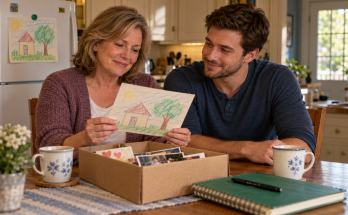
That afternoon, I took the photograph of my father and the boys from the shelf.
I carried it to the dining table and sat down.
Sarah noticed me.
"What are you doing?"
"I was thinking we should make a few copies of this."
She came over and looked at the photograph.
"That's a good idea."
I wanted the boys to have their own copies when they were older.
I wanted them to remember their grandfather as a real person, not just as someone who had been sick.
I wanted them to remember his jokes.
His sweater.
His chair.
His habit of saving the last cookie.
And I wanted them to remember that he had loved them.
Not because I needed to prove that our family had been happy every day.
Because even in difficult years, there had been love.
It had not always been expressed perfectly.
Sometimes it had been buried under worry.
Sometimes it had been overshadowed by frustration.
But it had been there.
I placed the photograph back on the shelf.
That evening, Sarah and I talked about the future.
We discussed the household expenses and the things we wanted to save for.
The conversation wasn't easy.
We still had limits.
There were still things we couldn't afford.
But I no longer felt that every financial discussion was a judgment of my ability to provide.
We were planning together.
That made a difference.
At one point, Sarah mentioned that we might need to replace an appliance soon.
I looked at the numbers and felt the familiar tension rise.
Then I put the paper down.
"We'll work it out."
She studied my face.
I smiled.
"We don't have to solve everything tonight."
She smiled back.
It was something my father might have said.
Or perhaps it was something I had finally learned to say for myself.
The next morning, I sat in the chair beside the window with my coffee.
I thought about the years before my father became ill.
I remembered him standing in the garage, showing me how to use a tool.
I remembered the sound of his footsteps in the hallway.
I remembered how he could tell when I was upset, even when I insisted nothing was wrong.
I had once believed that being a good son meant listening to his advice and then building a life in which I no longer needed it.
I had confused independence with outgrowing the person who helped me become independent.
When he needed me, I struggled to recognize him in that new role.
I wanted him to remain the father who knew what to do.
I didn't know how to be the son who could help him without feeling frightened.
The letter had forced me to look at that failure honestly.
It had also shown me that my father had understood more than I knew.
He had seen my fear.
He had seen my efforts.
He had seen the love beneath my frustration, even when I failed to express it well.
I couldn't ask him whether he forgave me.
But I no longer believed that the only way to honor him was to spend my remaining years regretting what I had done.
I could honor him by becoming more patient.
By listening before answering.
By helping Sarah without making her ask repeatedly.
By teaching my sons that responsibility did not require cruelty.
And by remembering that people could need us without becoming a burden.
I finished my coffee and stood.
The chair creaked softly.
I pushed it back toward the window.
Then I went into the kitchen to begin breakfast.
The boys were still upstairs.
Sarah was getting ready for the day.
The house was quiet.
For a moment, I thought about how my father must have felt during mornings like this.
Perhaps he had enjoyed the quiet.
Perhaps he had wished someone would come sit with him.
I would never know for certain.
But I could make a different choice now.
I could walk into the living room and spend a few minutes with my family before the day began.
I could listen to whatever they wanted to tell me.
I could stop acting as though the people I loved were interruptions to the life I was trying to build.
Because they were the life.
And I had nearly forgotten that.
Click here to continue reading: PART 16: I Finally Understood That My Father’s Letter Was Not Asking Me to Live in Guilt, but to Become the Man He Had Always Hoped I Could Be
I Thought My Father Had Taken Too Much From My Family Until One Letter Forced Me to Face What I Had Done
Part 15 of 20