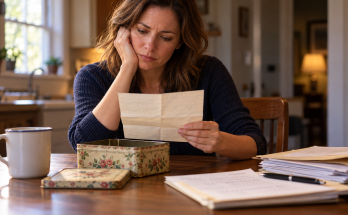
The next few days moved slowly.
I kept going about my usual business, but my mind returned to the courthouse whenever I had a quiet moment.
I washed clothes.
I cleaned the kitchen.
I paid my electric bill and checked the balance in my bank account.
I called my sister to ask how she was feeling after the cold she had caught.
Every ordinary task reminded me that life did not stop simply because one question had become too large to ignore.
On Wednesday morning, I opened my notebook again.
The date beside the property entry stood out.
I checked it against the year I had started working for Rosella.
I had been with her for several years by then.
That surprised me.
I had imagined the entry might have been made near the end of her life, perhaps after she became ill or started thinking about her estate.
Instead, it had existed while I was still learning the small habits of her house.
I thought about the woman I had been then.
I was younger, but not young enough to believe that hard work always led to security.
I had rented a small place on the edge of town.
The kitchen was narrow, the windows rattled when the wind came from the north, and the back steps needed repair.
I had been proud to pay my own bills.
I had also been afraid of what would happen if I missed too many days of work.
Rosella knew that.
She had never asked me to tell her how much money I had in the bank, but she understood what it meant to live without much room for a mistake.
She paid me on time.
When she asked me to stay late, she paid me for the extra hours.
If she wanted me to buy something for the house, she gave me the money before I left the kitchen.
Those things may sound small to someone who has never had to count every dollar.
They were not small to me.
I had learned to trust the practical things Rosella did more than the kind things she sometimes said.
The practical things could be counted.
Her words were harder to understand.
One afternoon, several years into my work for her, she had found me wiping dust from the dining room shelves.
"You still renting that little place?" she asked.
"Yes, ma'am."
"Do you like it?"
"It's fine."
"Fine isn't the same as liking it."
I had laughed.
"It's close to work, and the rent is manageable."
She had watched me put the cloth into my bucket.
"Have you ever thought about owning something?"
I assumed she meant a house.
"Not seriously," I said. "I don't have enough saved."
"That wasn't what I asked."
I remembered feeling uncomfortable.
I did not like discussing money with an employer, even one who had always treated me fairly.
"I suppose I'd like to own a small place someday," I told her. "Somewhere I could stay without worrying about a landlord selling it."
She had nodded slowly.
"That makes sense."
Then she had returned to her newspaper.
I had forgotten the conversation until I saw my name in the deed book.
Now the memory seemed different.
I could not tell whether Rosella had been thinking about the property or simply asking about my life.
I wrote the conversation in my notebook as accurately as I could remember it.
I marked the date as approximate.
I did not want to turn a memory into a fact just because I needed it to mean something.
Later that morning, I called the courthouse to ask whether my document request had been entered.
The clerk checked the reference number.
"Yes, ma'am. It's in the system."
"Do you know when it might be ready?"
"The request is still being processed. We don't have the original in this office, so it may take a few more days."
I thanked her and hung up.
I had wanted a quicker answer.
But there was no use being impatient with someone who had not caused the delay.
That afternoon, I drove past Rosella's property.
I told myself I was only going into town to pick up a prescription for my neighbor, and the road past the farmhouse was the easiest route.
That was partly true.
The other part was that I wanted to see the land.
I slowed as I approached the long gravel drive.
The farmhouse stood where it always had, with its pale siding and broad front porch.
The pecan grove behind the tenant house was beginning to lose its leaves.
Beyond it, the fields ran toward the creek.
I could see the line of trees along the water, dark against the gray sky.
Nothing about the place looked different.
That was what unsettled me most.
I had cleaned that farmhouse for twenty-six years.
I had carried laundry through its hallways and scrubbed the kitchen floor until the boards shone.
I had opened the windows on warm days and shut them before storms.
I had watched Rosella stand on the porch with a cup of coffee, looking across the fields as if she were checking on something only she could see.
Yet I had never thought of the land as connected to me in any way.
I parked briefly on the shoulder across from the entrance.
I did not turn into the driveway.
I had no reason to enter the property without permission, and I did not want anyone to mistake my presence for an attempt to claim it.
A truck was parked near the house.
I could not tell whether it belonged to one of Rosella's sons or to someone working there.
I started the car and drove on.
That evening, Rosella's friend called me.
She had been thinking about our conversation at the courthouse.
"There's something I remembered," she said.
I sat down at the kitchen table.
"What is it?"
"Rosella once asked me whether I thought you were a careful person."
I waited.
"What did you tell her?"
"I said you were one of the most careful people I knew."
I felt a small, uncomfortable warmth in my chest.
"Why would she ask you that?"
"I don't know. I asked her the same thing, and she changed the subject."
"Did she say anything else?"
"She said that some people were trusted with things because they understood the value of keeping them safe."
I wrote the words down.
"Did she say my name?"
"No. I connected it to you because of the way she asked the question, but I can't promise she was talking about you."
I appreciated that she made the distinction.
We were both trying to remember a woman who could be direct about a dirty floor and silent about her deepest concerns.
"Did she ever mention a deed?" I asked.
"No."
"Or a will?"
"Not to me."
I rubbed my forehead.
Every memory seemed to lead toward another question.
I was beginning to understand why Rosella's friend had not wanted to guess at the courthouse.
There was too much we did not know.
"Thank you for telling me," I said.
"Don't let this make you forget who you are, Elnora."
I looked at the notebook.
"What do you mean?"
"You've spent your life working honestly. Whatever that entry means, you don't need to apologize for asking what it says."
After we hung up, I sat without moving for a while.
I had been raised to keep my head down and avoid appearing greedy.
If someone offered me something, I wanted to be sure I had earned it.
If someone accused me of wanting too much, my first instinct was to explain myself.
That instinct had followed me into adulthood.
It was one reason I had hesitated to ask questions about the property.
I worried that even looking at the record would make me seem ungrateful or dishonest.
But Rosella had been a grown woman who understood the meaning of a public deed.
If she had put my name there for a reason, asking about it would not erase that reason.
If the entry had another explanation, asking about it would help me understand that too.
The truth did not become less true because I was afraid of what people might think.
I wrote that sentence in my notebook.
Then I closed it.
The following morning, I returned to my normal routine.
I cleaned my own kitchen, folded the towels, and took out the trash.
I made a list of the bills that were due before the end of the month.
I checked the mailbox twice, although I knew the courthouse would not send anything so quickly.
Nothing came.
I felt disappointed, then reminded myself that a few days was not a long time to wait for an old document.
I had waited years without knowing there was a question to ask.
I could wait a little longer for the answer.
Click here to continue reading: PART 11: Her Son Wanted to Know What I Was Doing at the Courthouse, and I Finally Told Him the Truth Without Apologizing
I Spent Twenty-Six Years Cleaning a Wealthy Woman’s Home Without Knowing Why She Never Let Me Leave It Behind
Part 10 of 20