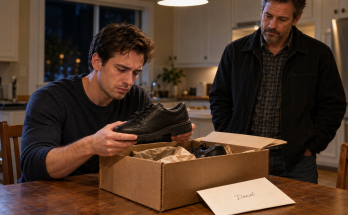
Candice finally closed the rear door of her car.
The sound made me look up.
For a moment, I thought she was leaving.
Instead, she stood beside the vehicle with her keys in her hand, watching me as if she were waiting for me to change my mind.
I didn't.
I still wanted answers.
The photograph of Arthur was safe, but I couldn't stop thinking about the other things in the box.
My medication.
My slippers.
The nightgowns I wore around the house.
They were small, ordinary possessions, but together they told a story I hadn't agreed to be part of.
I looked toward the front door.
The new locks were still there.
I had changed them because I wanted to make one decision without having to defend it to everyone around me.
Now I was beginning to wonder how many other decisions had been made while I was busy trying not to upset anyone.
I had never been a woman who enjoyed confrontation.
When Arthur was alive, we disagreed sometimes, as all couples did, but we usually found a way to talk things through.
He could be stubborn.
So could I.
The difference was that neither of us believed the other person's wishes stopped mattering when an argument began.
After he died, I found myself trying harder to keep everyone happy.
I told myself that family was precious and that I shouldn't waste time on arguments.
That was true.
What I failed to understand was that peace built on one person always giving in wasn't really peace.
It was simply silence.
And I had been silent for too long.
Candice glanced toward the street.
"Are you going to stand there all morning?"
I looked at her.
"I'm waiting for you to explain."
She shook her head.
"I've already told you that you're making this difficult."
"No. You've told me that I'm making you uncomfortable."
Her eyes narrowed.
I hadn't meant to say it quite that way, but once the words were out, I knew they were true.
She was uncomfortable because I had found something she hadn't expected me to see.
I was uncomfortable because I had discovered that my own belongings had been packed without my permission.
Those were not the same problem.
Candice looked down at her keys.
"You don't understand everything that's going on."
"Then explain it to me."
She didn't.
I waited.
The silence stretched between us.
I could hear a dog barking somewhere nearby and the distant sound of a lawn mower starting up.
It was an ordinary Sunday morning.
That was what made the whole thing feel so unreal.
I had expected to spend the day doing ordinary things.
Making something to eat.
Tidying the kitchen.
Perhaps sitting with a book for a while.
Instead, I was trying to understand why someone had prepared my belongings for a departure I knew nothing about.
I looked again at the label on the box.
EVELYN — MAGNOLIA GARDENS.
I had read it enough times to remember every letter.
The name of the place sat beside my own as if the decision had already been settled.
I wondered what I would have thought if I had seen that box before Candice arrived.
Would I have recognized what it meant immediately?
Or would I have found another way to explain it away?
I couldn't say.
I had become very good at finding explanations that allowed me to avoid uncomfortable truths.
If Candice spoke sharply, I told myself she was tired.
If she made a decision without consulting me, I told myself she was trying to help.
If Julian failed to challenge something that hurt me, I told myself he was caught in the middle.
There was always a reason.
There was always another excuse.
And somehow, I was always the person expected to understand.
I didn't want to keep living that way.
I stepped toward the car again.
Candice watched me.
I wasn't trying to frighten her or provoke another argument.
I simply wanted to see the box clearly.
The top flaps had been folded inward, but they weren't closed.
I could still see the corner of a folded nightgown.
Beside it was one of my slippers, turned on its side.
The sight brought back a memory of getting ready for bed the previous evening.
I had put my glasses on the nightstand.
I had checked that my medication was where I expected it to be.
I had looked at Arthur's photograph.
Then I had turned off the light.
Nothing about that evening had suggested that someone would be gathering my belongings before the next morning was over.
I looked at Candice.
"When did you pack these?"
She shifted her weight.
"I don't see why the timing matters."
"Because I was here last night."
She said nothing.
"I went to bed in my own room. My things were where I left them."
Her face tightened.
I continued.
"Now they're in your car."
I didn't raise my voice.
I didn't need to.
The objects spoke for themselves.
Candice crossed her arms.
"You keep acting as though I did something terrible."
I looked at her for a long moment.
"I haven't decided what to call it yet."
That seemed to irritate her more than a direct accusation would have.
She turned away and looked toward the house.
I followed her gaze.
For years, that house had represented stability to me.
Arthur and I had built our lives there.
We had celebrated birthdays, shared meals, welcomed friends, and made plans for the future.
Even after his death, it had remained a place where I could feel connected to the person I had lost.
I had never believed that owning a home meant I could control every aspect of life.
I understood that circumstances changed.
Repairs became necessary.
People needed help.
Families had disagreements.
But I had believed that I would at least be consulted about decisions that affected where I lived.
Finding my belongings in that car had shaken that belief.
It had made me wonder whether the life I thought I was protecting had already become something other people were arranging around me.
I wasn't ready to accept that possibility without answers.
"Did Julian know about this?" I asked.
Candice looked at me quickly.
For the first time since I had found the box, she seemed genuinely caught off guard.
Then her expression hardened again.
"Why are you bringing him into this?"
"Because he's my son."
"This is between you and me."
I glanced toward the suitcases.
"Then why does it feel as though my life has been discussed without me?"
She didn't answer.
I thought about calling Julian myself.
I could have reached for my phone and demanded that he explain what he knew.
But I stopped.
I didn't want to begin another conversation while I was still trying to understand the first one.
If I called him in anger, the argument might become about my tone instead of the box.
I had seen that happen before.
So I took a breath and waited.
Candice finally said, "You need to stop assuming the worst."
I looked at the photograph in my hands.
"I'd like you to give me a reason not to."
She stared at me.
Neither of us spoke.
For the first time that morning, I felt less afraid of the silence than I had been before.
I didn't need to fill it.
I didn't need to apologize for asking questions.
And I didn't need to pretend the sight of those suitcases had not changed something inside me.
I had spent years trying to make sure my family never had to feel uncomfortable around me.
Now I understood that I had been making myself uncomfortable instead.
I was finished doing that.
I looked toward the front door.
The house was still mine.
The photograph was still mine.
And my decisions still belonged to me.
Whatever happened next, I would not agree to leave simply because someone else had prepared a box.
Click here to continue reading: PART 6: I Wanted to Believe Julian Had Nothing to Do With the Suitcases, but I Could No Longer Protect Him From Questions He Needed to Answer
I Thought Owning My Home Meant I Could Never Be Made to Feel Like a Stranger Inside It
Part 5 of 20