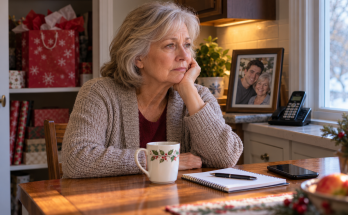
I used to believe that being a good mother meant there was always a place for you.
I believed it for sixty-eight years.
Then, on Christmas Eve, I learned how wrong I could be.
My name is Margaret Whitmore, and I was standing outside my son's house with a dish of homemade turkey and a bag of Christmas presents when he told me to go away.
Not later.
Not after dinner.
Right then.
I remember the cold more than anything else.
The wind slipped through my coat, and snow settled on my shoulders while I stood on the porch trying to understand what my own son had just said to me.
Daniel was looking at me as though I had arrived to cause trouble.
I kept waiting for him to smile.
I thought he might be joking, or perhaps he was having one of those terrible evenings when everything seemed to go wrong at once.
But he didn't smile.
He didn't step aside.
He just stood there, holding the door open enough for me to see the warm light behind him.
There were people inside.
I could hear them talking over the music, and I caught the faint clink of glasses from somewhere near the living room.
It sounded like a lovely Christmas gathering.
The kind of evening I had imagined when I packed the food that afternoon.
The kind of evening I had hoped to share with my family.
Instead, Daniel glanced over his shoulder, then looked back at me.
He seemed more concerned about what the people inside might see than about the fact that his mother was standing in the snow.
"Mom, you need to go."
He spoke softly.
That somehow made it worse.
I tightened my grip on the red gift bag.
The handles had begun to dig into my fingers, but I hardly noticed.
"I brought the turkey," I said.
It was a foolish thing to say.
Of all the words I could have chosen, that was what came out of my mouth.
I had spent hours preparing the meal, carefully covering the dish so the food would stay warm on the drive over.
I had thought he might appreciate it.
I had thought the children would be excited about the presents.
I had even imagined Daniel shaking his head at me with that familiar smile he used to give me when I went a little overboard.
Instead, he looked past me toward the driveway.
"Please don't do this tonight."
I didn't understand what I was doing.
I hadn't raised my voice.
I hadn't complained about being left out of the preparations.
I hadn't asked for anything.
I had simply come to see my son.
And yet, there I was, being treated like someone who had shown up at the wrong address.
I looked into the house again.
For a brief moment, I thought I saw one of the children moving through the hallway.
I wanted to call out.
I wanted to ask whether they had been expecting Grandma.
But Daniel shifted his body, blocking more of the doorway.
"People are here," he said.
"I know."
I tried to smile.
"I won't stay long."
He rubbed his forehead with one hand.
That small gesture told me more than his words did.
He was irritated.
Not confused.
Not surprised.
I had inconvenienced him, and he wanted me gone before anyone noticed.
"Mom, please. You're making this uncomfortable."
I looked down at the dish in my arm.
The foil had started to collect tiny drops of melted snow.
I wiped one away with my thumb.
There was something humiliating about that little movement, about trying to protect a meal nobody wanted while standing in front of the person I had spent my life protecting.
I should have put the dish down.
I should have told him that I wasn't going anywhere until he explained himself.
At least, that was what I imagined a stronger woman might have done.
But I had never been especially good at demanding things from my family.
I had spent most of my life making myself useful.
If someone needed help, I helped.
If someone needed money, I tried to find it.
If someone was struggling, I looked for a way to make the burden lighter.
I didn't always ask whether they appreciated it.
I simply assumed that one day, when it mattered, they would remember.
That evening, I wanted Daniel to remember that I was his mother.
I wanted him to look at me and see the woman who had raised him.
Instead, he glanced toward the people gathered behind him and lowered his voice.
"Just go home, Mom."
For a second, neither of us moved.
I could hear the music more clearly now.
Someone laughed.
Daniel's face tightened.
Then he said the words that stayed with me long after the snow had melted.
"You're making me look bad."
I felt something inside me go quiet.
Not angry.
Not yet.
Just quiet.
I had spent years worrying about whether Daniel was doing well, whether his home was comfortable, whether his children had everything they needed.
I had worried about bills he never wanted to discuss.
I had worried about the future he was building.
I had worried so much about his life that I had never stopped to ask what place I actually had in it.
Now I was standing outside his house, holding Christmas dinner, while he worried about how I made him look.
I wanted to ask him whether he remembered who had helped him get that house.
I wanted to ask whether he remembered all the times I had quietly stepped in when things became difficult.
But I said none of those things.
I was afraid that if I started speaking, my voice would break.
And I didn't want to cry in front of him.
Not because he didn't deserve to see how much he had hurt me.
Because I was still hoping he might change his mind.
I waited for him to look at me differently.
I waited for the son I remembered to come back into his face.
He didn't.
"Please leave, Mom."
Then he closed the door.
The sound wasn't especially loud.
It was just the ordinary sound of a door shutting.
But I stood there staring at it as though something enormous had happened.
I couldn't seem to move.
My arm was aching from the weight of the dish.
The gift bag hung from my other hand.
I remember thinking that I should knock again.
Just once.
Maybe Daniel would open the door and apologize.
Maybe he would realize how cruel it was to send his mother away on Christmas Eve.
Maybe he had simply been embarrassed in front of his guests and would feel differently once he had a moment to think.
I waited.
A few seconds passed.
Then a little longer.
From inside, I heard the music rise again.
Someone said something I couldn't make out.
More laughter followed.
The evening continued without me.
That was when I finally understood that Daniel wasn't coming back to the door.
I turned toward the steps.
Snow had gathered along the edges, covering the spots where people had walked earlier.
I moved slowly because the surface was slippery.
At my age, a fall could mean a broken hip or worse, and I knew better than to take chances on icy steps.
I had spent thirty-one years as a school nurse.
I had seen children rush down wet staircases, trip over their own feet, and insist they were fine while holding a bleeding knee.
I had taught them to slow down.
To look where they were going.
To ask for help when they needed it.
Yet there I was, moving carefully through the snow because I knew there was nobody waiting behind me to make sure I reached the bottom safely.
I made it to the driveway.
Then I looked back at the house.
The windows glowed against the dark evening.
Inside, my son was celebrating Christmas.
Outside, his mother stood alone with a turkey and a bag of gifts.
I didn't know what to do with the food.
I didn't know where to put the presents.
And I didn't know how to make sense of the fact that the person I had come to see was the same person who had just sent me away.
I started toward my car.
The snow continued to fall.
By the time I reached the driver's door, my fingers were stiff, and I had to try twice before I could turn the key.
I placed the covered dish carefully on the passenger seat.
Then I set the red gift bag beside it.
For a while, I just sat there.
I didn't start the engine.
I didn't cry.
I stared through the windshield at the house and tried to remember the last time Daniel had looked genuinely happy to see me.
I couldn't find the memory.
That frightened me more than I wanted to admit.
I had plenty of memories of him as a boy.
I remembered his small hand wrapped around two of my fingers as we crossed the street.
I remembered him falling asleep in the back seat after school.
I remembered how he used to run to the door when I came home from work, asking what we were having for dinner before he even took off his coat.
Those memories were clear.
But the adult man who had just shut the door in my face seemed like a stranger.
I finally started the car.
The heater blew cold air for several minutes before it warmed up.
I held my hands in front of the vents and watched the snow gather on the windshield.
Then I pulled away from the curb.
I drove home with the turkey beside me and the presents at my feet.
I didn't turn on the radio.
I didn't call anyone.
I couldn't imagine explaining what had happened without making excuses for Daniel.
That was what mothers did, I suppose.
Even when their children hurt them, they searched for reasons the children might not have meant it.
He was stressed.
He had guests.
He didn't want a scene.
I repeated those thoughts to myself until they sounded almost reasonable.
But there was one thing I couldn't explain away.
He had looked directly at me.
He knew exactly who I was.
And he had chosen to close the door anyway.
Click here to continue reading: PART 2: Before I Became the Mother Standing Alone in the Snow, I Spent Decades Believing Love Meant Never Letting My Family Struggle
I Thought Bringing Christmas Dinner to My Son Would Make Him Happy, Until I Saw the Look on His Face at the Door
Part 1 of 20