Several weeks passed before I understood what the sale had really changed.
At first, I thought the most important difference was financial.
I no longer had to organize every decision around the needs of the farm.
I could take my time.
I could think about where I wanted to live and what I wanted to do.
I could make choices without worrying that one difficult season would undo years of work.
Those things mattered.
Thirty-nine million dollars was more money than I'd ever expected to have.
I didn't pretend otherwise.
But the amount wasn't the answer to every question I'd carried away from my parents' porch.
It couldn't tell me whether my father had always underestimated me.
It couldn't explain every assumption my sister had made.
And it couldn't erase the years I'd spent hoping my family would see me differently.
That part took longer.
My father continued calling.
Sometimes he asked about my plans.
Sometimes we talked about nothing important.
The change was small, but I noticed it.
He began asking questions without assuming he already knew the answers.
If I said I hadn't decided what to do next, he accepted it.
If I mentioned something I wanted to consider, he listened instead of immediately offering advice.
My mother did the same.
She still worried about me.
I didn't expect that to change.
But she began asking whether I needed anything rather than assuming that I did.
When I said I was fine, she accepted the answer.
My sister's change was less consistent.
There were times when she seemed genuinely sorry for the way she'd described my circumstances.
There were other times when she slipped back into offering opinions about what I should do with my money.
I learned to respond without turning every remark into a fight.
When she asked whether I planned to buy an expensive property, I told her I hadn't decided.
When she suggested I should invest in something, I said I would consider my options carefully.
When she asked how much of the sale proceeds remained, I told her I preferred to keep the details private.
At first, she seemed surprised.
Then she accepted it.
That was enough.
I didn't need her to agree with every boundary.
I needed her to respect that it existed.
The money for Fay remained a subject I remembered clearly, though it no longer dominated every conversation.
My parents had reviewed what they could verify.
They had confirmed that the payments had gone to my sister, not to me.
They had acknowledged that their assumptions about my finances had influenced their decisions.
The exact details of every conversation from the past could not be recovered.
I accepted that.
I wasn't going to spend the rest of my life trying to reconstruct every sentence spoken when I wasn't in the room.
The important part was clear.
My family had believed a story about me without asking whether it was true.
They had acted on that belief.
And I had stayed quiet for years because I thought explaining myself would only lead to another argument.
We had all contributed to the distance between us in different ways.
That didn't mean we were equally responsible for every hurt.
It meant we had a choice about what happened next.
I could continue treating my family as people who would never understand me.
Or I could give them the chance to show whether they were willing to change.
I chose the second.
Not because I had forgotten the past.
Because I didn't want the past to decide every conversation we would have in the future.
One afternoon, I visited my parents again.
I brought no groceries this time.
I didn't need a reason beyond wanting to see them.
My mother was in the kitchen when I arrived.
My father was sitting near the window.
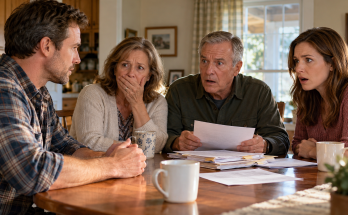
The old table stood between us.
I took the chair I'd used during our difficult conversations.
For a moment, I remembered the papers my father had laid there when he explained the payments.
I remembered the coffee mug beside my hand.
I remembered telling them about the sale and watching their expressions change.
Then the memory passed.
We talked about the future.
I told them I was still considering what I wanted to do with my time.
My father asked whether I might take a long break before making another major commitment.
I said that sounded reasonable.
He nodded.
"There's no need to rush."
I looked at him.
It was a simple sentence.
But it was different from the advice he'd given me for years.
He wasn't telling me that I needed to catch up.
He wasn't suggesting that I was falling behind.
He was allowing me to make a decision at my own pace.
I appreciated that.
My mother brought coffee to the table.
We sat together for a while, talking about ordinary things.
No one asked about the exact balance in my account.
No one suggested that I should spend the money to prove I'd made the right choice.
For once, the sale was simply part of my life rather than the center of it.
Before I left, my father walked with me to the door.
He paused on the porch.
"I've been thinking about what happened," he said.
I waited.
"I should have asked you how things were going instead of assuming I knew."
I nodded.
"Yes."
He looked toward the driveway.
"I suppose I thought I was looking out for you."
"I believe you."
He turned back to me.
"But I didn't do a very good job of listening."
I didn't have an immediate answer.
For years, I'd wanted him to understand that the way I lived wasn't proof that I had failed.
Now he was acknowledging something more important.
He had been looking at me without really listening to me.
I told him I appreciated the apology.
Then I added something I had learned about myself.
"I should have spoken up sooner, too. I let things build because I didn't want another argument."
He nodded.
"We both have things to work on."
It wasn't a perfect resolution.
It was a real one.
I drove home afterward, thinking about how much energy I'd spent trying to change my family's opinion of me.
I had wanted my father to admire my work.
I had wanted my sister to stop judging my choices.
I had wanted my mother to stop worrying that I couldn't manage my own life.
Some of those wishes had come true.
Others might never be fully resolved.
But I no longer felt that I needed to win their approval before I could be satisfied with myself.
That was the biggest change.
The farm sale had given me financial security.
It had given me options I hadn't possessed before.
It had also forced me to confront a question I'd avoided for years.
Who was I when I stopped trying to prove that my family was wrong about me?
I was still the man who woke early out of habit.
I still preferred practical things to expensive ones.
I still liked the quiet of an ordinary morning.
I still believed that work mattered, even when nobody was watching.
The money hadn't created those qualities.
They had been there long before the sale.
I didn't need a new truck to prove I had succeeded.
I didn't need a different house.
I didn't need to announce the number in my account every time someone questioned my choices.
I could simply live.
That was enough.
I also learned that keeping my life private didn't mean I had to remain silent when someone misrepresented it.
I could protect my boundaries without disappearing from the conversation.
I could ask direct questions without turning them into accusations.
And I could listen to an explanation without accepting every excuse.
Those lessons weren't easy.
I still caught myself rehearsing arguments before family visits.
I still felt the old frustration when my sister offered advice I hadn't requested.
Sometimes I still wanted to remind my father that he had been wrong about me.
When that feeling came, I tried to let it pass.
I didn't need to repeat the sale amount to make my point.
The facts were already clear.
I had supported myself.
I had made my own decisions.
I had sold the farm on my terms.
And I had never needed my parents to rescue me.
The most difficult part was accepting that I had spent so many years waiting for them to recognize those facts.
I couldn't get those years back.
I could only decide how to use the ones ahead.
A few months later, I drove past the road that led toward my former farm.
I slowed down.
For a moment, I considered turning in the direction of the old property.
Then I continued down the road.
The farm had been an important part of my life.
Selling it didn't erase what I'd built there or the work I'd put into it.
It simply meant that chapter was finished.
I didn't have to keep returning to prove that it had mattered.
When I reached home, I parked the old pickup and went inside.
My phone was on the kitchen table.
There was a message from my mother asking whether I wanted to join my parents and sister for dinner that weekend.
I replied that I would.
Then I put the phone down.
No announcement.
No argument.
No need to prove anything.
For a long time, I had believed that the greatest surprise my family could face was learning how much money I had made from the farm.
I was wrong.
The real surprise was that I no longer needed their surprise.
I didn't need my father to look at my truck and see success.
I didn't need my sister to admit that every assumption she'd made about me was wrong.
I didn't need my mother to stop worrying before I could trust my own judgment.
I wanted a better relationship with all of them.
But I could want that without surrendering my independence.
The thirty-nine million dollars had changed my future.
The conversation on the porch had changed how I understood my family.
And the weeks that followed had changed how I understood myself.
I had spent years believing that silence kept the peace.
Now I knew that silence could also leave room for other people to write your story.
I couldn't control what anyone believed about me.
I could control whether I allowed their beliefs to define me.
That was the lesson I carried forward.
Not the number in the bank.
Not the surprise on my father's face.
Not even the apology I had waited years to hear.
Just this.
I could be a good son without agreeing with every judgment my father made.
I could be a brother without letting my sister decide what my life meant.
I could love my family without handing them control over my choices.
And I could keep my life private without pretending I had nothing worth saying.
The next time I visited my parents, I would take the same old truck.
I might wear the same faded flannel.
I might bring groceries if I felt like it.
But I would walk through the front door knowing that I didn't have to prove my worth before I sat at the table.
I had spent fifteen years waiting for my family to see me clearly.
It was time I stopped waiting for their permission to see myself.
The End
Read more original stories on Feel Every Story.
My Family Thought I Was Broke, Until I Heard My Father Ask Where the Money for My Sister Had Gone
Part 20 of 20