I didn't drive away immediately.
I kept staring at the message on my phone, trying to connect it to what I'd heard inside my parents' house.
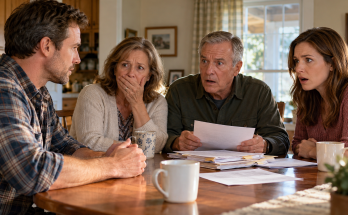
My father had asked how much money they'd already given for Fay.
My sister had been talking about me as if I couldn't survive without help.
Those two things belonged together somehow.
I just didn't know how.
I read the message again.
Then I looked at the house through the windshield.
I could have gone back.
I could have knocked hard enough that everyone inside would know I wasn't leaving.
But I had spent fifteen years trying to convince my family that I was capable of managing my own life.
I wasn't going to start another argument without understanding what I was arguing about.
So I put the phone down.
I started the truck.
The engine took a moment to settle into its familiar rumble.
Then I pulled out of the driveway.
The grocery bags remained on the passenger seat.
I remember glancing at them at the first stop sign.
They looked ridiculous sitting there.
Two bags of ordinary food, bought for people who apparently believed I needed financial assistance.
I almost laughed.
Almost.
Instead, I drove home.
The road gave me time to think about how my family had come to see me this way.
It hadn't happened all at once.
There was no single dinner when my father announced that I was a failure.
No dramatic fight that divided us forever.
It had been a slow process.
A comment here.
A suggestion there.
A question asked with just enough concern to make it sound reasonable.
When I was younger, I thought my father was trying to help.
He wanted me to have a secure future.
He wanted me to make sensible choices.
He wanted me to stop taking risks that might leave me with nothing.
Those weren't terrible things for a father to want.
But somewhere along the way, his concern became a judgment.
Every decision I made seemed to confirm what he already believed.
If I worked long hours, it meant the farm was struggling.
If I drove an old truck, it meant I couldn't afford a better one.
If I wore the same work clothes to a family gathering, it meant I wasn't moving forward.
The possibility that I simply didn't care about impressing anyone never seemed to occur to him.
My sister made the situation worse.
She had a talent for turning assumptions into accepted facts.
She would mention that I was having a difficult year, even when I hadn't told her anything about my finances.
She would talk about how hard it must be to live alone on a farm.
She would tell my parents that I needed to think more carefully about my future.
Sometimes I wondered whether she believed every word she said.
Other times, I thought she enjoyed being the person who understood my problems better than I did.
I never knew which possibility was worse.
At family dinners, I learned to keep my answers short.
If my father asked about work, I told him the farm was keeping me busy.
If my sister asked whether I was making enough money, I said I was managing.
If someone suggested I sell the property and find a regular job, I changed the subject.
I didn't want to spend every visit defending the life I'd chosen.
The farm was not a temporary mistake.
It was my work.
My responsibility.
The place where I had spent years building something that belonged to me.
There were difficult seasons, of course.
There were repairs that cost more than I expected.
There were days when the weather ruined plans I'd made weeks earlier.
There were mornings when I was so tired that I stood outside for a moment before beginning the day's work, wondering how I was going to get through it.
But none of that meant I was helpless.
I had never asked my parents to rescue me.
I had never asked my sister to manage my affairs.
And I had never been given the kind of support my father had apparently been discussing.
That last thought stayed with me.
I drove home and carried the groceries inside.
I put the bags on the kitchen counter.
For a while, I left everything where it was.
Then I took out the bread and vegetables and placed them in their proper spots.
The simple routine helped me settle down.
A man could spend years being told who he was.
Sometimes he began to believe it, even when the evidence said otherwise.
I knew I had done that.
I had started to see myself through my father's eyes.
Whenever I bought something inexpensive, I told myself it was sensible.
Whenever I avoided discussing money, I told myself privacy was better.
Whenever my sister made a remark about my future, I acted as though it didn't matter.
But it did.
It mattered because I still wanted their respect.
That was the part I found hardest to admit.
I could have said I didn't care what my family thought.
I could have pretended their opinions had never affected me.
But if that were true, I wouldn't have stood outside their door feeling as though the floor had shifted beneath me.
I wanted them to see the years of work.
I wanted them to understand that the old pickup wasn't proof of failure.
I wanted them to know that a quiet life wasn't necessarily a small one.
Instead, they had built a story about me.
And apparently, they had built a financial arrangement around that story, too.
I returned to my phone.
The message was still there.
I read it carefully, looking for something I might have overlooked.
I didn't want to jump to conclusions.
I didn't want to accuse anyone based on a few words overheard through a closed door.
But I couldn't ignore what I'd heard, either.
My father hadn't asked whether I needed help.
He hadn't asked whether I had been paid.
He had asked how much money they had already given for Fay.
The question sounded like a man checking on an ongoing arrangement.
I sat down at the kitchen table.
The chair made a small scraping sound against the floor.
For years, that table had been where I handled paperwork, reviewed expenses, and planned the next day's work.
I had always believed that if I kept my business organized, I could keep my life organized, too.
That afternoon, the papers on the table offered no comfort.
The farm sale was complete.
The money was real.
My future was no longer tied to the land in the way it had been before.
Yet the most important question had nothing to do with the sale.
It had to do with my family.
I thought about the times my parents had told me they were worried.
I thought about the conversations where my sister offered advice I hadn't requested.
I thought about every vague reference to my difficult circumstances.
Had they been discussing me behind my back for years?
Had my sister told them I was struggling financially?
Had my parents believed her?
And what exactly did Fay have to do with any of it?
I didn't have answers.
I had a suspicion, and I knew suspicion could be dangerous.
It could turn a misunderstanding into a betrayal before anyone had a chance to explain.
So I made myself slow down.
I would not call my sister in anger.
I would not send my father a message demanding an explanation.
I would not tell them about the sale just to watch their faces change.
The money gave me options.
It didn't give me the right to act recklessly.
I had spent too many years keeping my life private to throw that privacy away in one emotional afternoon.
Still, I couldn't return to the way things had been.
The words I'd heard were too clear.
My father had mentioned money.
My sister had mentioned my inability to support myself.
And neither of them seemed to know I had been standing outside.
That was what made the moment feel so revealing.
They hadn't been performing for me.
They had been speaking as they normally spoke when they thought I wasn't listening.
I looked at the grocery receipt lying beside the bags.
A few ordinary purchases.
Nothing that could explain the life my family imagined I was living.
Then I looked at my phone again.
The sale had changed my financial circumstances.
But the conversation at my parents' house had changed something else.
It had made me question whether I understood my own family at all.
And I was beginning to think that the truth wouldn't be found by telling them how much money I had.
It would be found by learning what they believed they had already done for me.
Click here to continue reading: PART 3: Thirty-Nine Million Dollars Could Buy Me Freedom, but It Couldn’t Explain Why My Parents Thought They Had Been Helping Me
My Family Thought I Was Broke, Until I Heard My Father Ask Where the Money for My Sister Had Gone
Part 2 of 20