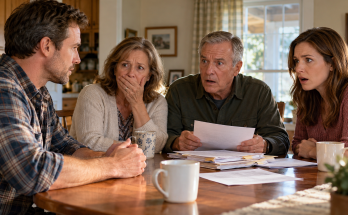
Grandma had always been good at noticing when people wanted a conversation to end.
She noticed it in the way they changed subjects.
She noticed it when somebody became suddenly interested in clearing the table.
And she noticed it when an answer created more questions than it resolved.
The discussion about my husband's money had done all three.
She wasn't interested in humiliating anyone.
She wanted to know what had happened.
That difference mattered to me.
I had spent much of my recovery trying to avoid becoming a burden.
I didn't want relatives worrying about me.
I didn't want every conversation to turn into another discussion about my injuries or my husband's death.
If somebody offered help, I accepted it.
If somebody told me to rest, I tried.
I had learned to be grateful for whatever support came my way.
But gratitude could become a trap when it made you afraid to question the people helping you.
I was beginning to understand that.
I could appreciate what someone had done for me without accepting every explanation they offered.
I could love my family without agreeing that my memory was the problem.
And I could acknowledge my own vulnerability without pretending it made me responsible for an account I had never knowingly opened.
Grandma didn't ask me to make a dramatic declaration.
She didn't tell me to confront my mother.
She kept returning to the records.
The account existed.
The application had been submitted.
The dates were documented.
The signature was disputed.
Those facts gave us something solid to work with.
I found comfort in that.
The rest of the situation felt uncertain, but the documents did not change simply because we were uncomfortable with what they suggested.
I kept thinking about the three days between the account opening and the first transfer.
March 11.
March 14.
The dates were close enough to make me wonder how the arrangements had been organized.
But I had to remind myself that a sequence was not a complete explanation.
I didn't know who had initiated the transfer.
I didn't know who had control of the account.
I didn't know whether the person responsible had acted alone.
I had no right to fill those gaps with assumptions.
I had every right to insist that they be examined.
That became my position whenever the subject returned.
I wanted facts, not a family argument built on suspicion.
I wanted the money traced through the available records.
I wanted the account's connection to my identity explained.
And I wanted to know why the arrangements my husband had made had failed to provide the support they were meant to provide.
Grandma agreed that those were the questions that mattered.
Her steadiness helped me more than she probably realized.
I was still learning how to speak firmly without feeling guilty afterward.
Every time I questioned something, part of me worried that I was being unfair.
I had been raised to believe that family members deserved patience.
I still believed that.
But patience didn't mean accepting an explanation that contradicted what I knew.
My mother had been present during the months when I was most vulnerable.
I could not forget that.
Neither could I forget how quickly she had suggested that I might have signed the bank form without remembering.
I tried to consider her point of view.
Maybe she was frightened by the possibility that something had gone wrong.
Maybe she thought I was becoming overwhelmed.
Maybe she believed she was protecting me from a painful conclusion.
I couldn't know.
I only knew that the explanation did not answer the question.
I had not knowingly opened the account.
The fact that I had been taking medication did not change that statement.
The fact that I had been recovering from an accident did not make the signature familiar.
And the fact that my mother wanted me to consider another possibility did not make it true.
I was learning to trust those distinctions.
One afternoon, I found myself remembering my husband sorting papers at home.
He had always kept things in order.
If he received an important document, he put it somewhere he could find it again.
He believed that being prepared was part of being responsible.
I used to laugh when he spent time organizing things that seemed unimportant to me.
Now I wished I had paid more attention.
I wished I had asked him more about the arrangements he was making.
But I couldn't change what I had failed to ask.
I could only work with what remained.
His intentions mattered to me because they represented the care he had taken before his death.
The money was not simply an amount that should have appeared in an account.
It was part of his effort to make sure his daughter and I would have something to rely on.
That was why I couldn't treat its disappearance as a minor inconvenience.
I didn't want to become consumed by the investigation.
I didn't want every memory of my husband to become connected to paperwork and missing funds.
I wanted to remember his kindness without having to think about the account.
But ignoring the problem would not protect those memories.
It would only leave the question unanswered.
Grandma understood that.
She continued to take the matter seriously, even when doing so made the family uncomfortable.
I began to understand that her question at Thanksgiving had not been an attempt to embarrass me.
She had believed the money was supposed to reach me.
When she learned it hadn't, she wanted to know why.
I was grateful she had asked.
Without that conversation, I might have continued assuming that everything was in order.
I might never have learned that my name was attached to an account I didn't recognize.
The thought frightened me.
It also made me more determined.
I would not let the matter disappear simply because everyone wished it would.
I would keep the application.
I would keep the dates straight.
And I would continue separating what the documents showed from what I still needed to learn.
There was no satisfaction in any of it.
No sense of victory.
Only the uncomfortable knowledge that something important had gone wrong and that I could no longer rely on assumptions to explain it away.
I wanted the truth.
I wanted the money accounted for.
And I wanted my family to understand that asking those questions was not an act of disloyalty.
It was an act of responsibility.
Click here to continue reading: PART 7: I Kept Returning to the False Signature Because It Was the One Part of the Story I Could Recognize Without Anyone Telling Me What to Believe
The Thanksgiving Question That Turned a Family Gathering Into Something None of Us Could Pretend Was Ordinary Anymore
Part 6 of 20