There are details you remember because they are important.
Then there are details you remember because you cannot make them fit.
For me, it was the signature.
I could have forgotten the exact wording of a conversation.
I could have mixed up the order of an ordinary afternoon.
But I knew how I signed my name.
I had done it often enough for the movement to feel familiar.
The signature on the bank application did not.
That fact kept bringing me back to the same place.
My personal information had been used to establish an account.
The account had received a transfer.
The money had not reached me.
And the paperwork suggested that I had authorized the arrangement.
I could not make those facts agree with my own experience.
At first, I kept looking for a way to explain the discrepancy without questioning anyone.
Maybe the document had been prepared incorrectly.
Maybe a signature had been copied from another source.
Maybe the account had been opened through some process I didn't understand.
I considered those possibilities because I didn't want to assume the worst.
But none of them changed the central problem.
I had never knowingly opened the account.
I had never knowingly authorized the transfer.
And I had no memory of agreeing to the arrangement the form described.
I didn't need to know exactly how the document had been created to say that.
I needed the people examining the records to take the discrepancy seriously.
Grandma did.
She understood that a signature was supposed to represent a person's decision.
If the signature was not mine, then the document could not be accepted as proof that I had willingly agreed to something.
That didn't identify the person responsible.
It didn't tell us where the money had gone after the transfer.
But it meant the question was still open.
I was grateful that Grandma didn't pressure me to identify someone.
She knew I was already struggling with the possibility that the problem involved people close to me.
I didn't want to look at my mother and see guilt where there might only be fear.
I didn't want to mistake silence for proof.
I didn't want to turn a troubling explanation into a verdict.
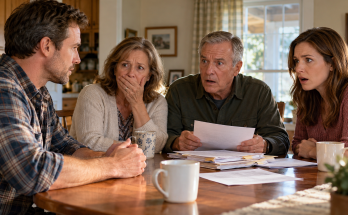
But I also couldn't ignore the way she had reacted when the form appeared.
She had immediately suggested that I might have signed it while taking medication.
I replayed that moment in my mind.
Her glass touching the table.
Her voice becoming gentle.
The way she had shifted the conversation toward my memory.
I tried to imagine how I would have responded if I had been in her position and had known nothing about the account.
I thought I would have been shocked.
I thought I would have wanted to examine the signature.
I thought I would have asked how an account could have been opened without my daughter's knowledge.
Perhaps people reacted differently under pressure.
I had to allow for that.
Still, her response remained difficult to forget.
I could not decide what it meant.
I could only recognize that it had made me less comfortable accepting her explanation.
There were moments when I wished I had never learned about the account.
Before Thanksgiving, I had been grieving and recovering.
My problems had been difficult, but I understood them.
My husband was gone.
My daughter needed me.
My body needed time to heal.
Those were painful facts, but they were facts I knew how to live with.
Now I had another problem, one that involved trust.
It was harder because I didn't know where to place it.
I could not direct my anger toward a person without evidence.
I could not dismiss the matter without abandoning questions that deserved answers.
So I learned to live with the uncertainty while continuing to ask for clarity.
It wasn't a satisfying way to move forward.
It was simply the honest one.
When I spoke with Grandma, I told her that the signature continued to trouble me.
She said that made sense.
She didn't tell me I was overthinking it.
She didn't tell me to calm down.
She acknowledged what I had noticed and returned to the need for a proper explanation.
That helped me feel less alone.
I had spent so much time worrying that I might be unfair to somebody that I had nearly forgotten I was the person whose name appeared on the application.
I was allowed to ask questions about my own identity.
I was allowed to dispute a signature that wasn't mine.
I was allowed to know what had happened to money intended for my future.
None of those things required me to accuse anybody.
They required me to be honest.
I started thinking about the application as a record that needed to be tested against what I knew.
The photograph was mine.
The address was mine.
The date of birth was mine.
Those details established who the account was supposed to belong to.
They did not establish who had opened it.
The signature was the disputed part.
And the timing of the first transfer made it important to understand how the account had been used.
The more carefully I separated those details, the easier it became to resist the urge to guess.
I could see the gaps in the information.
I could name them.
I could wait for evidence instead of inventing answers.
That was not the same as being passive.
I was still asking questions.
I was still insisting that the records be examined.
I was still refusing to let the matter be explained away by the condition I had been in after the accident.
I simply wasn't going to claim certainty where I didn't have it.
That decision gave me a little peace.
Not enough to make the problem disappear.
Enough to let me concentrate on my daughter without feeling that I had to solve everything in a single afternoon.
I wanted her to grow up knowing that her father had tried to protect her.
I wanted her to have the security he had intended to leave behind.
And I wanted to be able to tell her, someday, that when something didn't make sense, I had tried to understand it rather than look away.
I didn't know how the story would end.
I didn't know who had opened the account.
I didn't know whether the money could be recovered.
But I knew I would not stop asking questions simply because the answers might be painful.
The signature remained the clearest clue I had.
I would keep returning to it until the facts made sense.
Click here to continue reading: PART 8: By the Time I Stopped Hoping for a Simple Explanation, I Understood That My Husband’s Money Was Only Part of What Needed to Be Accounted For
The Thanksgiving Question That Turned a Family Gathering Into Something None of Us Could Pretend Was Ordinary Anymore
Part 7 of 20