I used to believe that if Martin finally told me the truth, everything else would become easier.
I imagined the relief.
I imagined us sitting together, admitting what had happened, and finding a way to move forward.
I thought the truth would open a door.
It did.
But it didn't tell me which direction to walk.
In the days after our last conversation, Martin began making changes that I could see.
He stopped referring to the fertility problem as though it belonged to me.
When the subject came up in conversation, he no longer used my supposed fragility as an explanation for our childless marriage.
He acknowledged that the medical issue had involved him and that he had handled it badly.
He didn't turn every discussion into a long confession.
He simply stopped repeating the lie.
It was a small change in the way he spoke.
It mattered because I had spent years listening to him tell the same story while I sat beside him.
Now, when he corrected it, I no longer felt that I had to remain silent to protect him.
I also began to understand that I could not measure his entire character by one conversation or one promise.
He would have to keep choosing honesty.
I would have to decide whether I could trust what I saw.
Neither of us could settle that question in a single evening.
We continued living in the same house.
We shared meals.
We spoke about work and ordinary plans.
Sometimes we laughed at something that reminded us of the years when our life had felt easier.
Those moments were real.
So was the damage.
I no longer believed I had to choose one truth and discard the other.
I could remember loving Martin without pretending he had always treated me well.
I could recognize his shame without allowing it to excuse the harm he had caused.
I could hope that he would become more honest without promising to stay if he didn't.
That was a different kind of life from the one I had imagined when I married him.
It was also more honest.
One morning, I opened the bedside drawer to put away a receipt.
The appointment envelope was still there.
I took it out and sat on the edge of the bed.
The first card had softened at the folds.
My handwriting remained clear enough to read.
I remembered sitting in the clinic while the clock clicked above the cabinet.
I remembered Martin leaving.
I remembered how long I had waited for him to return.
For years, I had thought of that moment as the beginning of our failure to have a child.
Now I understood that it had also been the beginning of my willingness to accept less honesty than I needed.
I had taken his fear and made it my responsibility.
I had taken his silence and treated it as a request I was obligated to honor.
I had taken his explanation of my supposed fragility and repeated it to myself until I struggled to remember what I had believed before.
I folded the card carefully.
Then I placed it beside the newer one.
I wasn't keeping them because I wanted to remember Martin at his worst.
I was keeping them because I wanted to remember myself at a moment when I had known something important and had been too afraid to act on it.
I wanted to remember that I had eventually found the courage to ask questions.
I returned the cards to the envelope and put it away.
When I went downstairs, Martin was in the kitchen.
He was making coffee.
He looked up and asked whether I wanted some.
"Yes, please."
He poured a cup and placed it beside me.
I thanked him.
We sat at the table.
For a while, neither of us spoke.
Then he asked whether I had been thinking about the past.
I looked at him.
"A little."
He nodded.
"I do that too."
I waited.
He said he wished he had handled the first appointment differently.
He wished he had stayed in the room.
He wished he had told me what he was afraid of instead of allowing the fear to control everything that followed.
I listened.
I had heard versions of those regrets before.
This time, I didn't ask him to explain them further.
He had acknowledged what he had done.
The next part was not about finding a better way to describe the past.
It was about whether he would continue making different choices.
I told him I appreciated his honesty.
Then I said I still didn't know what the future would look like.
He nodded.
"I understand."
I believed that he was beginning to understand.
But I no longer needed to turn that belief into a promise.
We finished our coffee.
Martin went to work.
I stayed in the kitchen for a few minutes, looking at the place where the envelope rested in the drawer upstairs.
Then I put my cup in the sink and got ready for my own day.
I had once imagined that the end of this story would be a moment when Martin and I finally understood one another completely.
I thought we would reach some clear conclusion about our marriage, our future, and the life we had lost.
Real life had not offered that kind of ending.
There were still questions.
There were still things that hurt.
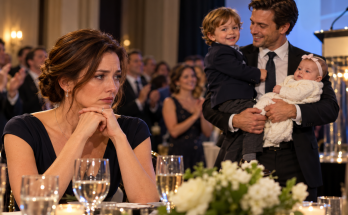
There was still the memory of Clara standing beside Martin at the charity dinner, holding a child while he held another.
I couldn't erase that image.
I couldn't pretend it had not changed the way I saw my husband.
But I no longer needed to let the image decide everything about me.
I was Evelyn.
I was the woman who had wanted a child.
I was the wife who had kept a secret because she believed silence was a form of loyalty.
I was also the woman who had finally understood that loyalty could not require her to abandon herself.
I didn't know whether Martin and I would remain married for the rest of our lives.
I didn't know whether the trust between us could be rebuilt.
I didn't know whether the love I still felt would be enough to make that work possible.
What I knew was that I would no longer pretend those questions had already been answered.
That evening, Martin and I ate dinner together.
We spoke about the day.
We discussed a few practical things that needed attention around the house.
At one point, he made a small joke about something that had happened at work.
I laughed.
The sound surprised me.
For a moment, I felt the ease we had once shared.
I let myself enjoy it.
I didn't tell myself that it meant everything was fine.
I didn't tell myself that it meant nothing either.
It was simply a good moment between two people whose marriage had been hurt by the truth and by the choices they had made around it.
After dinner, I carried the plates to the sink.
Martin dried them.
When we finished, I placed the last plate in the cupboard and turned off the kitchen light.
The small dish near the door held our keys.
The table stood where it always had.
The drawer beside my bed still contained the appointment cards.
The objects were ordinary.
Their meanings had changed.
I used to think the doctor's words had taken something from Martin.
I believed his shame had made it impossible for him to face me.
I thought that if I could be patient enough, I could help him recover the life he believed he had lost.
Now I understood that the doctor's words had only revealed a medical truth.
Everything that followed came from the choices Martin made and the choices I made in response.
He chose to leave the room.
He chose to hide his fear.
He chose to let people believe I was the reason we had no children.
And I chose, for too long, to protect the story because I was afraid of what would happen if I challenged it.
I could regret my choices without taking responsibility for his.
I could love him without promising that love would solve everything.
I could forgive him someday without pretending that forgiveness meant the past had not happened.
Most of all, I could stop waiting for him to tell me who I was.
The next morning, I woke before the alarm.
I sat on the edge of the bed and looked at my wedding ring.
I turned it once around my finger.
Then I stood, opened the curtains, and let the morning light into the room.
I didn't remove the ring.
I didn't make a promise to keep it on forever.
I simply left it where it was.
For five years, I had known something Martin could not bear to admit.
I had carried that knowledge as though it were a duty.
Now I understood that knowing the truth had never been the same as knowing what to do with it.
That part had taken longer.
And the answer was not that I had to stay.
It was not that I had to leave.
It was that I finally had the right to choose without pretending the truth was someone else's to decide.
I went downstairs and made coffee.
Then I sat at the kitchen table and began my day.
For the first time in years, I wasn't waiting for Martin to make the truth bearable.
I was learning to live honestly with what it meant.
The End
Read more original stories on Feel Every Story.
The Night My Husband Presented Another Woman’s Children as His Own, I Finally Understood What My Silence Had Cost Me
Part 20 of 20