The following morning, Martin was already awake when I entered the kitchen.
He sat at the table with his coffee untouched.
I poured myself a cup and took the chair opposite him.
Neither of us spoke at first.
Then he said he had spent much of the night thinking about our conversation.
I waited.
He admitted that he had treated his embarrassment as though it gave him a special claim on my understanding.
He had expected me to protect his feelings even when doing so meant ignoring my own.
He said he had convinced himself that if he kept the medical problem private, he could continue being the person everyone expected him to be.
I listened.
He said he had never considered how much of my life he was asking me to sacrifice for that image.
I looked down at my cup.
I had wanted him to understand this for years.
Now that he was saying it, I didn't feel the relief I had imagined.
Perhaps I had expected the truth to arrive with some clear sign that the damage could be undone.
Instead, it arrived as another thing I had to accept.
"I wish you had trusted me," I said.
He looked at me.
"I should have."
That was all he said.
It was enough for that moment.
But it wasn't enough for the marriage.
We finished our coffee in silence.
Before leaving for work, Martin asked whether I wanted to talk again that evening.
I said we could.
I didn't promise that the conversation would lead to forgiveness.
I didn't promise that we would stay together.
I was beginning to understand that honest conversations had to be allowed to produce answers neither person wanted.
That evening, we sat in the living room.
Martin asked what I thought had happened to us.
I considered the question.
I could have said the fertility problem had changed everything.
I could have blamed Clara.
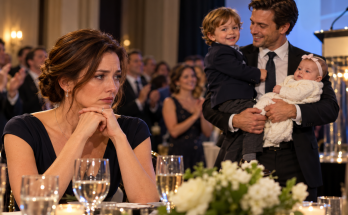
I could have pointed to the charity dinner as the moment our marriage had fallen apart.
But none of those answers would have been complete.
"Our marriage changed when you decided I couldn't handle the truth," I said.
He remained still.
"The medical problem was difficult. I know that. But you didn't give me the chance to face it with you."
I told him I had spent years trying to prove that I was strong enough to be his wife.
I had believed that if I asked fewer questions and demanded less, he would eventually feel safe with me.
I had mistaken his avoidance for a wound I needed to heal.
In doing so, I had stopped asking whether he was willing to help me carry anything at all.
Martin listened.
He said he hadn't understood how much I had changed myself to accommodate him.
I told him that I hadn't understood it either.
That was the part I found hardest to admit.
I had participated in the silence.
I had allowed his explanation to become my explanation.
I had chosen not to tell anyone because I was afraid of hurting him.
But my silence had not created his choices.
It had only made it easier for him to continue making them.
"I can't change what I did," he said.
"No," I answered. "You can't."
He looked down.
"But you can decide what you do now."
He nodded.
For a moment, I felt the old desire to reassure him.
I wanted to say that we could still make things work.
I wanted to tell him that the years we had shared were worth saving.
But I didn't know whether I could promise that.
And I had finally learned that a promise made to avoid someone's disappointment was not necessarily an act of love.
We talked for a long time.
Martin said he wanted to stop hiding the medical truth.
He said he understood that I had been forced to live with a version of our marriage that protected him at my expense.
He also admitted that he had not been honest with himself about what he wanted from our relationship with Clara.
I listened carefully.
I asked him whether he wanted to repair our marriage because he loved me or because he was frightened of losing the life we had built.
He took a long time to answer.
"I think it's both."
The honesty surprised me.
He admitted that he didn't know how to separate his love for me from his fear of what would happen if our marriage ended.
I appreciated that he hadn't pretended to have a perfect answer.
But I also knew that loving someone and fearing the consequences of losing them were not the same thing.
I told him that he needed to understand what he wanted before asking me to make a decision about our future.
He nodded.
Then he asked whether I still loved him.
The question hurt.
I had spent years believing that love could solve anything if I was patient enough.
Now I understood that love could remain even when trust had been damaged.
I could still care about Martin.
I could still remember our good years.
I could still wish him well.
None of those things meant I was ready to continue our marriage as it was.
"Yes," I said. "But love isn't the only thing we need."
He closed his eyes briefly.
I saw the disappointment in his face.
I felt it too.
I had not wanted to reach this point.
I had wanted the truth to bring us closer.
Instead, it had shown me how far apart we had become.
When the conversation ended, Martin went upstairs.
I remained in the living room, looking at the book I had left on the sofa.
I picked it up and read a few pages.
I couldn't concentrate.
My thoughts kept returning to the same question.
What would it mean to forgive him?
I had once imagined forgiveness as a decision to stop being hurt.
Now I understood that I couldn't simply choose to feel differently about what had happened.
Forgiveness, if it came, would have to exist alongside the truth.
It could not require me to pretend that the charity dinner had been harmless.
It could not require me to forget the empty chair in the doctor's office.
And it could not require me to accept another promise without evidence that Martin intended to keep it.
I closed the book.
Then I went upstairs.
Martin was sitting on the edge of the bed.
He looked up when I entered.
Neither of us spoke.
I removed my earrings and placed them in the small dish on my dresser.
Then I took off my wedding ring and held it between my fingers.
I had done this before, briefly, when I was trying to understand what I felt.
This time, I looked at it for longer.
The ring had not changed.
The meaning I had attached to it had.
I put it back on.
I wasn't ready to decide what would happen to our marriage.
But I was no longer willing to let the ring decide for me.
Click here to continue reading: PART 16: I Had Finally Stopped Asking Martin to Protect Me From the Truth, and Now He Had to Decide Whether He Could Face It Without My Help
The Night My Husband Presented Another Woman’s Children as His Own, I Finally Understood What My Silence Had Cost Me
Part 15 of 20