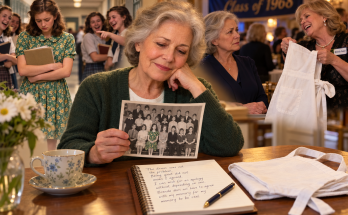
I thought putting the envelope away would help me stop thinking about it.
It didn't.
I could still picture the photograph.
Robert Whitmore standing beside his daughter.
The same daughter who had struggled to pay for diapers at my register.
The same woman who had written to me about losing her husband and her father.
I kept returning to the words on the back of that picture.
They were short.
Almost painfully short.
Robert was her father.
He was the twins' grandfather.
And he was gone.
I couldn't stop thinking about the last part.
Gone.
That word made every question I had about the family feel different.
I had spent so much time wondering why Robert hadn't helped Emily.
I had wondered what his money meant.
I had wondered whether Daniel had been right to refuse it.
But Robert was dead.
Whatever he might have done next was no longer something anyone could ask him to do.
I looked at Mike.
"Do you know what bothers me most?"
He shook his head.
"Tell me."
"She can't ask him anything now."
Mike was quiet.
I looked down at my hands.
"Whatever she wanted to say, whatever he wanted to say, they don't have that chance anymore."
I stopped.
Then I corrected myself.
"I mean, I don't know what they said before he died."
Mike nodded.
"Neither do I."
"That's the part I have to remember."
I had caught myself doing it again.
Trying to write the ending of an argument I hadn't witnessed.
I didn't know whether Emily and Robert had exchanged words during those final days.
The letter said they hadn't spoken properly for almost three years.
That was all.
It wasn't enough to tell me every conversation they'd had.
And it wasn't enough to tell me what remained unfinished.
But I knew death had changed what was possible.
There could be no ordinary future conversation with Robert.
No chance to see how he might respond to Daniel's absence.
No chance to watch the twins grow older with him.
At least not in the ways living grandparents do.
That much was unavoidable.
I thought about the babies.
Four months old.
They were too young to understand what had happened.
They couldn't know why their grandfather had been absent.
They couldn't know about the accusation against Daniel.
They couldn't know why Emily had chosen her husband.
And they couldn't understand the death their mother had just experienced.
They needed care regardless.
Their mother had to keep going.
That was the part of Emily's letter that hurt me most.
She could grieve.
She could feel angry.
She could regret things.
She could remember her father however she wanted.
But the boys would still need to eat.
They would still need diapers.
And she would still have to find a way through the day.
I knew those were ordinary needs.
But ordinary needs can become enormous when a person has very little left.
I thought about the counting.
Emily sitting beside the crib at night.
Checking the formula.
Working out how long it would last.
That image had stayed with me more clearly than Robert's photograph.
I had never seen her room.
I hadn't seen the crib.
I hadn't seen the twins.
Those details came from her letter.
But I understood what she meant.
She wasn't describing a mother worrying about something unnecessary.
She was describing the things her babies depended on.
I looked at Mike again.
"She said she sometimes cries when they sleep."
He nodded.
"I remember."
"I keep thinking about that."
He waited.
"Because she has to hold herself together while they're awake."
I looked down.
"At least, that's how I understood it."
I didn't want to claim I knew everything she felt.
But the words had made an impression on me.
A mother with two infants.
A widow.
A daughter grieving a father from whom she'd been separated.
She had plenty of reasons to be exhausted.
The failed payment wasn't the beginning of her troubles.
It was one more difficult moment in a life already carrying too much.
I thought about the sound of the scanner again.
That little beep.
I had heard it so often that I barely noticed it anymore.
Each item passed across the glass.
Each price appeared.
The total grew.
Usually, that was all.
But with Emily, the total had become something else.
A number she couldn't meet.
Eight dollars and forty-two cents.
I could remember the amount without looking.
I wasn't proud of remembering it.
It simply wouldn't leave me.
I had paid it because she needed help.
I didn't know the rest.
I hadn't expected to.
The payment should have been a brief act between two strangers.
But Emily's letter had made me understand what happened on her side of the counter.
She'd felt ashamed.
She'd been afraid.
And when I paid, she had been able to leave with the diapers her boys needed.
I thought about the difference between our memories.
For me, it had been a small interruption in a workday.
For her, it had been important enough to write about afterward.
That difference was hard to accept at first.
I hadn't done anything extraordinary.
I hadn't changed her family's history.
I hadn't brought back Daniel.
I hadn't repaired the distance between her and Robert.
I'd just paid a small amount.
But I had begun to understand that the size of an action and its importance weren't always the same.
Mike looked at me.
"You seem sad."
"I am."
"About Emily?"
"Yes."
I paused.
"And about the boys."
There was no use pretending otherwise.
I had become worried about children I'd never met.
Not because I imagined myself part of their family.
I wasn't.
But because I knew they were four months old and their mother was counting formula.
Those two facts were enough.
I looked at the envelope.
I couldn't do anything about Robert's death.
I couldn't settle the argument with Daniel.
I couldn't give Emily three years of family life back.
And I couldn't decide what she should have done.
That was difficult for me.
I wanted something clear.
A person who was right.
A person who was wrong.
A simple lesson I could take away.
But the letter didn't provide one.
Robert believed Daniel was using Emily to reach the family business.
Daniel denied it.
He refused the money.
Emily chose him.
The relationship with her father suffered.
Then Daniel died.
Then Robert died.
Those facts didn't prove everything about anyone's motives.
I was learning to accept that.
I thought about how quickly I'd judged Robert when I first recognized him.
He had so much.
Emily had so little.
It had been easy to feel that something must be wrong with him.
But the letter hadn't told me enough to decide exactly what he'd done beyond the argument.
It told me what he believed.
It told me what Daniel refused.
It told me which side Emily took.
It didn't tell me every event between then and her return to town.
I needed to be careful.
A person's death doesn't erase mistakes.
But it doesn't give strangers permission to invent them either.
I looked at the picture again.
There were no answers in Robert's expression.
No explanation for the argument.
No indication of how he felt when his daughter chose Daniel.
I had been searching his face as though it might tell me something.
It couldn't.
A photograph records a moment.
It doesn't record a person's entire character.
I put it down.
"Mike, I don't want to decide what kind of father he was."
He looked at me.
"Then don't."
I nodded.
"I know."
I almost laughed.
He had been giving me versions of that advice throughout our conversation.
Don't assume.
Don't force answers.
Don't make decisions for someone else.
Simple things.
But I kept needing to hear them.
Maybe because I cared more than I expected.
Maybe because the letter had surprised me.
Maybe because I couldn't make the facts fit neatly together.
I wasn't sure.
I only knew that I wanted to understand Emily without making her explain every part of her life.
I thought about what she'd written concerning Daniel.
Her late husband.
The man she had defended.
The man who hadn't wanted Robert's money.
I wondered what it felt like to have stood beside someone during a difficult family argument and then lose him.
I couldn't know.
But I could imagine the silence left by his absence.
And I knew Emily had two babies who depended on her now.
I looked down at the envelope.
The photograph was a reminder of Robert.
The letter was Emily's voice.
That distinction mattered.
The photograph had attracted my attention because I recognized the man.
But the letter had held it because of the woman.
She was the one I'd met.
She was the one who'd tried to pay for diapers.
She was the one who'd taken the trouble to tell me what happened.
It seemed wrong to let Robert's name become more important than hers.
I looked at Mike.
"When you speak to her, don't mention all my questions."
He nodded.
"I won't."
"I don't want her to think I'm examining her family."
"She won't hear that from me."
"Thank you."
I meant it.
Emily hadn't written to ask for a judgment.
She had written to explain her embarrassment.
And I wanted to respect that.
I had already asked Mike to tell her she owed me nothing.
I had asked him to say that I believed she was doing her best for the twins.
Those words still felt right.
I didn't need to add anything about Robert.
I didn't need to ask whether Daniel had been a good husband.
I didn't need to ask why she had returned to town.
All of those things belonged to Emily.
She could tell me more if she wanted.
But she didn't have to.
I thought about the time she'd spent writing the letter.
I didn't know how long it took.
I didn't know what she'd been doing before she began.
I didn't know whether writing had helped her.
But I could see that she'd made an effort.
Her handwriting wasn't perfectly even.
Some of the words looked pressed harder into the paper.
The letter contained things she could have kept private.
That told me it wasn't casual.
I wanted to honor that effort.
Not by making a grand gesture.
By listening to what she actually said.
I picked up the envelope again.
The paper was light.
I thought about how strange that was.
A little paper.
A photograph.
A few written pages.
And enough pain to keep me thinking for hours.
I had spent years handling ordinary receipts.
Most of them ended up folded into pockets or left in shopping bags.
They showed what someone bought.
They showed the price.
They showed the total.
Emily's letter told me something a receipt never could.
What it felt like to need the things on it.
I looked down.
For six years, I had worked with numbers.
Now I was thinking about people.
Not that I hadn't cared before.
I had.
But this was different.
The amount had become attached to a face.
And the face had become attached to a story.
I couldn't separate them anymore.
I thought about tomorrow.
About the store.
About another customer standing in front of me.
I wouldn't know whether that person had lost someone.
I wouldn't know whether they were struggling at home.
I wouldn't know whether the purchase in front of them was the last thing they could afford.
But I could remember Emily.
I could be patient.
I could keep my voice calm.
I could avoid making a difficult moment worse.
That was something I could actually do.
It didn't require knowing anyone's history.
It didn't require money.
It didn't require praise.
It only required attention.
I placed the envelope down beside me.
I wasn't going to find the answers to Emily's family history by rereading the photograph.
Robert was gone.
Daniel was gone.
And Emily was still trying to care for her sons.
That was the reality I needed to remember.
I couldn't repair what the family had lost.
But I could stop letting my curiosity get in the way of the kindness I'd wanted to offer.
And that was the decision I carried forward.
Click here to continue reading: PART 14: I Kept Remembering How Emily Held Her Payment Card, and I Began to Understand What It Costs Someone to Ask for Help
I Thought I Was Helping a Mother Buy Diapers, but the Photograph Mike Gave Me Made Everything Harder to Understand
Part 13 of 20